• Skip to main content

Suzanne W. Churchill

  • DH Scholarship
    • Mina Loy
    • Gwendolyn Bennett
    • Modernist Magazines
  • Teaching
    • Recommendation Requests
    • Reading Tips
    • Secondary Source Reports
  • Writing
  • Painting
  • About Me
    • C.V.

Suzanne Churchill

Museum Feet

May 24, 2014 by Suzanne Churchill 2 Comments

image

Today we had a great day of museum going, starting with a four-hour guided tour of the State Central Museum of Contemporary Russian History.  Here we are outside the museum.

After lunch at a nearby cafe, several of us decided to forgo the Metro and walk along tree-lined boulevards to the Pushkin Fine Arts Museum. We went to the twentieth century building, which was the perfect sized museum, the fine arts equivalent of Alison’s ideal play length–70 minutes without intermission. Still, by the end of the day, I had a case of serious museum feet and felt like the woman in this painting looks.

imageOur party broke up, with Mark, Allison, and Sharon going to meet a theater director, and the others heading north in the city to meet a current and former Davidson student for dinner at 8 pm. Having slept little last night, I just didn’t have the energy for a late dinner, so I walked back to our apartment, stopping for a ham and cheese bliny on the way. Though I managed to navigate the streets of Moscow, I couldn’t figure out how to call Amanda to tell her I made it back. Maybe she’ll check this blog and see that I have.

Filed Under: Russia Trip 2014

Women and Self-Fashioning in Moscow

May 23, 2014 by Suzanne Churchill 2 Comments


Amanda had warned us that women in Russia tend to dress up and dress fashionably. When we first got to Moscow, I didn’t notice the difference, because I was distracted by the wide variety of fashion, ranging from elegant dresses to jeans and even shorts. I couldn’t detect any dress code. But the more I people-watched, the more I was struck by the care and attention the women devoted to fashion and grooming.

The high standards were most clear at MGIMO university where the halls and classrooms were filled with young men and women. While the young men dressed well, the women were positively stunning, many wearing what I would call party dresses. Their makeup was exquisite. Most popular was the carefully lined “cat’s eye,” with the upturned curve at the outer corner of the upper lid, extending the lashes and widening the eyes. Shoes ranged from dainty ballet flats to strapping stilettos.

Back on the streets and metro of downtown Moscow, I realized that nearly every woman I saw, no matter how casually or formally dressed, appeared to have devoted a great deal of time and attention to her clothing, make-up, and hair.

Among women, grey hair is almost non-existent. Shelley and I have both had women who weren’t much younger than we are give us their seats on the metro. Call it vanity, but I could only conclude that they thought we were much older because of our grey hair. When I told Kristi my theory, she thought I said that they gave us their seats “because we have great hair.”  The look of perplexity on her face lasted only until we both dissolved in laughter. Later, when Shelley and Kristi both scored a seat on the metro, I told them they had great hair.

But I digress… Back to the Moscow women, who have great (not grey) hair… Whether the look is catwalk, corporate, goth, or gamine, it is decidedly feminine.  Like grey hair, androgyny has no place in Moscow.

Women seem to have plenty of freedom: they walk on the streets, in the metros, and through the halls of the university. They wear high heels, low heels, and sneakers. They bare cleavage and curves, or cover up. They travel alone and in pairs, with and without men and children (but mostly without). But despite their freedom of movement and wide range of stylistic choices, I can’t help feeling like the standards of femininity are limiting.

imageThis sneaking suspicion surfaced today during our tour of the Tretyakov State Gallery of Russian art. We looked at art spanning the 12th through the 19th century. Every work our guide directed our attention to was painted by a man. When at last we entered the early 20th century wing, just as we were leaving a room, Amanda pointed out a painting that was done by a women. It was a self-portrait by Z. Serebryakova, entitled “At the Dressing Table” (1909). The painting seemed surprisingly bold and modern, yet also distinctly feminine.  Was it celebratory or ironic? Her expression is coy; the hairpins are preposterously oversized. I don’t know enough about Serebryakova (our guide didn’t mention her), or about Russian women, to come to any  conclusion.

Filed Under: Popular Culture, Russia Trip 2014, Selfhood

“Everybody is wrong”

May 23, 2014 by Suzanne Churchill 2 Comments


In the weeks prior to our trip to Russia, the political crisis in Ukraine was front page news.  US coverage of the tensions between Russia and the Ukraine led me to believe that:

  1. Most Ukrainians desired independence from Russia.
  2. Aside from right-wing hard-liners, most Russians were (secretly) aghast at Putin’s despotic machinations (even if they are afraid to admit it publicly).
  3. Russians were as preoccupied with the East-West conflict as we were, if not more anxious and dismayed.

Now that I’ve been in Moscow for a few days, I get the sense that the Russians aren’t nearly as concerned about the US as the US is about the Russia, and they fear chaos much more than they fear Putin.

We first met with Russian businessman who is a Davidson alum.  When we asked his opinion on the Ukraine situation, he said,

Look, there’s no right or wrong in this situation. Everybody’s wrong.

In his view, political situations always complicate business transactions, and business is always political. The current crisis was no more critical than any other. The important thing was getting the deal done.

Later, on our tour of the Kremlin, our guide explained the four party system in Russia, explaining that two of them exist to create the illusion of democracy. “But we don’t have democracy in Russia,” she said cheerfully.

imageWe’ve also encountered evidence that plenty of Russians are quite content with the situation.  A dean at the university we visited (MGIMO) shrugged off our concerns, saying, “Everyone knows Crimea has always been a part of Russia.” In the theater district, next to the theater once famed for its political radicalism, was a huge billboard celebrating “Crimea and Russia, Together Forever.” Meanwhile, cars and busses sped by, and people passed without a glance.

Wherever we go and whomever we talk to, I get the sense of “business as usual.” The locals are aware of what is going on politically, but not particularly concerned, as long as it doesn’t disrupt the business of their lives.  Irina and Amanda explain that Russians remember all too well the economic collapse and deprivations after the dissolution of the Soviet Union in 1991. No one wants to return to that kind of “free state,” in which no one can afford anything. A strong ruler like Putin is preferable, even if “we don’t have democracy in Russia.”

Today we toured the Tretyakov Gallery of Russian art.  Our tour guide displayed the same cheerful cynicism, as he linked the habits of former rulers like Ivan the Terrible to more recent heads of state.  Even though Ivan the Terrible didn’t have the nationalist vocabulary, our guide said, he was the first to commission blatantly self-serving political propaganda. Our guide then directed our attention to an “impudent” painting depicting Ivan and his troops being welcomed into the gates of heaven (the panoramic scene naturally omitted any reference to the roughly 20% of the population Ivan had killed during his rule).

Later, in the 19th century wing, the guide directed our attention to a painting by Perov (aka Nikita Pustosvyat), called “Dispute About Faith.” The painting depicts the Schism between the old believers and the new believers in the Russian Orthodox Church.

Perov, “Dispute About Faith”

imageThe queen-like figure on the upper left who looks fearful and aghast is Sophia, the sister of Peter the Great. Neither she nor the other aristocratic figures on the left side of the painting look very sympathetic. Their stern faces and elegant clothing hardly make them seem like noble keepers of the faith. But the bearded rebel in the center of the painting, presumably the radical reformer, looks pretty crazy–not like a prophet I’d want to stand behind. And the people on his side don’t look very comfortable there either.

As I studied this painting, trying to figure out whose side Perov was on, it occurred to me that maybe he’s not worried about who is right and who is wrong, because he knows “everybody’s wrong.” Americans (like me) look for heroes and villains in history, but maybe Russians adopt a different perspective, in which the divisions aren’t so stark. Maybe for them, the greatest danger is neither the ruler nor the reformer, but the chaos that can come between them.


Filed Under: Popular Culture, Russia Trip 2014

At Charlotte Douglas Airport

May 19, 2014 by Suzanne Churchill Leave a Comment

imageWe are at the airport, reviewing our updated itinerary, learning key words like “mozhno,” and figuring out how to log into our blog. I also followed Mark Sutch’s lead and ordered a green apple salad, which is beckoning me, so this post will be short. I’m relaxed enough now to register my excitement about the trip to come.

Filed Under: Russia Trip 2014

"There’s no friend like a sister"

May 10, 2014 by Suzanne Churchill 1 Comment

So my last post is a downer, and I want a quick rebuttal, so that you know I do have “a right to smile” and a lot to smile about. Writing this blog is really cathartic for me. Emotions percolate deep below my conscious thought, often manifesting in anxiety about teaching. But when I write about them, I discover their true source and literally come to terms with them, feeling calmer and more accepting in the process.

So when people read my blog and tell me how sorry they are, I feel grateful for their concern, but also a little embarrassed. “I’m okay, now,” I think, “I’ve written about it.” I don’t always admit that, because I’m a little ashamed that I do feel better.

There are bright sides of this disease, and one of them is that it brings our family together. I’m so grateful that my Dad is so strong, loyal, and cabable, and my siblings are in Connecticut to support him. My sister Elizabeth and brother-in-law Peter host Sunday dinners for my folks, and my brother Jonathan brings his kids to see them whenever he can. I phone in regularly to get status reports, and then we distract ourselves with other topics. We’ve had a lot to celebrate, with my nephew Ben graduating from McDaniel College and Alex landing a dream summer job as athletics coordinator at a summer camp. My niece Isabelle is blossoming in kindergarten, and her little brother William has dreamy, mischievous blue eyes that drown all sorrows in a wink. Luke will be heading to Washington University at St. Louis and Thomas to Stanford in the fall, and the next few weeks are full of proms and graduation parties.

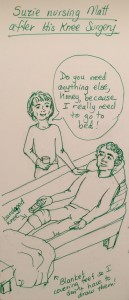
SCAN0023 I want to make an extra shout out to my sister here, because although Elizabeth gives me credit for being the writer, she has really found her voice in the midst of this crisis. She knows just what to say (or write in an email) to my Dad to boost his spirits. She also gives great advice to me, as she did recently when I was ruminating guiltily about not sending enough cards to Mom. The trouble is that I want to include photos to give her something to look at, but I never get around to taking news ones and then printing them, and then I don’t send the card. “Why don’t you just make a cartoon drawing, like Nana used to draw in her letters to us?” Elizabeth suggested. We loved getting those letters with the funny cartoons. Nana (Mom’s mother) would draw her hair in curlers and come up with funny situations and nicknames for herself. She always tried to figure out a way to avoid drawing hands and feet, which she insisted she couldn’t draw.

photoJust when I was feeling hopeless about Mom’s disease and my own ability and motivation to support her, Elizabeth came up with the perfect solution. Drawing a silly cartoon not only gave me a quicker, more efficient way to reach out to Mom, it also restored a maternal lineage, making me feel anchored and supported in a fun-loving tradition that spans generations. Instead of dreading the task of writing to Mom, I had fun drawing a scene of me “nursing” Matt after his recent knee surgery. My cards can’t ever recapture the humor, color, or charm of the inimitable “Mz. Gates,” but with the help of my sister, they can help me feel connected and make me smile, even in the face of loss.

Filed Under: Alzheimer's, Family

Break a Leg

May 10, 2014 by Suzanne Churchill 2 Comments

As I said on Facebook, my folks can’t seem to get a break—well, they got one, but not the kind we wanted. A couple of weeks ago, Mom fell and broke her femur, near the hip joint. She may have had a second fall, but we don’t know the details. A caregiver found her, and my Dad spent another day in ER, while they took x-rays and CT-scans, eventually coming to the conclusion that she would need surgery. After surgery, she would need physical therapy and an extended stay in the Masonic hospital rehab wing, before she could return to the Hearth.

The doctor’s reports were more optimistic than I felt. Sure, they could screw the bone back into place, but how would Mom be able to manage with physical therapy? Even before the fall, she could scarcely follow directions to stand or sit. Another disorienting hospital stay was likely to wreak more havoc on her dwindling cognitive functions. How could her plaque-ridden brain possibly learn to walk again?

Doubts like these breed terrible thoughts like: why bother repairing the body when the mind is so damaged? Wouldn’t it be better if she could catch pneumonia and go swiftly, saved from the discomfort and indignities of hospitalization? Wouldn’t it be better if (Write it!) if she could just die?

There, I’ve written the unthinkable. It can’t get any worse, can it? To understand hopelessness, to fully inhabit despair, there’s no better place to turn to than the “terrible sonnets” of Gerard Manley Hopkins. Take this excerpt from “No worst, there is none“:

No worst, there is none. Pitched past pitch of grief,
More pangs will, schooled at forepangs, wilder wring.
Comforter, where, where is your comforting?
Mary, mother of us, where is your relief?
My cries heave, herds-long; huddle in a main, a chief
Woe, wórld-sorrow; on an áge-old anvil wince and sing —
Then lull, then leave off. Fury had shrieked ‘No ling-
ering! Let me be fell: force I must be brief.”‘
Hopkins cries out for relief from the burden of his own life. The pain is different, however, when your mind is silently shrieking, “No lingering! Let her be fell,” about your own mother. It’s less wild and turbulent, more muted and weighty—a dull, intermittent ache, a deadly desire that seems at once utterly human and miserably inhumane.

I used to think T. S. Eliot’s “Portrait of a Lady” was a miserably inhumane poem. It enacts a series of one-sided conversations between the speaker and the eponymous lady. She’s needy and suffocating, and he’s desperate to elude her emotional demands. After several evasive maneuvers, the speaker imagines the ultimate escape:

Well! and what if she should die some afternoon,
Afternoon grey and smoky, evening yellow and rose;
Should die and leave me sitting pen in hand
With the smoke coming down above the housetops;
Doubtful, for quite a while
Not knowing what to feel or if I understand
Or whether wise or foolish, tardy or too soon …
Would she not have the advantage, after all?

…And should I have the right to smile?

The speaker’s lack of empathy—his calculated distance from his own emotions—always struck me as cruelly misogynist. But now his imagined relief at the prospect of the lady’s death seems more human and uncomfortably familiar. When intimacy cannot be reciprocated—whether because of a disease of the psyche (Eliot’s modern condition) or the brain (Mom’s Alzheimer’s)—the relationship can feel oppressive and burdensome. You just want to escape, and death beckons slyly, like a guilty pleasure.

Yet with Alzheimer’s, another apparition also beckons: the glimpse of the person as you once knew her. She appeared to my brother one day, when she was lying in the hospital bed, dozing off mid-sentence, unable to focus. Then, suddenly, she looked at him and said, “I just don’t want to disappoint you.” Voila, there she is, as anxious to please as ever. A few days ago, on the phone with me, she asked, “So have they made their decisions?” clearly referring to Thomas and Luke’s college plans. As I rambled on in enthusiastic detail, she seemed to disappear and go silent. “Mom, are you there?  Mom? Hello? Can you give the phone to Dad, Mom?” Silence. TV noise in the background. “Give the phone to Dad, Mom. I’ve got to go. I love you.” Silence. “Mom? I’ve got to go. I love you.” Then, suddenly, she replies, “I love YOU very much,” so ardently and intentionally that I feel cradled in a blanket of maternal love. I tell her I love her and say good bye again. Another pause, and then she scrapes the most wrenching, “Goodbyyeeee,” from her throat. It sounds like ripping apart industrial strength Velcro.

In those rare, unexpected moments of connection, I feel as if Mom is still there, intact, but able only on fleeting occasions to break through the thick fog and express herself. She’s moved past that horrifying stage of the disease when she couldn’t recognize her own husband. She knows, trusts, and loves us. And at those moments when she manages to reach us, I know that when she dies, it will be much worse than I have imagined. So I want her to live.

Filed Under: Alzheimer's, Family, Poetry, Uncategorized

Microaggressions and the Need to Know More

April 13, 2014 by Suzanne Churchill 1 Comment

Microaggressions are in the news, nationally and locally. In a recent New York Times piece, “Students See Many Slights as Racial ‘Microaggressions,'” Tanzina Vega describes microaggressions as “the subtle ways that racial, ethnic, gender and other stereotypes can play out painfully in an increasingly diverse culture.” The concept isn’t new. It was developed in the 1970s by Dr. Chester M. Pierce, a professor of education and psychiatry at Harvard University, to describe the “subtle, cumulative miniassault that is the substance of today’s racism” (qtd by Brockenbrough).  Common parlance among social scientists and critical race theorists, microaggressions have recently spread from the higher echelons of academic discourse into the mainstream, causing a stir even in the bubble of tranquility that is Davidson College.

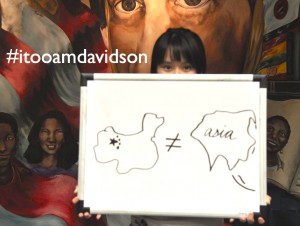
tumblr_n2yc7hTiIr1tw512jo1_1280Inspired by a Tumblr blog at Harvard University, students here have created their own Tumblr, I, Too, Am Davidson (echoing Langston Hughes’ “I, Too, Sing America“). Standing in front of the new mural depicting the College’s multicultural history, they hold signs citing microaggressions like, “After a party, the police stopped me and said, ‘Hurry up and get to your car and go back to your school.'”

Microaggressions may elicit shock, disbelief, anger, isolation, alienation, fear, shame, or any combination thereof. But as poet Claudia Rankine observed in her recent talk at Davidson, a victim’s response is often delayed. The immediate reaction tends to be silence.

Rankine explores this effect in her latest work, Citizen, a documentary prose poem that collects microaggressions from her own experiences and from interviews, such as this one:

You are in the dark, in the car, watching the black-tarred street being swallowed by speed; he tells you his dean is making him hire a person of color when there are so many great writers out there.
You think maybe this is an experiment and you are being tested or retroactively insulted or you have done something that communicates this is an okay conversation to be having.

Rankine uses the second-person “you” to put you, the reader, in the place of a microaggression victim. The use of “you” isn’t just a strategy for arousing empathy, however; it is also symptomatic of psychological alienation experienced by the victim who, instead of responding to the offender, goes silent, turning inward and questioning herself.

Rankine’s goal, she said, is to shorten the response time—that is, to offer language that may empower people to respond immediately and vocally to microaggressions, in order to promote healing and understanding.

In seeking to break the silence, Rankine’s experimental poetry is like the microaggression blogs (even if it doesn’t get as much internet traffic). Vivan Lu, co-creator of The Microaggressions Project, says the blog “gives people the vocabulary to talk about these everyday incidents that are quite difficult to put your finger on” (qtd by Vega). The blog testimonials are empowering acts of witnessing and protest: they allow people to assume ownership of damaging remarks, to reframe them, and to reverse the target. Contributing to a Tumblr may also replace feelings of marginalization and alienation with a sense of belonging to a community.

Athough these Tumblr sites are beneficial for the contributors, however, it’s less certain how much good they do for broader public discourse about race. Vega reports, “What is less clear is how much is truly aggressive and how much is pretty micro — whether the issues raised are a useful way of bringing to light often elusive slights in a world where overt prejudice is seldom tolerated, or a new form of divisive hypersensitivity, in which casual remarks are blown out of proportion.”

The concept of microaggression, by definition, does not imply intentional hostility or conscious racism. In Psychology Today, Derald Wing Sue and David Rivera define microaggressions as, “the brief and everyday slights, insults, indignities and denigrating messages sent to people of color by well-intentioned White people who are unaware of the hidden messages being communicated” [emphasis added]. Nevertheless, the term can lead to misunderstandings, in that it connotes aggression on the part of the microaggressor. From the Latin aggredi for “to attack,” the term aggression, even when miniaturized, doesn’t seem to allow for bumbling curiosity or hapless ignorance. For people unfamiliar with the social scientific definition who perceive themselves as implied offenders, the term microaggression may arouse defensiveness. “I hate the term microaggression,” I heard someone say, “it is itself a microaggression.”*

Which raises the question: are microaggressions reversible? This is a version of the controversial topic of reverse racism. My colleague Hilton Kelly, Associate Professor of Education Studies, who teaches courses on critical race theory, defines racism as “a system of advantages based on skin color.” He distinguishes racism from prejudice, the personal belief that one race is superior to another. Since racism is about deep-seated power inequalities, Kelly argues, it can’t be easily reversed. He offered the example of a white woman going to black nightclub, but feeling unwelcome and overhearing hostile remarks about her presence. Is this reverse racism? No, because the system still favors the white woman. As soon as she steps outside, who’s on her side? Whose side is the police and criminal justice system on? There may be prejudice the black nightclub, but it’s not racism unless it’s reinforced by a system of advantages based on skin color.

Okay, I said, but let’s take a local example: what about a black fraternity here at Davidson that won’t accept a white student? Kelly replied: “I’d need more information to respond to that question. For instance, I’d need to know, why is it that no one has asked the same questions about similar practices by white fraternities that went on for decades?” That’s not just a good point, I think; it’s good practice: ask for more information. Like racism, microaggressions aren’t reversible, but asking for more information is.

In my class the next day, when we’re scheduled to discuss Rankine, racism, and microaggressions, we start with an experiment. We stand in a circle and first identify our “triggers”: those remarks, attitudes, or behaviors that arouse anger and defensiveness, and shut down conversation about racism. Then we go around again and identify, “openers”: remarks, attitudes, or behaviors that encourage us to talk openly with each other. After we finish, one student observes:

Isn’t it interesting that our triggers are all different, but our openers are the same?

It’s a profound moment. Wow, I think, we’ve done it: we’ve broken through to a way we can talk openly about racism at Davidson.

Not so fast. A student raises the issue of affirmative action, asking if it is racist for positions to be taken away from whites and given to minorities. “Hmm,” I say, echoing Kelly: “I’d need more information to know if that’s racism. For instance, I’d need to know, why is it that no one complains about how many places were taken away from minorities and given to whites over the decades?”

“Good point,” someone murmurs.

The point isn’t mine, of course, and neither is the practice. But it is a good one. Instead of getting angry, try saying: I need to know more.

Take this example from the Davidson Tumblr, where a student makes the reasonable request, “Please stop asking why I can’t tolerate spicy food.” Presumably she’s been asked countless times, “Why don’t you like spicy food?” And she’s understandably annoyed by the question. But let’s reimagine that irritating encounter by applying Hilton Kelly’s approach:

— “Why don’t you like spicy food?”

— “That’s an interesting question. Why do you think I would like spicy food?”

— “Because you’re Asian.”

— “Asia’s a big, diverse continent. I wonder if tastes are consistent across any continent. Do you think North Americans like bland food?”

Is this approach putting more burden or responsibility on the minority? Maybe. But it’s also “shortening the response time” and giving everyone, including minorities, an opportunity to get beyond anger, and come to a greater understanding of the triggers that divide us and the openers that can bring us together.

And who knows? Maybe someday somebody will start a Tumblr, #NeedToKnowMore.


*The person who made this statement preferred not to be named, believing that openly expressing skepticism about the term microaggression would only incite more anger and resentment. This fear of reprisal reflects the polarizing effect the term can have: in this case, it foreclosed conversation.

Works Cited:

Brockenbrough, Ed, Ph.d. “Microaggressions: Conceptual Foundations.” Warner Graduate School of Education, Rochester University. Dec. 3, 2010. Accessed April 21, 2104.

I, Too, Am Davidson. Tumblr Blog. Accessed. April 13, 2014.

Kelly, Hilton. Personal Conversation. Summit Coffee House. Davidson College. March 20, 2014.

Sue, Derald Wing, Ph.D., and David Rivera, M.S. “Racial Microaggressions in Everyday Life.” Psychology Today. Published Oct. 5, 2010. Accessed April 21, 2014.

Vega, Tanzina. “Students See Many Slights As Racial Aggressions.” NewYorkTimes.com. May 21, 2014. Accessed April 13, 2014.

Filed Under: Language, Poetry, Popular Culture

Lay Back the Darkness

March 27, 2014 by Suzanne Churchill 2 Comments

If I’d read Edward Hirsch’s “Lay Back the Darkness” before writing my previous post, maybe I could have laid back some of my own darkness. Hirsch read the poem at Davidson a few years ago, but it didn’t speak to me then. That was well before Mom’s Alzheimer’s diagnosis. I’m a firm believer that poems open up to you when you need them, and shun you—sometimes quite rudely—when you don’t. Yesterday, watching the video of Hirsch’s talk at Davidson, I clearly needed this poem, because it not only opened up to me, but also extended its hands, saying, “Here’s another way, Suzanne, here’s another way to look at the situation.”

Lay Back the Darkness


My father in the night shuffling from room to room
on an obscure mission through the hallway.


Help me, spirits, to penetrate his dream
and ease his restless passage.


Lay back the darkness for a salesman
who could charm everything but the shadows,


an immigrant who stands on the threshold
of a vast night


without his walker or his cane
and cannot remember what he meant to say,


though his right arm is raised, as if in prophecy,
while his left shakes uselessly in warning.


My father in the night shuffling from room to room
is no longer a father or a husband or a son,


but a boy standing on the edge of a forest
listening to the distant cry of wolves,


to wild dogs,
to primitive wingbeats shuddering in the treetops.

Before he read this poem, Hirsch talked about poetry, saying, “I don’t know if you’ve ever had the experience—I hope you have—of sometimes reading a poem that is so… personal to you, so strong that it feels almost as if you’re writing the thing to which you’re actually only responding.” Hirsch then quoted the great Argentine writer, Jorge Louis Borges, who wrote in his own first book of poems:

Dear Reader,

Please forgive me for having written these poems first. It’s only something of an accident that I’m the unsure, ardent writer of these verses and you’re the reader.

It’s a strange plea, but what Borges alludes to, and what Hirsch underscores, is that uncanny feeling you get when you read a poem that speaks so exactly to your thoughts, feelings, and experiences that you could have written it yourself. When I listened to Hirsch read “Lay Back the Darkness” yesterday, I got that feeling.

If I did write that poem for Mom, it might go like this:

Play Back the Music


Dear Ed Hirsch,

Please forgive me for having rewritten your poem. It’s only something of an accident that I’ve become the unsure, ardent writer of your verse.


My mother in the Hearth shuffling from room to room
on an obscure mission through the hallway.


Help me, spirits, to penetrate her dream
and ease her uncertain passage.


Lay back the darkness for a lady
who could tidy everything but the shadows,


a musician who stands on the threshold
of a vast hall


without her walker or her heels
and cannot remember what she meant to say,


though her smile is bright, as if in greeting,
while her hands shake uselessly in worry.


My mother in the Hearth shuffling from room to room
is no longer a mother or a daughter or a wife,


but a girl standing on the edge of a dance
listening to the stirring thrum of song,


to young suitors,
to amorous heartbeats murmuring in the music.


800px-Olympic_Gardens_Dance_Hall,_Hunter_Street,_Halifax,_Nova_Scotia,_Canada,_ca-1._1948

Olympic Gardens Dance Hall, Hunter Street, Halifax, Nova Scotia, Canada, ca. 1948 [public domain].

Filed Under: Alzheimer's, Poetry

  • « Go to Previous Page
  • Page 1
  • Interim pages omitted …
  • Page 4
  • Page 5
  • Page 6
  • Page 7
  • Page 8
  • Interim pages omitted …
  • Page 11
  • Go to Next Page »

Copyright © 2026 · Infinity Pro on Genesis Framework · WordPress · Log in