• Skip to main content

Suzanne W. Churchill

  • DH Scholarship
    • Mina Loy
    • Gwendolyn Bennett
    • Modernist Magazines
  • Teaching
    • Recommendation Requests
    • Reading Tips
    • Secondary Source Reports
  • Writing
  • Painting
  • About Me
    • C.V.

Language

The Political Afterlives of Poems

September 10, 2019 by Suzanne Churchill Leave a Comment

It is difficult
to get the news from poems
                        yet men die miserably every day
                                                for lack
of what is found there.

– William Carlos Williams, “Asphodel, That Greeny Flower” (1955)

It may be “difficult / to get the news from poems,” but you can get poems from the news. Just last month, a sonnet made headlines after the Trump administration announced a new policy refusing green cards to anyone who relies on government assistance. At a press conference, a reporter asked U.S. Citizenship and Immigration Director Ken Cuccinelli whether the new policy necessitated the removal of the famous lines engraved on the pedestal of the Statue of Liberty: “Give use your tired, your poor,/ Your huddled masses yearning to be free” (Giaritelli).

Those lines come from Emma Lazarus’s sonnet, “The New Colossus,” which she composed in 1883 as part of a fundraising campaign for the statue’s pedestal. The journalist invoked the poem as representative of time-honored American values, but Cuccinelli offered a different spin: “Give me your tired and your poor who can stand on their own two feet, and who will not become a public charge,” he asserted. Later, he insisted that the poem referred to “people coming from Europe” (Fortin).

The trouble is, they’re both wrong. Lazarus’s poem did not represent the dominant sentiments of American people at the time it was written, nor does it refer to Europeans who can take care of themselves. Here’s the poem in its entirety:

Not like the brazen giant of Greek fame,
With conquering limbs astride from land to land;
Here at our sea-washed, sunset gates shall stand
A mighty woman with a torch, whose flame
Is the imprisoned lightning, and her name
Mother of Exiles. From her beacon-hand
Glows world-wide welcome; her mild eyes command
The air-bridged harbor that twin cities frame.
“Keep, ancient lands, your storied pomp!” cries she
With silent lips. “Give me your tired, your poor,
Your huddled masses yearning to breathe free,
The wretched refuse of your teeming shore.
Send these, the homeless, tempest-tost to me,
I lift my lamp beside the golden door!”

Although today, the sonnet is celebrated as an expression of the America’s inclusive, democratic ethos and melting pot character, its origins tell a different story, as Professor Emeritus Esther Schorr explains. The highly educated daughter of a wealthy Jewish family, Lazarus was a radical thinker and social activist. She wrote the poem in an era of rising anti-immigrant sentiment in America. The Immigration Act of 1882 set a head tax on immigrants, putting restrictions on criminals, insane, or “any person unable to take care of him or herself,” effectively establishing the first federal immigration bureaucracy. The Chinese Exclusion Act of 1882 put a 10-year moratorium on Chinese labor immigration, marking the first time a group of people were excluded from citizenship by nationality or ethnicity.

But Lazarus wasn’t thinking about these exclusionary acts when she wrote the poem, according to Schorr: she was more concerned about a wave of Eastern European Jews who were fleeing pogroms in Russia. These desperate refugees were definitely not the “people from Europe” Cucinella was referring, and they certainly weren’t in a position to take care of themselves. Lazarus worried about their welfare, as well as that of her own, established Jewish community. She was concerned that a tide of anti-semitism would rise in America in response to the influx of Jewish refugees. Rather than representing the highest ideals of the American people at the time, then, “The New Colossus” fights against their basest fears and xenophobic impulses, invoking the “Mother of Exiles” to urge maternal compassion for the tired, poor, and “tempest-tost.”
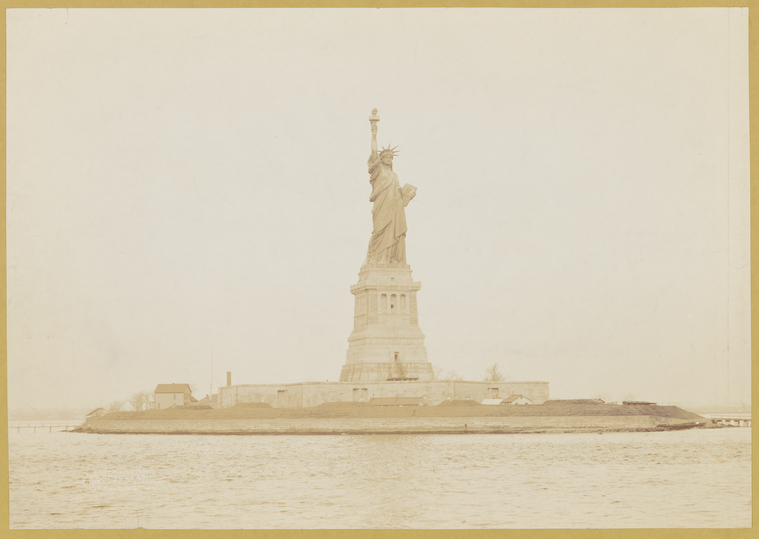
Sepia photo of Statue of Liberty on Ellis island
Irma and Paul Milstein Division of United States History, Local History and Genealogy, The New York Public Library. “Statue of Liberty from the harbor” The New York Public Library Digital Collections. 1890. http://digitalcollections.nypl.org/items/1dda7040-83b3-0132-0d80-58d385a7bbd0

II

“The New Colossus” is not the first time a poem has been brought back to life in ways that involve colossal misunderstandings of its origins. A hundred years ago, during the so-called “Red Summer” of 1919, another leftwing activist—Jamaican-born poet Claude McKay—wrote a sonnet called “If We Must Die.”

Armed white National Guard officer confronts African American soldier.
White National Guardsman confronts African American soldier.

McKay was responding to the race riots that broke out around the country in the summer of 1919, most famously in Chicago in reaction to the drowning of a black teenager name Eugene Williams who swam into the “whites only” side of Lake Michigan Beach. The ensuing violence did far more damage to black bodies and neighborhoods than to whites (Green). McKay connected the racial tensions to economic ones, explaining that WWI’s “end was a signal for the outbreak of little wars between labor and capital and, like a plague breaking out in sore places, between colored folk and white…It was during those days that the sonnet, ‘If We Must Die,’ exploded out of me” (qtd by Thompson). Here’s his explosive sonnet:

If we must die, let it not be like hogs
Hunted and penned in an inglorious spot,
While round us bark the mad and hungry dogs,
Making their mock at our accursèd lot.
If we must die, O let us nobly die,
So that our precious blood may not be shed
In vain; then even the monsters we defy
Shall be constrained to honor us though dead!
O kinsmen! we must meet the common foe!
Though far outnumbered let us show us brave,
And for their thousand blows deal one death-blow!
What though before us lies the open grave?
Like men we’ll face the murderous, cowardly pack,
Pressed to the wall, dying, but fighting back!

McKay’s near-perfect Shakespearean sonnet has no explicit race markers, but rather articulates traditional British values of noble self-sacrifice for a cause greater than oneself—values that can traced back through English discourse all the way to Shakespeare’s St. Crispin Day speech in Henry IV. But in the heated context of the Red Summer of 1919, historian Nathan Huggins argues, “no one could doubt that the author was a black man” (qtd by Jenkins).

White mob attempts to pull black man off a bus.
White mob pulls African American man off a city bus.

So powerful was the rhetoric of communal courage, legend has it, that Prime Minister Winston Churchill read “If We Must Die” in radio broadcast to British people during WWII, to bolster their spirits and inspire their patriotism. Or did he read it before the American Congress in an effort to enlist them to join the war effort?

So inspiring was the rhetoric of noble self-sacrifice, legend has it, that a WWI soldier was found dead in the battlefield with sonnet folded in his pocket.

So powerful was the rhetoric of racial protest, legend has it, that Senator Henry Cabot Lodge, Sr. (or was it his grandson Henry Cabot Lodge, Jr.?) read the poem in the Congressional Record, citing it as an example of “Negro extremism,” and Lothrop Stoddard quoted poem in his best selling, white supremacist screed The Rising Tide of Color (1920) as evidence that McKay hated America (presumably like all liberals today).

As thrilling as these legends may be, there’s no evidence that any of these things happened. There’s no evidence that Churchill or Cabot Lodge read the poem in any context, and a WWI soldier couldn’t have had poem in pocket, because it wasn’t written until a year after the war ended. Stoddard did quote McKay in The Rising Tide of Color, but he singled out another sonnet, “The White House,” as the target of his racist attack.

The Churchill appropriation legend appears to have been instigated by African American poet Melvin Tolson, who perhaps was attracted to the story because it provided evidence both of McKay’s poetic power and of white imperialist appropriations of black art. And while these legends attest to the poem’s power, what gets lost in them is its roots in the Red Summer of 1919—a specific, historical instance of white violence against black citizens.

III

New York skyline with huge black cloud emerging from World Trade Towers
Smoke billows from World Trade Towers on September 11, 2001. https://en.wikipedia.org/wiki/September_11_attacks

My final example of the political afterlives of poetry takes us back to 2001, the year that my current first-year students were born. After the terrorist attacks on 9/11, W.H. Auden’s “September 1, 1939,” circulated widely by email. Here are the first and fourth stanzas of the poem, whose title marks the date of Germany’s invasion of Poland and start of WW II:

I sit in one of the dives
On Fifty-second Street
Uncertain and afraid
As the clever hopes expire
Of a low dishonest decade:
Waves of anger and fear
Circulate over the bright
And darkened lands of the earth,
Obsessing our private lives;
The unmentionable odour of death
Offends the September night.
.   . .   
Into this neutral air
Where blind skyscrapers use
Their full height to proclaim
The strength of Collective Man,
Each language pours its vain
Competitive excuse:
But who can live for long
In an euphoric dream;
Out of the mirror they stare,
Imperialism’s face
And the international wrong.

“With its references to skyscrapers, dazed citizens, and the approach of war, ‘September 1, 1939’ seemed less a poem than a news bulletin,” observes Scott McLemee. (Maybe Williams was wrong and it is possible to get the news from poems.) McLemee explains that the poem resonated with people after 9/11 because it articulated a “complex, disturbed reaction to historical event.” It signaled a deep crisis of confidence in its recognition that the ideals of freedom, liberty, and rationality can’t prevent violence, evil, or war.

Yet as much as readers found solace in the poem, Auden repudiated and came to loathe it. He was disgusted by the sentimentality and false consolations of lines such as:

All I have is a voice
To undo the folded lie,
The romantic lie in the brain
Of the sensual man-in-the-street
And the lie of Authority
Whose buildings grope the sky:
There is no such thing as the State
And no one exists alone;
Hunger allows no choice
To the citizen or the police;
We must love one another or die.

Auden, who admired discretion, ambivalence, and irony, grew embarrassed by the vatic confidence of these lines, which seem to say: Here I am, the wise, all-knowing poet, telling you the shining truth. “I don’t want it to be reprinted in my lifetime,” he later said, admitting, “It may be a good poem, but I shouldn’t have written it” (qtd by McLemee).

IV

What lessons can we take away from the chaotic political afterlives of these three poems? Their complicated histories demonstrate that there is no single moment of truth for a poem. The poet’s original idea or intention does not set limits on what a poem can mean or do in the world. Poems are active, living texts that continually generate new meanings in new political contexts. As Auden himself wrote in “In Memory of W. B. Yeats“:

The words of a dead man
Are modified in the guts of the living.

Acknowledgements

Grateful appreciation to Lee M. Jenkins, University College Cork, who did the painstaking research to explode the myths about Claude McKay’s “If We Must Die,” compiling his findings in the excellent article, “‘If We Must Die’: Winston Churchill and Claude McKay, ” Notes and Queries (September 2003): 333-337.

Filed Under: All Posts, Language, Poetry, Teaching

Peace in Our Time!

December 17, 2016 by Suzanne Churchill 1 Comment

This morning’s newspaper headlines the N. C. General Assembly’s last minute power grab to limit the already restricted powers of Democratic Governor-elect Roy Cooper. The Republicans are defending their actions, saying the Democrats “did it first” 20 and 40 years ago. Colin Campbell reports:

“House Bill 17, which legislators approved Friday, would limit the number of state employees the governor can hire and fire to 425. The current limit is 1,500 and was increased from 400 around the time Republican Gov. Pat McCrory took office.”
Can no one see that the G.A.’s raising of the limit from 400 to 1,500—just when a Republican-dominated legislature had a Republican governor for the first time in almost 25 years—as a much bigger power grab? I’m almost as annoyed at the reporting, for failing to note the blatant hypocrisy, as I am at the N.C. legislature, for cartoonish antics that are making North Carolina the laughing stock of the nation. Even Mitch Kokai of the conservative, Art Pope-funded John Locke Foundation, admitted that “the lack of process in the special session “causes lots of problems for anyone who wants to see good government,” and “to see this being done as it’s being done, has to raise some red flags.”

Another red flag flew up when I turned the page to this political cartoon by Tom Toles of the Washington Post:

Hilter/Trump comparisons are overused and overstated, but this cartoon isn’t comparing Trump to Hitler. Instead, it suggests an analogy between Republican leaders and Neville Chamberlain, the conservative British Prime Minister from 1937-1940. Here’s the back story…

In March 1938, Germany invades and annexes Austria. With no appetite for another war, Britain looks away. Tensions escalate. Just when Great Britain seems on the cusp of war, reprieve comes in the form of an agreement by Hitler to hold a diplomatic conference at Munich. There, on September 23, 1938, representatives from Germany, Italy, France, and Britain sign the Munich Agreement. Czechoslovakia was not invited to the talks.

The next day, Hitler and Chamberlain sign a separate Anglo-German Declaration of their own. Chamberlain flies home to England and declares:

“We have achieved peace in our time.”

Soon after Chamberlain’s return to England, Germany seizes Czechoslovakia, and a year later invades Poland.

Chamberlain’s famously false declaration of “peace in our time” comes from his “Radio Speech to the British People,” delivered on September 27, 1938, in which he reports on his talks with Hitler regarding Germany’s territorial claims on Czechoslovakia. It’s worth examining his rhetoric of appeasement more closely.

Chamberlain acknowledges “the present anxious and critical situation” and “growing anxiety” about another world war:

“How horrible, fantastic, incredible it is that we should be digging trenches and trying on gas-masks here because of a quarrel in a far-away country between people of whom we know nothing.”

…

“Yet I believe after my talks with Herr Hitler that, if only time were allowed, it ought to be possible for the arrangements for transferring the territory that the Czech government has agreed to give to Germany to be settled by agreement under conditions which would assure fair treatment to the population concerned.”

…

“For the present I ask you to await as calmly as you can the events of the next few days. As long as war has not begun, there is always hope that it may be prevented, and you know that I am going to work for peace to the last moment. Good night.”

Notice how Chamberlain distances Britain from Europe, trying to reassure people that things aren’t as bad as they seem, and that surely Hitler will be just and appropriate in his political and military actions.

W. H. Auden wasn’t reassured. In fact, he was as troubled by British appeasement as he was by German aggression. He expressed his concerns obliquely, in a poem called “Musée des Beaux Arts.”

Musée des Beaux Arts

About suffering they were never wrong,
The old Masters: how well they understood
Its human position: how it takes place
While someone else is eating or opening a window or just walking dully along;
How, when the aged are reverently, passionately waiting
For the miraculous birth, there always must be
Children who did not specially want it to happen, skating
On a pond at the edge of the wood:
They never forgot
That even the dreadful martyrdom must run its course
Anyhow in a corner, some untidy spot
Where the dogs go on with their doggy life and the torturer’s horse
Scratches its innocent behind on a tree.

In Breughel’s Icarus, for instance: how everything turns away
Quite leisurely from the disaster; the ploughman may
Have heard the splash, the forsaken cry,
But for him it was not an important failure; the sun shone
As it had to on the white legs disappearing into the green
Water, and the expensive delicate ship that must have seen
Something amazing, a boy falling out of the sky,
Had somewhere to get to and sailed calmly on.

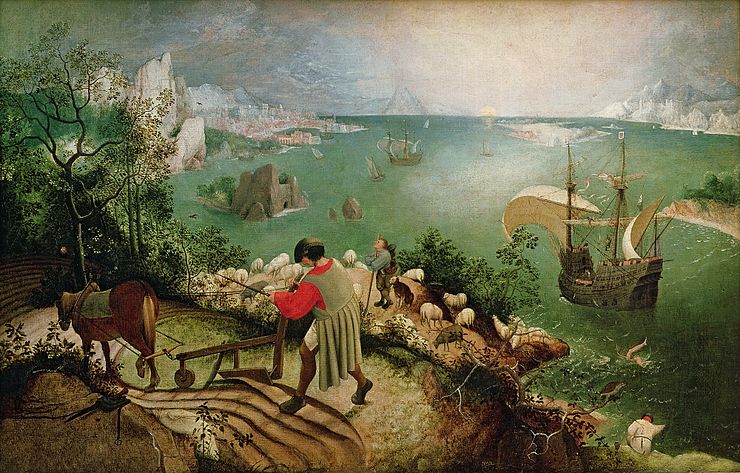
Auden wrote this poem in December 1938, while staying in Brussels, Belgium with his lover, Christopher Isherwood. While there, he visited the Musées Royaux des Beaux-Arts de Belgique and saw its collection of Early Netherlandish painting, including “Old Masters” such as Pieter Bruegel the Elder (ca. 1525–1569). The speaker of the poem strolls by a series of paintings, pausing to reflect on Bruegel’s Landscape with the Fall of Icarus.

In both the poem and the painting, suffering happens elsewhere, off in “in a corner, some untidy spot” of the world distant from us. You scarcely notice the flailing legs of Icarus in the bottom right corner of the painting, your eyes drawn to the central figure of the plowman, who looks down at the ground, focused on his work. Like the speaker, he is “just walking dully along,” scarcely attending to a drama of mythical proportions unfolding beside him. “The ploughman may / Have heard the splash, the forsaken cry, /But for him it was not an important failure.” He “Had somewhere to get to and sailed calmly on”—not unlike Republican leaders today, who overlook impending disaster, focused on immediate goals of consolidating their own power. And sadly, not unlike me, who though opposed to current political trends, find it all to easy to go on with my doggy life, focused on the business of everyday life.

Auden’s poem responds to escalating political tensions and events in Europe by looking back, indirectly through art from long ago and far away, at his own nation’s response, examining the moral consequences of appeasement. And in that indirection, Auden both mirrors and critiques evasive political discourse. He doesn’t stand outside or above the problem; he acknowledges that he’s part of it. As a poet, he’s just as guilty of evasion and accommodation, finding it just as difficult to confront the political crisis directly and feeling helpless to do anything about it.

“Of suffering they were never wrong, the Old Masters”—and the old poets, too. Even as Auden acknowledges how difficult it is to remain focused and vigilant, he reminds us to pay attention. In the the familiarity of his colloquial language, the sharpness of his description, and the subtlety of his analysis, he awakens our attention. He makes us think again about the risks of appeasement and accommodation and the moral consequences of ignoring the suffering of others.

Works Cited

Chamberlain, Neville. “Radio Speech to the British People” (September 1938). The Past Speaks: Sources and Problems in British History. Volume II: Since 1688. 2nd edition. Lexington, MA, and Toronto: D. C. Heath & Co., 1993. 368-370.

“The Munich Agreement and the Anglo-German Declaration (September 1938). The Past Speaks: Sources and Problems in British History. Volume II: Since 1688. 2nd edition. Lexington, MA, and Toronto: D. C. Heath & Co., 1993. 370-71.

Filed Under: All Posts, History, Language, Poetry, Politics, Popular Culture

Make America Think Again

November 14, 2016 by Suzanne Churchill 3 Comments

I haven’t posted on this blog in months. Now that Mom’s gone and Dad’s remarried, I get an occasional urge to write, but lack the urgency.

…until this week, when the triumph of Trump convulsed me from low-grade anxiety to a fever pitch of terror and sadness. On Tuesday, November 8, 2016, I went to bed at 9:50 pm, unable to watch what already appeared inevitable. I tossed and turned in bed, my feet cramping. I tried to reassure myself that more than 50% of Americans can’t be bad or wholly wrong. I tried to breathe and adopt a mindfulness mentality and open my heart to greater trust and understanding.

Spoiler alert: none of these strategies are particularly effective at 3 a.m.

As morning dawned, I shuddered from my routine listening to NPR and reading the paper. Instead I trolled Facebook, relying on friends to direct me to articles, editorials, and blogposts that could help me make sense of this senseless turn of events.

Soon I turned to poetry. The first lines that came to mind were from W. H. Auden’s “September 1, 1939“:

All I have is a voice
To undo the folded lie,
The romantic lie in the brain
Of the sensual man-in-the-street
And the lie of Authority
Whose buildings grope the sky:
There is no such thing as the State
And no one exists alone;
Hunger allows no choice
To the citizen or the police;
We must love one another or die.

Auden wrote the poem at the outbreak of World War II, while sitting in a New York city gay bar, feeling maudlin and melancholic. Soon after publishing the poem, he disavowed it, probably because he felt embarrassed by its unabashed sentimentality and certainty. “We must love one another or die” is such a satisfying line—which is probably why Auden rejected it. It’s too gratifying. The stanza winds its way along a twisted path of physical images (“the sensual man in the street,” “buildings grope the sky”) and ambiguous abstractions (“romantic lie in the brain,” “no such thing as the State”). What does that mean? How can there be “no such thing as the State” when Fascism is marching across Europe? Never mind, the stanza rollicks to a close with its unequivocal affirmation of love, dispelling ambiguity with an easy, satisfying solution.

Although the line offers a reassuring (if guilty) pleasure in a time of dramatic uncertainty, it’s not the one I was drawn to. The words that echoed in my head were: “All I have is a voice / To undo the folded lie.” I felt lost, afraid, and powerless, and these lines suggested a way forward, encouraging me to speak out and undo the folded lies of racism, sexism, xenophobia, and bigotry.

Auden probably would cringe at such an earnest embrace of his words. He was a poet of ambivalence, as driven by political conviction as he was by skepticism about the poet’s ability to effect change. “For poetry makes nothing happen,” he famously declared in his poem, “In Memory of W. B. Yeats.”  People love to quote that line as an unequivocal disavowal of poetry, but they neglect what comes after:

For poetry makes nothing happen: it survives
In the valley of its making where executives
Would never want to tamper, flows on south
From ranches of isolation and the busy griefs,
Raw towns that we believe and die in; it survives,
A way of happening, a mouth.

Sure, “poetry makes nothing happen,” especially in the modern age. It doesn’t launch a thousand ships or incite countries to war. Yet “it survives, / A way of happening, a mouth.” Poetry is an ongoing response to loneliness (“ranches of isolation”) and loss (“busy griefs”). It doesn’t make things happen, but helps us live through their happening. It’s “a mouth” that enables us, literally, to come to terms with the chaos of our lives and extract meaning from the wreckage.

By Saturday morning, my terror had abated to a stunned recognition that the world hadn’t, in fact, ended. Undocumented people hadn’t been rounded up, marriage equality and reproductive rights hadn’t been revoked, and international environmental protections hadn’t been retracted. But all this could happen, and probably will, when Trump takes office. And who knows what will happen in terms of international diplomacy? How long will it take Putin, Kim Jong-Un, or IS to provoke Trump into flexing his military muscles? Two of our sons are already registered for the draft and the other is only 3 years from having to do so.

I drove the boys to a soccer tournament. After the game, we went to iHop, along with seemingly half the population of Rock Hill. It was a diverse crowd of diners, all eating piles of pancakes in harmony, seemingly indifferent to the imminent apocalypse. I thought of another Auden poem, “As I Walked Out One Evening“:

‘O look, look in the mirror,
   O look in your distress:
Life remains a blessing
   Although you cannot bless.

‘O stand, stand at the window
   As the tears scald and start;
You shall love your crooked neighbour
   With your crooked heart.'

In Auden’s homoerotic codes of desire, “crooked” signals homosexuality. What makes this poem resonate for me today is that it still has that valence, and also connotes “crooked Hillary.” The lines also remind me to try to love even those neighbors whose attitudes and beliefs I find truly crooked—the Trump supporters. And that’s a taller order.

Lest you think you’ve come to some reassuring and satisfying conclusion about loving thy neighbor, bear in mind that Auden gives those lines to the clocks that “whirr and chime.” Can we really trust mechanical instruments to teach us how to live humane lives? Auden maintains an ironic distance from any certainty that love trumps hate.

We should be wary, too. We should be skeptical of the calls to move beyond the divisiveness of the campaign, to join hands in unity and remember that “good people voted for Trump.” Undoubtedly, good people did vote for Trump, people who were not consciously motivated by racism or sexism, and who believed they had good reasons for voting for Trump. They must have believed that their reasons were more important than resisting racism, sexism, bigotry, bullying, greed, and ignorance. They didn’t support racism. But they also didn’t have to think about it. Maybe they were sick of thinking about it.

Here’s where I’m haunted by another poem, Claudia Rankine’s Don’t Let Me Be Lonely: An American Lyric. Rankine began the poem as a critique of the Bush administration (2000 – 2008). In lyrical prose, she reflects on how it feels to live in a country whose optimism for the future is greater than its concern about racism in the present day:

Cornel West makes the point that hope is different from American optimism. After the initial presidential election results come in, I stop watching the news. I want to continue watching, charting, and discussing the counts, the recounts, the hand counts, but I can­not. I lose hope. However Bush came to have won, he would still be winning ten days later and we would still be in the throes of our American optimism. All the non-reporting is a distraction from Bush himself, the same Bush who can’t remember if two or three people were convicted for dragging a black man to his death in his home state of Texas.
/
You don’t remember because you don’t care. Some­times my mother’s voice swells and fills my forehead. Mostly I resist the flooding, but in Bush’s case I find myself talking to the television screen: You don’t know because you don’t care.
/
Then, like all things impassioned, this voice takes on a life of its own: You don’t know because you don’t bloody care. Do you? 
/
I forget things too. It makes me sad. Or it makes me the saddest. The sadness is not really about George W. or our American optimism; the sadness lives in the recog­nition that a life can not matter. Or, as there are billions of lives, my sadness is alive alongside the recognition that billions of lives never mattered…

When I think about all those good people who voted for Trump, a voice swells and fills my forehead: “You don’t know because you don’t care. Do you?” You don’t have to care about racial injustice because you are white. You don’t have to care about undocumented people because you are lucky enough to be a citizen. You don’t have to care about the prison industrial complex because you’re not likely to be stopped, frisked, arrested, or jailed. You don’t have to care about marriage equality because you don’t stand to lose the 15 federal benefits of legal marriage, including parental custody and next-of-kin status. You don’t have to care about environmental protections because you can afford to water your lawn and turn up your AC.

As a white, documented, cis-gendered, legally married American citizen, homeowner, and professor with tenure and health insurance, I don’t have to care either. As my Republican brother reminds me, I also don’t have to worry about unemployment, stagnant minimum wage earnings, or diminishing career prospects, which are the genuine concerns of the white working class voters who helped elect Trump. These people aren’t stupid, and they have real fears about the future and legitimate gripes about the way they’ve been ignored. But are their diminished economic prospects a result of undocumented workers streaming in from Mexico, or of a widening gap between the very wealthy and the rest of Americans? Will lower taxes, the repeal of Obamacare, and a Great Trump Wall really help them?

I don’t know the answers. “I forget things too.” But I cannot forget and will not forget my sadness that billions of lives don’t seem to matter. I will not join hands and cooperate or compromise with policies that do further damage to the lives of the most vulnerable members of our society.

All I have is a voice to undo the folded lie that the rhetoric and policies touted by Trump will “Make America Great Again.” Last night, a candidate for a new, joint tenure track position in Africana Studies and English offered an alternative slogan, which he learned from a student: “Make America Think Again.” Poetry may make nothing happen, but it does make us think. So maybe it can help us make America think again.

If you disagree with me, please comment. Think out loud.

P. S. If you want to read some more poems that speak to our current predicament, check out the ones Austin Kleon gathers in this week’s newsletter, especially Emily Dickinson’s “We Grow Accustomed to the Dark,” Langston Hughes’ “Evil,” and Maggie Smith’s “Good Bones.” 


Filed Under: Language, Poetry, Popular Culture

Computerized Textual Analysis

June 10, 2016 by Suzanne Churchill Leave a Comment

Apologies for this rough post, but I don’t have much time before I have to catch my shuttle to the airport. I’m in Victoria at the Digital Humanities Summer Institute, taking a course with David Hoover (NYU) called “Out of the Box Text Analysis.” All week, I’ve been trying to work through my own skepticism about whether:

  1. computerized analysis of literary texts merely confirms/denies what we already know;
  2. the results are interesting and valuable enough to justify the tedious work of prepping the texts;
  3. we come up with reasons to justify the results so that they confirm what we already think about an author;
  4. these new, high-tech intellectual exercises serve as a way to justify talking about the same old texts and questions we always talk about;
  5. & so on…

But yesterday, I was able to produce my first results, and it’s amazing how the thrill of generating a meaningful graph can override the ache of skepticism.

Here’s what I did: I wanted to examine images of whiteness in Imagist poetry of the 1910s. I downloaded the PDFs of Imagist anthologies from 1914, 1915, 1916, and 1917, converted them to plain text, and cleaned up most of the errors. Then I combined the anthologies into one text set and ran a word frequency test. Much to my delight, the first word to appear after all the common words like articles (a, an, the), pronouns (I, he, it), prepositions (on, to, of), and “to be” verbs (is, are, was) was… WHITE!

In this case, the computerized text analysis did confirm what I already suspected about Imagist poetry, i.e., that it’s riddled with images of whiteness. But running the various tests (which I’ll spell out step by step when I have more time) offered information that could only be tediously gleaned through careful close reading and tabulations, such as:

  1. By inserting dividers <div><\div> between poets in my anthology texts, I could see that certain poets, such as Richard Aldington, H.D., and Amy Lowell, used white a lot (10-15 times each in a small set of poems), while others, such as F. S. Flint and D. H. Lawrence, hardly use the word at all.
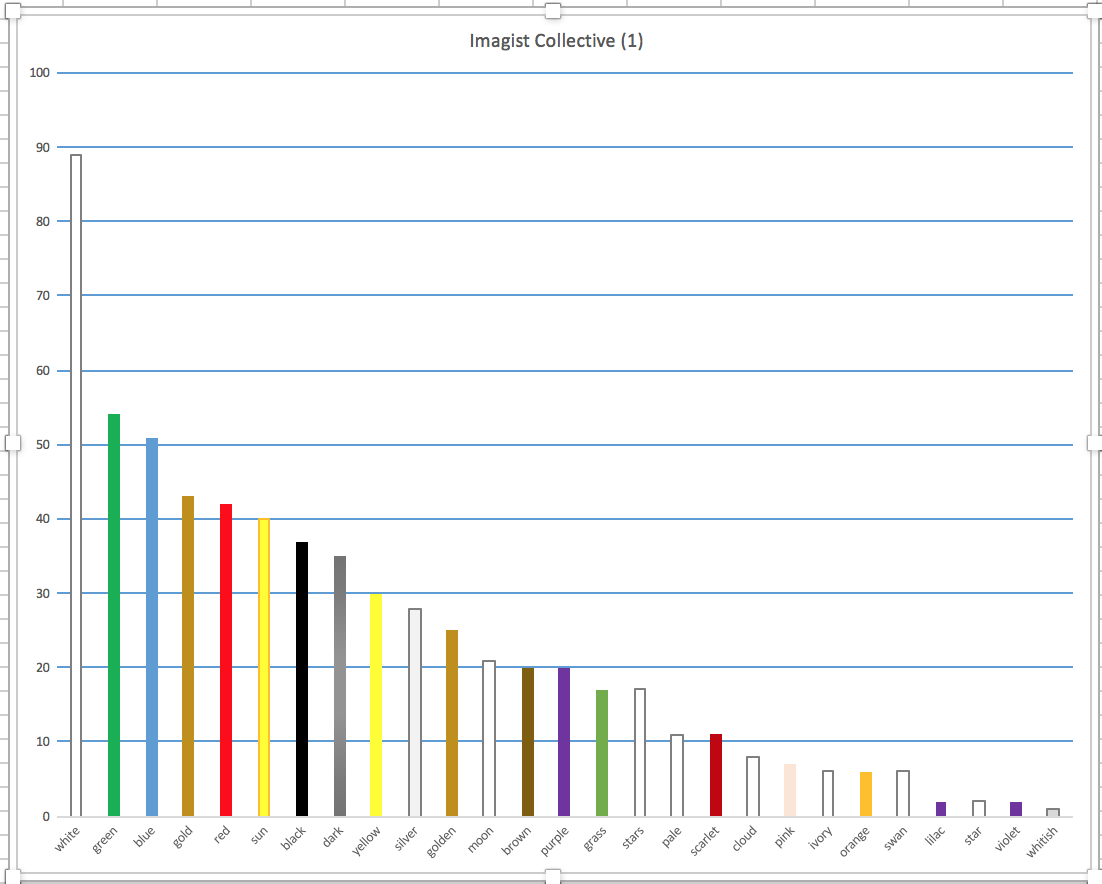
  2. By testing for color words more generally, I learned that Imagist poetry is rife with color words, though terms that connote whiteness, such as “silver,” “pale,” “moon,” “stars,” “ivory,” and “swan,” are most common, with terms for yellow, including “gold,” “golden,” and “sun,” are probably in second place.

Here’s a graph of the most common color words in the Imagist anthologies I tested.

Screen Shot 2016-06-10 at 2.34.24 PMI then attempted a more complex test of Cyrena Pondrom’s brilliant argument in her article “H.D. and the Origins of Imagism.” In that essay, Pondrom uses traditional close reading, historical, and biographical analysis to argue that, although Ezra Pound is typically credited as the founder of Imagism, H.D. actually originated the style. She was writing Imagist-like lyrics well before Pound, and when he saw her poetry and labeled it Imagiste, he then began adopting the concise, spare style in his own verse.

To test Pondrom’s argument, I ran a word-frequency comparison between a collection of H.D.’s poems, a collections of Pound’s poems, and compared them to a test set of the 4 Imagist anthologies combined. Each of these anthologies contain poems by H.D., Pound, and about a half dozen other poets.

Screen Shot 2016-06-10 at 2.35.37 PM

My comparison shows that the Imagist group [green dots] is in fact stylistically closer (as measured by word frequency) to H.D. [blue dots] than to Pound [red dots], which does imply that she may be the original “author” of the style. But perhaps more interesting than this rather loose conclusion is the list of most distinctive words for each poet that my test generated. The top 25 words that most distinguish Pound from H.D. are these:

hath, thee, thou, thy, ye, doth, time, mine, hast, lo, unto, ways, things, oh, ’tis, been, good, lady, glory, thine, art, truth, o’er, soul, seen

Compare that list to the top 25 words that most distinguish H.D. from Pound:

lift, has, cut, could, rocks, feet, across, fire, break, flower, touch, rock, leaf, caught, bright, wild, salt, must, gift, goddess, hurt, wet, beach, race, left

What’s so striking is surprising is that Pound’s list of distinctive words is chock full of archaic poetic diction: the “hath,” “thee’s” and “thou’s” that characterize old fangled English poetry—not the strikingly modern diction of Imagism. H.D.’s most distinctive words, in contrast, are short, concrete nouns and active verbs—the very kinds of language that characterize the Imagist Doctrine, which warns: “go in fear of abstractions.”

This list provides stronger evidence that H.D.’s poetry more closely aligns with Imagism stylistically, thereby providing additional support to Pondrom’s argument.

I may not yet have generated an original argument, but I’ve learned enough to begin to see how computerized textual analysis can complement (rather than substitute for) close reading of poetry, helping me to test, extend, and deepen my findings.

Filed Under: Language, Poetry

Serendipity

March 1, 2016 by Suzanne Churchill Leave a Comment

Bahram_Gur's_Skill_with_the_Bow_-_Haft_PaikarLong ago and far away in a land called Persia, there were three princes who spent their days traveling the world. As they roamed far and wide, thither and yon, across amethyst mountains, emerald valleys, and sapphire seas, the princes “were always making discoveries, by accident and sagacity, of things which they were not in quest of: for instance, one of them discovered that a mule blind of the right eye had travelled the same road lately, because the grass was eaten only on the left side, where it was worse than on the right.” Another one, after a long day of travel that left him aching and sore, lay down to rest upon a bed of soft, wooly leaves of arnica, only to discover that the plant had a marvelous capacity to relieve sore muscles. And the third prince, having recently attended the grape harvest in the hills of Tuscany, sought out a goldsmith in Germany to help him repair his family ring. The goldsmith was building a printing press at the time, which reminded the prince of the wine press he’d observed in Tuscany. He told Gutenberg about what he’d seen, and thus movable type was born.

The Persian fairy tale of The Three Princes of Serendip found its way into the English language via Horace Walpole (1717-97), who, distinguished by birth as the fourth Earl of Oxford and son of Prime Minister Robert Walpole, became famous for his best-selling Gothic novel The Castle of Otranto (London 1765).  Walpole recounted the tale in a 1754 letter to his friend Horace Mann to illustrate the concept of serendipity—”a very expressive word” he coined to describe “the most remarkable instances of this accidental sagacity (for you must observe that no discovery of a thing you are looking for comes under this description).”

Serendipity is the term we still use today to describe those happy accidents of creative insight: the phenomenon of “making discoveries, by accident and sagacity, of things which they were not in quest of.” And the term is making a comeback. Steven Johnson dedicates a chapter to the concept in his dazzling book Where Good Ideas Come From (2010). On January 2, just in time for new year’s resolutions, Pagan Kennedy published an essay the New York Times Review on cultivating “The Art of Serendipity” (2016). I read Kennedy’s essay first, before serendipitously encountering the concept again in Johnson’s book, which I’m halfway through. A Google search led me to Richard Boyles’ detailed account of the term’s origins in Walpole’s writings (2000).

I’ve embellished Walpole’s story with fictional examples of arnica and Gutenberg because I want to emphasize that serendipity is not merely good luck; it’s not just ideas dropping into your head “out of the blue.” Rather, discoveries come “by accident and sagacity”—by a combination of chance and intelligence. Serendipity, Kennedy writes, is not something that just happens, it’s “something people do.” It’s also something people do together, when minds and imaginations meet in print or in person. Like the Princes of Serendip, we can cultivate serendipity by being sharply observant of the world, following threads, and making connections between ideas, phenomenon, and people. It’s no accident that there are three Princes of Serendip traveling the world, not one lone, tortured genius holed up in an attic.

We don’t have to travel far to cultivate serendipity, Steven Johnson explains: “Reading remains an unsurpassed vehicle for the transmission of interesting new ideas and perspectives” (112). Far from seeing the digital age as a dark age for serendipity, Johnson says the the world wide web has moved a “fringe experience” to the “mainstream of our culture.”

153b5519912bde006c3422d01432a033I traveled along an archipelago of serendipity this morning, beginning with the New York Times daily briefing, which offers “what you need to know” to get through the day. Today’s briefing led me to stumble upon some word-image stories from the archive produced for Black History Month, which led me to this educational initiative, “What’s Going On In This Picture?” We often think we’re wasting time surfing the web, but maybe it’s better to think of it as diving into an ocean of ideas, stories, images, videos, games, tools, platforms, and resources, guided by passion and instinct, and rewarded by serendipity.

Filed Under: Books, Language, Teaching

Poetry Makes Something Happen

February 16, 2016 by Suzanne Churchill Leave a Comment

This morning, as I struggled to drag my mind out of a mire of missing my mother and regretting my own misfires in the classroom, I watched two videos by Davidson college alums that snapped me out of my solipsism and reminded me what poetry can do to change our perspectives and broaden our minds. (Go English majors!)

Clint Smith (’10) is a poet and teacher who uses poetry to change the narratives we tell about kids and poverty in inner city public schools. Watch his TED-X talk and celebrate resilience:

It’s a little early in the season for Will Reese’s Free Word poem, with icy rain falling from the sky, instead of the reign of the inchworms soon to befall us in North Carolina. But you won’t regret listening to Reese (’14), who steers this poem along funny, surprising twists and turns, moving you from laughter to outrage to introspection so fast you’re not sure what hit you. Was it an inchworm in your face, or a ear-worm in your mind that you can’t shake off?

W. H. Auden famously declared that “Poetry makes nothing happen.” Maybe he was mired in grief and hopelessness as he wrote his poem “In Memory of W. B. Yeats.” Or maybe he was hinting that poetry turns nothing into something—into a “way of happening, a mouth.” Admittedly, it takes an act of conscious will to turn a baldly cynical statement like “poetry makes nothing happen” into a hint of hope. And yet, for all his cynicism, Auden concludes his poem with a resounding prayer to the poet:

Follow, poet, follow right
To the bottom of the night,
With your unconstraining voice
Still persuade us to rejoice;

With the farming of a verse
Make a vineyard of the curse,
Sing of human unsuccess
In a rapture of distress;

In the deserts of the heart
Let the healing fountain start,
In the prison of his days
Teach the free man how to praise.

In the call to “Follow, poet,” you can almost hear an echo of a spoken word audience member, snapping fingers and saying, “Go, poet!” Auden cannot suppress his appetite for poetry, despite its apparent uselessness, nor can he suppress his own power to write poetry that can make something happen. In this case, the trochaic tetrameter and ingenious rhymes prod the grieving “heart” to “start” and convert sorrow-bound “days” to “praise.” And in doing so, the poem lets the healing begin.


Filed Under: Language, Poetry

The Work of Scholarship in the Age of Digital Reproduction

October 11, 2015 by Suzanne Churchill

Introduction

Who, What, and How

My title makes an appeal to humanities scholars who are uncertain about the survival of time-honored, print-based scholarly practices in the digital age of information abundance and attention deficits.

The argument laid out before you concerns not only the eponymous subject matter of the work of scholarship in the age of digital reproduction, but also the potential for undergraduates to make original contributions to humanities research. My focus on undergraduate participation is likely to appeal to a smaller subset of humanities scholars who are eager to involve students in research in their fields. Yet this more narrow focus is, in fact, a gesture toward a wider audience. Because undergraduates qualify as “non experts,” my emphasis on their participation is tied to a crucial component of my agenda: re-imagining humanities scholarship in the digital age to involve a broad public of experts and non-experts—and in the process, to dislodge hierarchies that currently divide these constituencies.

Hence my publishing here, on Atavist, a digital storytelling platform geared toward “a new genre of nonfiction, a digital form that lies in the space between long narrative magazine articles and traditional books and e-books” (qtd by Butler). Can a work of scholarship in the age of digital reproduction inhabit such a free, open space?

So much for the subject matter and platform, and on to methodologies. Like a three-legged stool, my argument rests on three methodological principles for humanities scholarship in the digital age:

1. bibliography,2. design, &3. collaboration.

The ideas I am about to unfold are not original to me. Rather, I will gather and arrange arguments made by scholars whose writings inspired me as I began my own path from a solid grounding in print-based scholarship and pedagogy into the uncharted terrain of digital humanities. In curating other scholars’ ideas here, I am effectively doing the work of bibliography, gathering sources on a subject and arranging them in an accessible, intelligible form.

Design is crucial to this effort. If I am going to capture and hold your attention, so that you ignore the new message alert that just popped up on the smartphone, tablet, or laptop on which you are reading, then I must deliver these ideas in a stylish, easily navigable, minimalist, and immersive format that reduces distractions and rewards concentration. (Thanks, Atavist.)

Collaboration will ensue when you use the comment function to critique my argument and make suggestions about how it might be refined and improved. Based on your suggestions, I will make corrections and improvements, so that this argument will remain a living, changing, unfolding statement of principles and practices concerning the work of scholarship in the age of digital reproduction.

___________________________________________________________________

WORKS CITED

Butler, Kirsten. “7 Platforms Changing the Future of Publishing and Storytelling.” Brain Pickings. N.p., n.d. Web. 12 Oct. 2015.

From Print Culture to the Digital Age

pieterdeho-1444781540-82.jpg10102090525-1444781219-46.jpg

The tectonic shift from print culture to the digital age is transforming practices of reading and writing, turning a once solitary endeavor into an interactive, multimedia activity. The shift is also affecting scholarly practices, albeit more gradually. Humanities professors, rooted as we are in print-based traditions and methodologies, tend to approach the digital revolution with attitudes ranging from healthy skepticism to horror. The popular “blog,” for example, seems the antithesis of the thoroughly researched, well-reasoned, expertly vetted analysis that we expect in academia.

As Scott Pound explains in “The Future of the Scholarly Journal,” these expectations arise from a system for producing and disseminating scholarly knowledge that dates back to the seventeenth century and is rooted in print cultural practices and values such as individuality, permanence, hierarchy, linear thinking, scarcity, and depth. According to this model, a lone scholar painstakingly researches and writes an academic book that takes years to prepare and requires the approval of two experts in the field before being published by a prestigious university press, issued in hard copy for $100+, purchased primarily by academic libraries, and reviewed in subscription based, peer-reviewed academic journals read only by professionals in the field.

The digital age has ushered in a new system for producing and disseminating knowledge, and with it, alternative practices and values such as collective intelligence; networks; divergent, lateral, systemic thinking; abundance; and breadth (Pound). In this model, anyone with access to a computer can publish online about any topic—climate change, You-Tube, Twitter, or twerking; research questions can be crowd-sourced on sites like Ask.com; community members can submit content to online bulletin board systems such as Reddit; and the general public can contribute to the expansion and regulation of free, open-access informational resources like Wikipedia, where you can learn about any subject in minutes, click on links, and surf across the World Wide Web to related (and unrelated) sites. 

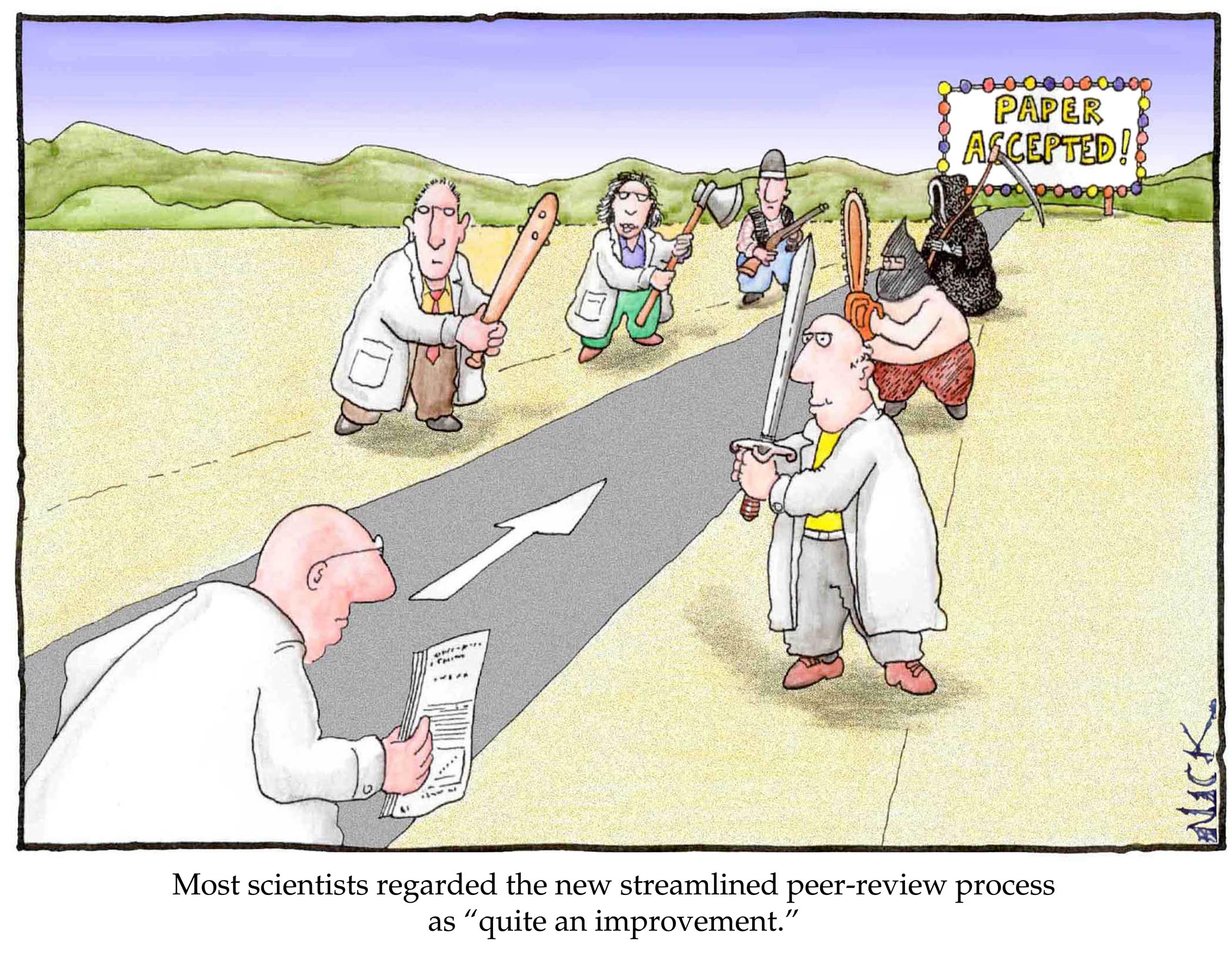
The typical scholarly response has been to resist the tide of information abundance, as Pound explains: “For the most part, the scholarly community has managed to artificially maintain its traditional grounding in information scarcity through hefty subscription rates, low acceptance rates, and slow mechanisms for vetting research.” Innovation in scholarly vetting procedures can a slow, arduous, and painful process, as Nick D. Kim’s cartoon shows.

But not all scholars resist the change. Pioneers in digital studies have begun to utilize digital tools and platforms for academic writing and research, with promising results. These innovators recognize that in the scholarly enterprise, as in book publishing, we must avoid simply relocating print-based practices to the digital realm. In this regard, we can take lessons from non-academics like independent writer, designer, and publisher Craig Mod:

Everyone asks, “How do we change books to read them digitally?” But the more interesting question is, “How does digital change books?” (2)

Academics may be similarly inclined to wonder, “How do we change our scholarship to publish it digitally?” But the more interesting question is: “How does digital change scholarship?” Rather than simply uploading our articles as PDFs, we must put our minds and imaginations to the task of using digital platforms to invent new methods and forms of scholarship—forms capable of presenting long and deep inquiry, fostering intellectual exchange, and maintaining rigorous standards of peer review.

Kathleen Fitzpatrick, co-founder of the digital scholarly network MediaCommons, is a leader in the effort to adapt digital tools and platforms to serve the highest standards of scholarly inquiry and communication. “The blog is not a form but a platform,” she argues, explaining that the blog is not a genre that precludes sustained analysis or concentrated attention, but a “stage on which material of many different varieties—different lengths, different time signatures, different modes of mediation—might be performed” (48).

“The blog is not a form but a platform.”

El Ponderoso platform shoe, “The Heights of Fashion: Platform Shoes Then and Now,” Mint Museum, Charlotte, NC.

The next two chapters discuss two different applications of blog platforms for academic research involving undergraduates. The first emphasizes the importance of bibliography and the second, the importance of design. But despite the difference in emphasis, both case studies reflect the three methodological principles of bibliography, design, and collaboration. And both offer models that you can adapt to involve your students in original research in your field using digital tools and platforms.

___________________________________________________________________

WORKS CITED

Fitzpatrick, Kathleen. “Reading (and Writing) Online, Rather Than on the Decline.” Profession (2012): 41-52. Web. 15 Sep. 2013.

Kim, Nick D. Peer Review Cartoon. Strange-Matter Archive. Web. 13 Oct. 2015.

Mod, Craig. “Post-Artifact Books and Publishing.” @craigmod (June, 2011). Web. 15 Sep. 2013.

Pound, Scott. “The Future of the Scholarly Journal.” Amodern. N.p., n.d. Web. 27 Mar. 2015.

Sapiens de Mitri, Nichola. “Studying at Starbucks.” (2013). Creative Commons licensed. Web. 13 Oct. 2015.

ja;fksdf lsf;lksjdf;lasflasdf

sa[s;dj;sodfj;soifjsdfj;soifjsdalkf ;ldskjf;lksadjc’dkf

sap;dkf’l;sadkfj;laksdfzj ;alksdfdszkbvlkjd

What did Surrealism offer women like Loy?

Filed Under: Language, Teaching

Grading with Love: an open letter to my first-year writers

September 21, 2015 by Suzanne Churchill Leave a Comment

I hate grading papers. This revulsion led me to innovate, so maybe misery is the real mother of invention. My thought process went like this:

Papers:
they hate writing them;
we hate reading them.
What’s wrong with this picture?

So I tried to change the picture. I turned to WordPress, a platform whose beauty and flexibility I hoped would make students more excited about writing, so that I could be more excited about grading.

It’s not a perfect fix, but with with practice, I’ve learned ways to use the platform to motivate students to take more interest in their writing. Your curation essays are a case in point: these are interesting essays because you are interested—not only in what you’re writing about but also in how you’re writing.

But I still hate grading. I can step into an essay and immediately get tripped up by tangled syntax, awkward grammar, and improper punctuation, so that I fail to see the idea straining for articulation.

I’m trying to change this process, too. I asked advice from Dr. Elizabeth Mills, a wise English professor who just retired from Davidson.

Me: “How do you approach grading essays? How do you keep from getting irritated and distracted by bungled grammar, clutter, and clichés?”

E. M.: “I try to see the person behind the essay. I try to think about what he or she is trying to accomplish and get across.”

As I turned that idea over in my mind, like a floury wad of dough between my hands, a realization began to rise: Dr. Mills grades with love.

When I read your curation essays, I tried to look for you and figure out what you were trying to say. Because if you have put something of yourself into an essay, there will be something to love in it. There will also be flaws, which are part of your humanness and your growing as a writer, and are therefore also something to love. Poet and playwright Kevin Kling tells a story about a cracked pot that reminds us why we should love the flaws. Listen:


drought-277453_640When I read your essays, I look for you. But when I attach the grade, I don’t grade you, I grade the essay, based on the extent to which it achieves the goals outlined in the assignment. You may not have achieved all those goals, but in attempting to meet them, I hope you have discovered something that more valuable than an A on an essay.


Filed Under: Language, Selfhood, Teaching

  • Page 1
  • Page 2
  • Page 3
  • Go to Next Page »

Copyright © 2026 · Infinity Pro on Genesis Framework · WordPress · Log in