• Skip to main content

Suzanne W. Churchill

  • DH Scholarship
    • Mina Loy
    • Gwendolyn Bennett
    • Modernist Magazines
  • Teaching
    • Recommendation Requests
    • Reading Tips
    • Secondary Source Reports
  • Writing
  • Painting
  • About Me
    • C.V.

Suzanne Churchill

One Wild and Precious Life?

March 23, 2014 by Suzanne Churchill 6 Comments

IMG_1589Something there is that doesn’t love a post, that sends me off to Facebook, Buzzfeed, and email, even when I know I need to write. It’s been more than two weeks since I flew home to Connecticut to visit my folks, seeing them, for the first time, living in separate quarters: Dad in his new apartment; Mom in assisted living. There was so much to take in that I didn’t even miss the basement. Dad has turned the master bedroom into a workshop, and it’s so full of train paraphernalia, tools, boxes, and scrap materials that it feels a lot like the basement anyway. Outside the workshop, his apartment looked much better than I expected. He’s got it decorated with paintings, family photographs, and even a sconce holding a mint green candle. A woman in his bridge group told him, “You can tell this is a man’s apartment,” but I disagreed, saying the sconce alone was grounds for recalling his man card. The punctum (to borrow a term from Roland Barthes)—the detail that shot out like an arrow and pierced me—was not the sconce, however, but the corner cupboard. There was no room for it in the living room, so Dad put it in his bedroom, asking my sister to arrange Mom’s china collection just as she’d had it. There’s no language for love like that.

When we got to the Hearth, Mom recognized me from across the activity room, brightening when she saw me. I wonder what I looked like when I saw her there, sitting in a string of chairs lining the periphery of the room, supporting timeworn bodies of various  shapes, sizes, and degrees of motor control. My face, answering hers, must have mingled shock with recognition and relief as I compelled a smile. How many times in my childhood had I been among children’s choirs and Girl Scout troops paraded through nursing homes to cheer the elderly residents? Yet never once did I imagine my own parent sitting in one of those chairs.

I don’t think my Mom ever imagined playing Bingo either—or rather, trying to play Bingo, but having difficulty following the logic of the game and struggling with her shaky finger to slide the red plastic window across the number. Mom never liked Bingo, but now she joins whatever group activities are offered. She accepts a snack of three Lorna Doones, tasting one and saying, “Oh, that’s dry.” She eats them anyway, then swallows the juice from the Dixie cup delivered a few minutes later.

Stiff and unsteady, she walks slowly with a walker and needs help to stand and sit. When she’s moving by instinct, she can be quite agile: once she dropped a Kleenex, bent down, and retrieved it without a wobble. But if she has to think about what she’s doing or follow instructions, all systems overload, the mind freezes, and the body balks. I imagine moving through the world for her is like it would be for me if I lost my glasses: blurry, uncertain, and unnavigable.

Her cheeks are soft, smooth, and pink. She’s ready with a smile or laugh, and likes to give and receive compliments. She remains preoccupied with her own symptoms and ailments, giving unsolicited “organ recitals,” especially when Dad is around. She enjoys food without the fear of weight gain that haunted her all her life, and once, when Dad put his arm gently around her, she exclaimed, “That’s WONderful!”

There are jarring moments of clarity. When my sister and I were driving her to the nail spa for a manicure, she said, “I just hope I don’t give you both the disease I have.” Did she mean Alzheimer’s? Most of the time she no longer seems aware of her dementia, though she did qualify one remark, saying, “The thing that stands out most in my mind, and I don’t know if this is true…” The vision—of my sister as a toddler trying to run away—was probably true.

Most of what she says makes no sense. She mixes memory, imagination, and perception in an irrational blend. We try to find humor in the way she imagines suitors everywhere, wanting to marry her. Dad says, “Well, you can see why they would want to be with her. She’s a very attractive woman.” He says this without irony (another punctum). We no longer correct Mom or try to decipher her logic. Instead we just pick up a piece of something she says and thread it into something that makes sense to us, as if we were picking up a nightgown blown off the clothesline and pinning one corner back on, leaving the rest tossing in the wind.

Truth is, it’s not much fun spending time with her in the Hearth. You can’t have a real conversation, and there’s not much to do. Flip through photo albums, play a Broadway show CD, or take her down to the activity room to listen to a middle-aged guy play Irish songs on his keyboard. Pass a woman in the hall on the way who complains, “They say it was Irish music. That is NOT Irish music! It makes me sick to my stomach.” Sit next to another lady who seems much sharper than Mom. She looks right at you and says, “I am NOT happy.” You say, “I hope the music cheers you up,” and indeed it does, because during a jig, she’s singing along, tapping her feet, bobbing out of her seat; then a waltz makes her weep. You wish Mom would respond more to the music: she seems so vacant. When a male resident shuffles into the room, the lady next to you leaps up, exclaiming, “That’s my father!” She sits down, caught up in the next tune. You tell Mom you have to go and kiss her goodbye. She doesn’t seem sad.

Taking Mom out of the Hearth isn’t much fun, either. When you do, she’s so disoriented that she scarcely knows where she is or who you are. You steer her into the nail spa, and she stiffens in her seat. You have to stand behind her to keep her chair from rolling backward, and every so often, you prop her back up in her seat. You gently massage her arms and shoulders, trying to relax her muscles, but she doesn’t respond to your touch. When she gets back to the Hearth, she sleeps all afternoon.

You just want to avoid the situation. You’ve finally accepted that there’s nothing you can do, nothing you can fix. You can’t even soothe her. She will be happy to see you, but she won’t be unhappy when you leave. So leave. Get away. Put it out of your mind.

Because you’re thinking terrible thoughts: what is the point of such a life? Each day, a pattern of dull, meaningless activities, punctuated by snacks, meals, and bathroom breaks. Visits from family members, old friends, a doctor, nurse, an attendant blur together. Is she just filling space, killing time, waiting for the next small pleasure that’s offered to her—a sip of juice after a dry Lorna Doone?

And then you get really morbid: Is her life really so different from yours? Sure, you have more control, more agency, and decision-making power. You’re a productive citizen. But in her own way, she’s a productive citizen who also contributes to the economy: think how many jobs depend on her needs—cooks, caretakers, nurses, administrators. And aren’t you just living your own routine, waiting for the next pleasure that falls within your own, slightly larger orbit? What makes your life any more meaningful? What keeps you living, knowing that you’re on the same path of inevitable decline, leading inexorably to death?

See Robert Penn Warren, “American Portrait: Old Style“:

“But Jesus,” he cried, “What makes a man do what he does—

Him living until he dies!”

Suddenly, in these words, you see something not morbid but heroic in the human will to live. It’s a marvelous mystery, this impulse to go on, whether you’re confined to the Hearth or free to roam the earth. “Doesn’t everything die at last, and too soon?” Mary Oliver writes in “The Summer Day,” insisting that mortality renders life more piquant and precious, asking, “Tell me, what is it you plan to do / with your one wild and precious life?” Maybe, as Oliver suggests, our greatest task is to figure out “how to be idle and blessed,” as Mom surely is, secure in the Hearth.

IMG_1820I try to make peace with thoughts of heroic endurance and blessed idleness. Dad and I go to see Mom for the last time before he drives me to the airport to catch my flight home. Before I even get there, the wisdom of the poets is drowned out by the throbbing thought, “This may be the last time I see her that she recognizes me.” The visit isn’t any different from any other, except that I can’t stop thinking, “this may be the last time,” and I can’t stop weeping. The visit isn’t any different from the last; my sorrow stems from the sentimental frame I impose on the encounter. If only I could change the frame. Instead I kiss her goodbye and fly away.


Featured Image:  Steven Craven, “Christmas Day in a nursing home.” 24 December 2008. Geograph.org.uk. Creative Commons 2.0 licensed.

Filed Under: Alzheimer's, Family, Poetry, Uncategorized

Woman much missed

March 1, 2014 by Suzanne Churchill Leave a Comment

In Thomas Hardy’s poem, “The Voice,” repetition and rhyme create a haunting echo, sounding out a persistent tugging of desire that can neither be escaped nor fulfilled:

Woman much missed, how you call to me, call to me,
Saying that now you are not as you were
When you had changed from the one who was all to me,
But as at first, when our day was fair.

Read this stanza once, and the earworm will burrow into your mind. You can’t not feel the pain of longing in the repetition of the phrase, “call to me, call to me,” which is subsequently rhymed and ironically reduced to “all to me”—an echo of a former fullness that may never come again. You might not realize that you’re hearing a dactylic meter (“CALL to me, CALL to me”), but your body feels the strong beat that diminishes over time. Hardy’s sound patterns rehearse the inevitability of loss and the persistence of desire.

Today we received some good news about our sons Thomas and Luke on the college admissions front (nothing’s final until April, but they’re going to college!).  I’ve shared the news with my father and in-laws, because telling grandparents never feels like boasting. It feels more like giving them compliment—a way of saying, “Look who you helped bring into the world! Look who is carrying on your legacy!”

SCAN0001While I am bursting with joy and pride, I’m gutted by longing. I want to call my mother and tell her the news, too, because one else on earth would be more pleased than she.* My mom would remember holding those tiny babies in the hospital just after they were born, marveling at their big, bony heads and thin, fragile limbs, wondering how they ever came into being and how we would ever manage to keep them alive. My mom would feel the way I feel: a curious mixture of surprise and awe, combined with a sense of deja-vu, because we should have known and always have known how marvelous are these beings who have somehow, miraculously, become young men.

I don’t know if my longing is any different because my mom is still alive but prevented by Alzheimer’s from comprehending the news. I do know that, even though she’s alive, I’m already much missing her:

 Thus I; faltering forward,

      Leaves around me falling,
Wind oozing thin through the thorn from norward,
      And the woman calling.

In this case, though, I’m faltering forward, and I’m the woman calling. Thank goodness those boys are marching on.


*I say “on earth” in deference to my mother-in-law, Jane Churchill, who would be thrilled, too, though she probably would have been just as delighted by the “artistic” arrangements of laundry Luke and Thomas have left on the floor of their room.  Jane had a knack for finding beauty in things as they are, whereas my mom has always preferred things in their best form, especially when folded and neatly arranged.

Filed Under: Alzheimer's, Family, Poetry

2014 Holiday Letter (by Matt Churchill)

February 14, 2014 by Suzanne Churchill 3 Comments

February 14, 2015

Dear friends and family,

Happy Valentines Day! 2014 was an eventful year in the Churchill household, with each kid hop-skipping off to new schools, and Suzanne leaping into a sabbatical, while I learned the old age shuffle. Yes, the “highlight” of my year was arthroscopic knee surgery.

Now I’m not one to complain, but you would think that when I’m going under the knife, Suzanne would be clutching her rosary beads and praying for my welfare. Instead, when I come out of the general anesthetic, I find that she’s been posting to Facebook about the lawn mower and polyp removal conversations she’s overheard in the waiting room and debating with her friends as to whether I’d be able to meet my weekend cooking obligations (not a chance!).

10731069_10205188736868323_6438003542574538943_nBut I have to forgive Suzanne. She was probably distracted by her upcoming 2-week trip to Russia as part of a Davidson College-sponsored faculty study tour (read about the experience on the “Studio R” blog), or the subsequent weeklong digital studies course in Victoria, British Columbia, or the potential “trials” of a year long sabbatical, or preparing for our Halloween trip to New Orleans for my brother Ian’s marriage to Pamela Waggoner (though as you can see from this photo, we didn’t dress up much). I recently asked Luke whether he had any inkling as to future career possibilities, and his reply was something like, “Well, Mom’s job seems pretty good right now!” Heck yeah.

I have to admit that I also enjoyed a work sabbatical last summer. Every 5 years my law firm allows for a 3-week “vaccatical” that we used to take a family trip to Italy and Switzerland. We feasted with Suzanne’s sister’s family for a week in Tuscany, toured 1,000 or so churches in Rome and enjoyed the extraordinarily generous hospitality of Suzanne’s Swiss relatives. Robin, Pat and Florence Alder hosted us at their vacation place on Lake Lugano in Southern Switzerland, took us on a tour of the Wallis Valley (including an unforgettable sunrise cable car ride to the top of the Eggishorn mountain and a day-long hike along the Aletsch glacier), and suffered through our gallant, but generally failed, attempts at water skiing. It was a real treat. The Schollenbergers also hosted us in Kusnacht, treating us to delicious meals and a guided family history tour of the town (with ice cream).

IMG_3668
Despite a significant amount of parental angst, Thomas and Luke appear to have both found ideal college situations, which makes it a lot easier for their parents to bear the long distance separation.

Thomas, 18, set his sights on Stanford early, and I thought his application was pretty strong, except for the “letter to your future roommate” essay. Thomas chose to tie this essay to the T.V. sitcom, “How I Met Your Mother” and the “Bro-Code” modeled therein (which I loosely interpret as a vow to lie to your parents to protect your brother). He also borrowed the main character’s trademark expression of describing any “legendary” experience as, “legen . . . wait for it . . . dary.”   I was pretty dead set against this essay and told Thomas that I thought it was going to be “legen . . . wait for rejection . . . dary,” but he stuck to his guns. And of course, when the acceptance letter came, the admissions officer told him she thought his time at Stanford would be “legen . . . wait for it . . . dary.”

Luke, 18, chose Washington University in St. Louis, which has a stellar academic reputation, a beautiful campus, and one of the worst names since Beaver College (my and Suzanne’s study abroad alma mater). Now I can understand adding a geographic descriptor if you need to distinguish between UNC Chapel Hill and UNC Wilmington, but do we really need to highlight St. Louis here? Our friend, Kristi, thinks my reaction stems from an anti-Midwest bias, but I beg to differ. I really like Chicago! Just to get on Luke’s nerves, I’m trying to convince members of my family to add geographic locators to their schools as well. So Suzanne could say she sent to Middlebury College in Middlebury and teaches at Davidson College in Davidson.

Zac, 13, is in 8th grade at J.M. Alexander Middle School (in Huntersville), which feeds into the I.B. program at North Mecklenburg High School (in Huntersville), from which Luke and Thomas graduated in the spring. When queried about the adjustment he’s had to make due to his older brothers’ departures, Zac opined that, “it’s no different” and promptly returned to Insta-gramming all of the other 13-year-olds that now dominate our neighborhood. Zac’s grown about 6 inches in the past 3 weeks (and added a bit of teenage attitude), but he still maintains a happy-go-lucky vibe that we treasure.

This year was not without significant loss. Suzanne’s Mom, Valerie Wintsch, suffered through the end stages of Alzheimer’s disease and just died peacefully early this January. Suzanne has written blog entries about Valerie and Alzheimer’s that I recommend to you (click on the topic “Alzheimer’s” in the right sidebar). We’ll all miss Valerie’s sparkle, warm chuckle, and fierce love for and devotion to her family.

Moments like this remind us of how important you, our friends and family, are to us, and how lucky we are to have you in our lives. We hope to see many of you in 2015, and we now even have a few extra bedrooms if you’d like to visit us in North Carolina. We promise that your visit with us will be legen . . . wait for it . . . dary!

Lots of love,

Matt, Suzanne, Thomas, Luke and Zac


Filed Under: Holiday Letters

Speak to me : Take my hand : What are you now?

January 19, 2014 by Suzanne Churchill 5 Comments

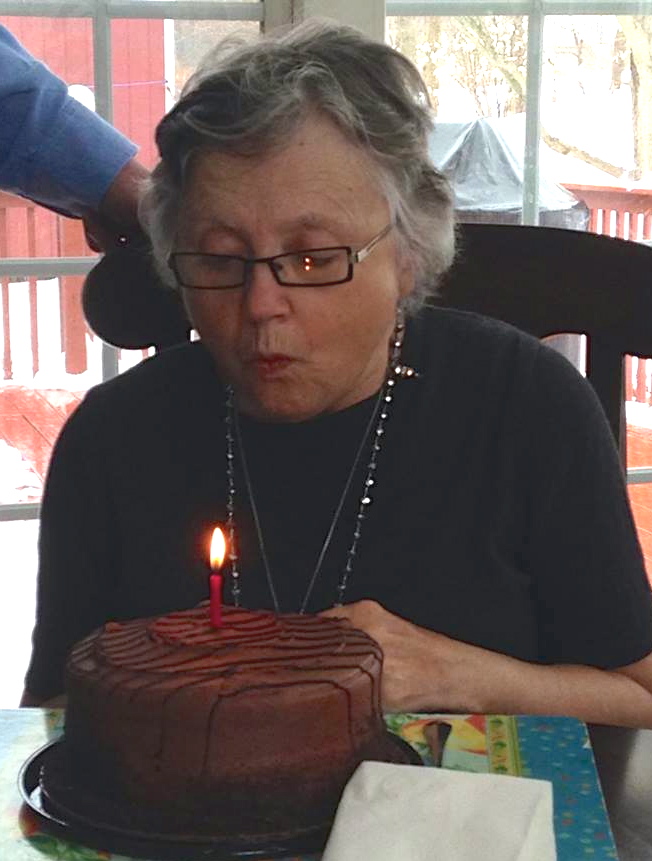
1532116_10202895045715800_602969367_nWhen I FaceTimed with my mom on January 5th—her 75th birthday—she was surprisingly “good.” I put that word in quotations marks because I’m uncomfortable with the moral judgment it seems to place on the natural course of her disease. Yet that’s the word that come to mind, and she was really, pretty good: she knew it was her birthday, she said she was 75, and she asked me (un-prompted), “What’s Matt doing?” The question meant that she not only knew who I was, but also remembered who I was married to. Conversation seemed pleasurable but tiring: by the time I summoned the kids to the screen to wish her a “Happy birthday,” she resorted to echolalia, wishing them “Happy Birthday” back, even though it wasn’t their birthday. She was cheerful and smiley. She seemed to be enjoying herself and the attention, not to mention the chocolate cake.

1557651_10202895045755801_1173266732_nIn our Face-Time encounter today, two weeks later, things weren’t so good. My sister reported last week that Mom had started exhibiting a strange symptom of straining to get words out, as if she had to wrench them out of her throat. I didn’t need to hear the guttural straining to know what my sister meant. I saw an early stage of the symptom in an expression that began appearing on Mom’s face last summer. A shadow would rise up on her face, lifting her eyebrows and wrinkling her forehead in a paralyzed anguish (you can see it happening in the photo on the left). “What does that expression on your face mean, Mom?” I asked, describing and mimicking it for her. She said she knew her face was doing that, but didn’t seem to know why. It was as her face was expressing things that her brain could no longer comprehend or control. Was it anxiety? Pain? Or just a neurological reflex?

Now the facial expression coordinates with speech, or rather, with the anguished effort to produce speech. She strains as if she has tear the words out of her body. Often words won’t come, or when they do, they stop mid-sentence. If you question her about the end of her sentence, or try to suggest a destination, she’s already forgotten it. In these moments, the effort to make conversation is futile, no matter how much we both want it to happen.

Our fragmented conversation reminds me of a fragmented scene in T. S. Eliot’s, The Waste Land, in which two lovers are bound in a fraught, intimate exchange. The first speaker desperately pleads for conversation, and the other lover refuses:

“Speak to me. Why do you never speak. Speak.
  “What are you thinking of? What thinking? What?
“I never know what you are thinking. Think.”
  I think we are in rats’ alley
Where the dead men lost their bones.

When I tried to talk to my Mom today, I felt as if I was silently urging her, “Speak to me. Speak. Speak.” It seemed as if her own mind was urging the same thing, pressing her to “Speak” and “Think.” And her own mind—or some other part of it—was as recalcitrant in refusing to cooperate as the lover in Eliot’s poem. Her mind had become a rat’s alley, and no matter how much she pressed it to speak, it would not give.

But maybe it’s not so bad for her. Psychologist Alan Dienstag, who conducts support groups for early Alzheimer’s patients, offers a reassuring perspective on the disease. Although Alzheimer’s is the disease Americans fear most, he says, it’s actually not the worst way to go, at least not for the patient. He tells this story about a workshop he ran:

There were about 20 people in the room and we were…going around the circle and people with early Alzheimer’s were talking about their lives and what they do to…give their lives meaning, find stimulating things to do, and so on. This man started talking about his experience as somebody with early Alzheimer’s, and he was painting a very…benign picture of it all. He said, “Well, you know, it’s difficult not to be able to remember, but I get up and I can do this and I can do that.” Basically he was just saying he’s fine, he’s OK. And over his shoulder, sitting behind him, was his wife. And she was crying…And I knew just how much he’d lost, how much she had lost.


…But there he was. He wasn’t uncomfortable. He really wasn’t. And so I think we project our feelings onto them, and we assume that they are suffering some terrible thing, but in fact that’s not necessarily the experience of it.

Listening to Dr. Dienstag’s interview helped me accept my Mom’s diagnosis: it was comforting to think that she wouldn’t suffer great pain—that for her, the worst was over. But now I’m not so sure. As I watch her on the screen, straining to extricate words, the effort appears agonizing. Maybe it isn’t physical pain. Maybe it’s emotional. Whatever it is, I can’t stand to see that look on her face and hear the words torn from her throat and shredded in the process. I feel like I’m not just witnessing pain, but actually inflicting it. By asking her questions and telling her about our lives, I’m putting her in a situation where she is compelled to speak, but cannot.

Our relationship has always been based on talking. Mom started reading aloud to my older sister and me well before I could understand the words. We spent the hot, humid summer days sitting in the living room in front of the fan as she read and read. When I was older, she would drive me places and tell stories about people’s lives and relationships—about marriage break ups, nervous breakdowns, jealousies and rivalries I was too young to understand but still fascinated by. I would ask questions, and she would always answer. Conversation became the fabric of our relationship.

So when she sees me, she knows, instinctively, that conversation should happen. And she can no longer make it happen. I can chatter on to fill the silence, but I’m not alleviating the pain that comes from the absence of reciprocation. Whose pain is it? Am I projecting my pain onto her, assuming she is “suffering some terrible thing,” as Dr. Dienstag says, when her experience is different? Her expression tells me I’m not projecting pain, though I’m probably mirroring it.

A few months ago, seeing her face on the screen gave me a sense of emotional connection, even when words faltered. But today, the effort of speech is too painful. I want to shut down the screen, to sit next to her and hold her hand, so that she won’t see me and feel like she has to speak.

Thinking about the effort of speech made me think of Muriel Rukeyser’s poem, “The Effort at Speech Between Two People.”  So I looked it up, and in one of those uncanny acts of grace, the poem handed me the very guidance I was looking for. Its recurrent refrain is:

:  Speak to me.          Take my hand.            What are you now?

In juxtaposing these phrases, the poem suggests that speaking to someone is analogous to taking that person’s hand. Both are reciprocal gestures of contact and communication. The poem also delivers a lesson I thought I’d already learned: we are always changing in relation to one another. So as my Mom and I continue to change (she on a more rapid course than I), I’m going to have to let go of speech and take her hand. That gesture may be my only answer to the question, “What are you now?” For now, anyway.

Filed Under: Alzheimer's, Family, Language, Poetry, Selfhood

2013 Holiday Letter (by Matt Churchill)

December 26, 2013 by Suzanne Churchill

bridge
Luke, Suzanne, Thomas, Matt, and Zac
on a college tour in New England.


December 2013

PO Box 2143
Davidson, NC 28036


Dear friends and family,

‘Tis the season of college applications, and our children are nestled all snug at their laptops, while visions of essay prompts dance in our heads:

What’s the first thing that comes to mind when you see the word “Future”?

Suzanne’s Answer: Tense.

But I reject that pessimistic attitude.  When I see the word, “Future,” I think: Digital Age. And in that spirit, I offer this guide to the actual and virtual worlds we’ve explored in the past year.

If you haven’t joined the digital world yet, don’t worry.  I’m just baby-steps ahead of you.  I did manage to join Facebook on December 1, 2012 (thanks to my brother-in law, Scott) but forgot my password within a month and only managed to recover it a few days ago. So I must have missed out on a ton, right?!  Let’s see . . . brother Andy is drinking too much Stag’s Leap ’97 at a restaurant in Amherst; brother Ian has changed his profile picture to a clown face; and brother Bruce is eating lunch at the Museum of Fine Arts in Boston but skipping the art.  Hmm – and they say teenagers should clean up their digital footprints!

Fortunately, Suzanne is on the cutting edge of the digital world, writing a blog on high-minded topics like the viral, pop song sensation, “What Does the Fox Say?”  She’s also featured quite prominently (in a hot, polka-dot dress I might add) in Davidson College’s website news release on a digital studies grant.

Kennesia
Kennesia and Zac

But I learn the most useful digital tidbits from the young people in my life – and we’ve had a couple of new additions to our family this year (intriguing, no?).  Kennesia Martin, who became part of our family when she was a student at Davidson, moved in with us this fall as she began her career as a middle school math teacher in the Charlotte-Mecklenburg public school system. Kennesia not only teaches her students algebra and geometry M-F, but also, on holiday occasions, leads them in line dances like the “Stanky Legg.”

One of the highlights of my 2013 was to injure my left knee during an early morning workout.  I went to an orthopedic surgeon for a diagnosis of the dramatic swelling – Did I blow out my ACL or MCL or break my lateral tibia plateau like Kobe Bryant?  No, the surgeon replied, you’ve just been born with a slightly misaligned kneecap.  Yes, folks, it turns out that I was born with a stanky legg.

Flo  Ra
Florence and Rachel practicing
the universal language of laughter.

Our 14-year old Swiss cousin, Florence, who stayed with us for 3 weeks over the summer to improve her English language skills, has no such issue.  A snowboarding whiz, she zipped around on a ripstik and danced along the ropes course at the Charlotte Whitewater Center. Florence was a joy to be around and, along with our 14-year old neighbor, Rachel, proved that uncontrollable giggling is a trait of adolescent girls worldwide.  Suzanne has enjoyed the influx of estrogen into the household, watching classic chick flicks like “Safe Haven” while we were staying in a beach house near where the movie was filmed.

Luke and Thomas, 17, are seniors in high school and have the pleasure of spending their Christmas vacations answering college essay prompts like, “What would you hope to find at the other end of the rainbow?”  Thomas’ response:  “Breakfast.”  While neither has created his own nonprofit nor solved any previously unanswerable mathematical proofs, they did recently collaborate to build a life-sized, gingerbread house, decorated with Christmas lights, fake snow, and math equations, for a school project—an artistic achievement topped only by their performances in the classic film short, “Can We Have Our Ball Back?”

Zac, 12, and in 7th grade, is eagerly anticipating his older brothers’ departure for college (he has great plans for converting their bedroom into a rec-room of his own). Always trying to keep up with his brothers’ high standards, he’s written his first screenplay, “Rescuing Ricardo” (running time: 120 seconds). Plot synopsis: mean-spirited Ricardo has a moral awakening when he goes into the twilight forest in pursuit of his neighbor, Bill, the dumpster-diver. Ricardo first encounters the great ninja Ishikushu, whom he vanquishes with his super laser gun, only to face four, highly trained army men with knives, guns, and black belts in karate.  As the army men charge him, he calls for backup on his walkie-talkie, and a helicopter drops two AK-47s, which he uses to mow down his adversaries.  Ricardo rescues Bill and apologizes for his past, rude behavior, pledging, “Now I will be nice to everyone because I do not want this to happen again.”

Now you may be having a similar reaction to this letter, but there are some things in life that are worth repeating, like childhood photographs and visits to Davidson, NC. As much as we love stalking your Facebook pages, we’d rather see you in person.  We’ll have an extra room when Luke & Thomas (hopefully) matriculate in the fall, and the dance floor will always be open.  In fact, if you are lucky, we might even teach you the Stanky Legg.

Happy New Year!

Matt, Suzanne, Thomas, Luke, and Zac

Filed Under: Holiday Letters

2012 Holiday Letter (by Matt Churchill)

December 26, 2013 by Suzanne Churchill

December 15, 2012

Dear friends and family,

As I sit here slavishly tied to the computer, Suzanne is off gallivanting around England on another one of her modernism junkets.  I never realized what a gravy train early 20th century poetry could be (or that my wife could manage to convert a 45 minute lecture into a week-long extravaganza from Oxford to the Cotswolds and London).  But I am not one to complain—supportive spouse that I am.  I jumped into single parenting wholeheartedly last Monday night, serving up a dinner of grilled chicken and salmon, with two vegetables besides! But by Friday, I’d run out of steam, leaving Zac to forage his own dinner of 3 frozen waffles and a banana. But at least he had real maple syrup.

Zac & JosieZac doesn’t have much to complain about, however, as he has a new dog, Josie Doodah Churchill, and a new middle school, Woodlawn, both of which he loves.  Josie is a Havanese puppy that we acquired not from a mere breeder, but from a Southern “puppy ministry” (they use profits to cover the costs of adopting international children).  When we visited the ministry to pick up our puppy, we met the roundest, most placid, redheaded baby named Josie Doodah, who grinned (and drooled) at us toothlessly for 30 minutes straight.  Meanwhile, Josie’s brother Harry (yes – Harry Doodah) and the ministry’s recently adopted Chinese daughter ran around smacking each other’s heads with plastic light sabers. We were hoping our puppy would take after baby Josie, but she seems to have the spunk of Harry, even if she lacks the doodah.

Woodlawn is a small, private school with plenty of Davidson College connections—e.g. Zac’s English teacher is a former student of Suzanne’s who likes to regale her students with traumatic tales about cat sitting our other family pet, Fergus.  It’s the type of school where the first 6th grade assignment is to sew school mottos into burlap-type material for use as erosion barriers.  The students then install the barriers around the campus so that the words become part of the foundation of the school.  I, of course, had some great suggestions for Zac like, “Where would the top 1% be without lawyers?,” but his group came up with something pathetic like “There are no short cuts.” Ah, youth.

Luke & Thomas 2012Luke and Thomas are juniors at a large, public high school (school motto: Will you just graduate already?), and they are launching into the throes of the college search. On our annual pilgrimage to Massachusetts and Maine last summer we hit a few safety schools like Princeton, Yale, and Amherst for campus tours and info sessions.  The highlight for me was the Yale campus tour, where the cheerful student tour guide asked the prospectives to tell him their hometown and personal interests so that he could tailor his remarks accordingly.

Thomas was up first:  “Hi, I’m Thomas Churchill. I’m from Davidson, NC, and I like to play soccer.”  Definite Yale material.  But this is where it’s great to have twins.  Even if one strikes out, you still have that second chance, right?  “Hi.  I’m Luke Churchill.  I’m from Davidson, NC, and I also like to play soccer.”  Maybe not.  Of course, the other prospectives then proceed to discuss (at length) their interests in the human genome, neuroplastic re-engineering, transnational politics, and experimental poet Mina Loy’s migration from Italian Futurism to New York Dada as evidenced in modernist little magazines (oh wait, that last one came from Suzanne).

Suzanne loved Yale – she’d enroll there in a heartbeat, if they’d take her. At the Beineke Rare Books library, her nose was pressed up against the glass like Josie’s when she sees her boyfriend, Gus, outside.  Meanwhile, Luke, Thomas, Zac and I were busy plotting the route to the Dairy Serv – the soft-serve ice cream joint in our hometown of Durham, Connecticut.  But I guess that’s why the gentlemen in our family aren’t getting invited to give talks in England.

Luke and Thomas are not just soccer studs— they are also learners-permitted, teenage drivers, tooling about in our stylish 1998 Honda minivan, aka “the dank tank” (a moniker derived from the lingering odor of sweaty soccer gear).  They had “summer jobs” last year as a substitute lifeguard (Luke) and a volunteer at a local guitar lesson studio (Thomas), which netted them about $100 in the aggregate but bestowed on them a great tan and a certain vibe.  And they’ve reached an age where their math, science, and music knowledge (actually, pretty much any area of knowledge other than THE LAW and modernist poetry) dwarfs that of their parents.

family 2012When not dancing in London clubs with the British boy band, One Direction, Suzanne continues to enjoy teaching at Davidson College, as well as yoga, occasional painting, and a daily constitutional with Josie.  I continue to practice law in Charlotte, and I’ve joined a fitness group (which Suzanne affectionately calls “The Cult”) that holds boot camp workouts at the ungodly hours of 5:30 a.m. on Tuesday and Thursday, and 7:00 a.m. on Saturday.  So if you see a good-looking, super-buff guy running past you early in the morning in Davidson, wait about 10 minutes and I’ll come puffing along behind him.

Now I know this letter has gotten a bit long, but that’s what happens when your editor is lolling around London giving twins advice to William and Kate while you write the dang holiday card.  So I will end it with a heartfelt thanks to all of you for being part of our lives and with best wishes over the holidays and in 2013.

Please come visit soon – Josie needs a walk!

xo

Matt, Suzanne, Thomas, Luke & Zac

Filed Under: Uncategorized

2011 Holiday Letter (by Matt Churchill)

December 25, 2013 by Suzanne Churchill

December 2011

Dear friends and family,

2011 has been a difficult year for our family, mainly due to the sudden loss of my Mom, Jane Churchill, in October.  She was still working at the Durham, Connecticut public library when she died, and we were fortunate to gather as an extended family to celebrate her 80th birthday in June.  However, her full life and quick, peaceful passing simply do not fill the void left by her loss.  I thought about whether my traditional holiday letter would be appropriate given the circumstances, but I decided that since my Mom enjoyed the letters so much (or at least pretended she did), that I’d subject you to another installment – The Churchill Family 2011 Year in Pictures.

2011 kicked off with a couple of celebrations, including my law firm’s 50th anniversary gala and an Autism Speaks charity event that we attended with Davidson friends.  While Suzanne and I looked quite presentable at the start of the charity event, the bad influences in our South Street neighborhood contributed to late night debauchery on the dance floor.  (It’s strange that our neighbor, Charlotte Neal, appears in both photos, don’t you think?)

 SM11 S Char m char

After reviewing these pictures, Suzanne fled the country to serve as resident director of Davidson’s summer program in Cambridge, England.  We met her for a week in England and a travel week in Provence, France, where we were joined by Uncles Bruce and Scott (see below with Thomas – that’s Bruce saying “Call me!”). Before we arrived, Suzanne hiked the Lake Country (way to crawl up that mountain, Suzanne!) and sampled the fashions of Bath (that’s not exactly what I envisioned when I asked her to model a corset for me).

TBS 11 S climb 11 S hoop 11

When the boys arrived, they also felt the need to model the fashions of medieval France.

S Z hat 11 LT hat 11 s m 11

While visiting the seaside, Suzanne got the latest French coiffure, and I stuck a couple of French baguettes (and a chocolate croissant) up my shirt. Very attractive, I know.


LT laptop11Thomas and Luke, both 15, are now sophomores in high school, obsessed with athletics (soccer; winter track), music (guitar for Thomas; piano for Luke; awful attempts at freestyle rap for both) and, of course, technology (many of you probably Facebook and play “words with friends” with them).  Here’s a typical picture of them (left).  That’s Luke hiding his face with an iPod Touch, while Thomas simultaneously texts on his phone, surfs the net on the laptop and gives the camera a gorgeous smile.

Z wig 11Zac is 10 years old, in 5th grade and similarly obsessed with soccer and technology (see his “obsessed” self-portrait, left).  He was on his school’s “Odyssey of the Mind” competition team, where he designed a striking costume (right), and he is a proud member of his school’s safety patrol, which is teaching him responsibility and self-sufficiency. For example, after repeated requests to take down written phone messages, Zac finally succeeded in leaving me the following note earlier this year:  “Dad, Somebody called.  Love, Zac.”

Z face 11So, as you move into the New Year, rest assured that “Somebody wrote.” Write back soon!

Happy New Year, with love from,

Matt, Suzanne, Thomas, Luke, and Zachary Churchill


Filed Under: Uncategorized

2010 Holiday Letter (by Matt Churchill)

December 24, 2013 by Suzanne Churchill

December 2010

Luke Obama
Davidson middle school students
meet President Obama

Dear Friends and Family,

Now don’t you just hate receiving those holiday cards that brag about how son, Tyson, made straight A’s at Brown University while dating Emma Watson (Hermione Granger) and how daughter, Brittany, when not starring in her own reality T.V. show, has found a cure for halitosis?

“Wait a second, Matt.  I don’t mean to interrupt your rant, but is that a picture of your son, Luke, with President Obama?”

I’m a little embarrassed that you’ve brought that up, dear reader, because I hadn’t planned on highlighting it, but, yes, that would be Luke consorting with the leader of the free world.  There’s a strange coincidence between the release of this picture and President Obama’s downward spiral in popularity ratings, but I’ll leave the political science analysis to others.

The photo op resulted from Luke and Thomas’ 8th grade “Future City” team winning a national engineering contest focused on designing, you guessed it, a futuristic city.  I just asked Luke to highlight a few of the engineering marvels from the city, and he replied, “I don’t know, Dad . . . it’s been like a year since I thought about that.  We had beaming energy, virtual reality, walls made of cellulosics, fish poop fertilizer . . . stuff like that.”  Sounds like a place I want to live.

The victory resulted in what we lovingly refer to as the “Geek World Tour” – a White House visit for Luke (Thomas still thinks that if he’d met Obama the Democrats would continue to control Congress), dinners with local engineering trade groups (yowza!), a visit to Houston for the eco-marathon (a trade show focused on fuel-efficient cars), and a weeklong trip to Space Camp in balmy, Huntsville, Alabama.  The Space Camp trip was actually pretty sweet, as they were teamed up for the week with a group of Chinese scholars (English a bit spotty, but great present givers) and a cool, artistic girl from Ireland (how can you go wrong there?), and they got to try various simulators and mock space shuttle missions.

When not consorting with the President, Luke and Thomas (both 14), started high school, opened FaceBook accounts (please let us know if you see anything obnoxious on their “walls”), harassed their parents for unlimited texting (not yet, but we’re crumbling), played endless amounts of soccer, and made their parents drive them everywhere listening to Eminem, Bruno Mars, and similar drivel.

family 2010
(L to R) Thomas, Zac, Matt, Suzanne, Luke

On many of these rides, I’d hear a catchy tune by “Far East Movement” with the lyrics, “Like a G6.  Like a G6.  Now I’m feeling so fly like a G6.” Unfortunately, when I heard the song, I didn’t realize they were describing something as “fly” (cool) as a Gulfstream 650, a private jet with an estimated price tag of over $58 million.  I’m thinking snack food.  So I’m singing, “Like a cheese stick . . . like a cheese stick . . . now I’m feeling so fly like a cheese stick.”  That went over well with L & T.

Zac (age 9) caught the reading bug after devouring the “Mr. Gum” books by the British author Andy Stanton.  When asked why he likes the books so much, Zac says, “Because they’re so random.  If Mr. Gum doesn’t take care of his yard, an angry fairy shows up in his bathroom and hits him over the head with a frying pan.”  Good stuff.  Zac seems to have taken the “random” storytelling to heart.  He wrote a tale recently that starts, “An explorer was out on his ship exploring the ocean.  Suddenly, there was a crash and everything went dark.  When it was light again, two of his crew members were gone.  The explorer didn’t care about other people so he started munching on some virtual crackers and cheese.”  Strange how cheese snacks feature so prominently in the creative lives of Churchill men.

Zac loves soccer and his school’s Odyssey of the Mind club.  But mostly he just runs from house to house in our neighborhood seeking out his 9-year-old buddies and reporting progress en route.  “Dad, I’m going to Wesley’s.  Dad, Wesley’s not home so can I go play with Jackson?  Dad, Jackson’s not home, so can I go over to Tilly’s?  Dad, Tilly’s not home, can I go down to Jay’s?  I’ll call you when I get there.  I’ve written a sticky note and put it on my hand.”  No call.

Inspired by Zac’s travels, Suzanne and I thought we’d like to take a trip — without kids. Suzanne’s invite to a colloquium on the photographer Alfred Stieglitz in Normandy, France, provided just the ticket. After great visits with friends in England, we traveled to a small Chateau in Normandy that has historically hosted conferences for French intellectuals and was branching out to include North American scholars for the first time.  But this conference didn’t do much for Franco-American relations.

The first paper was given by a French professor, who explained why the year 1913 was a critical year for modernist intellectuals.  As soon as she had finished, an American scholar raised her hand and said something to the effect of, “Well, that was a nice, introductory paper for people not familiar with this period.  But I question the choice of 1913.  If you’d read my paper, entitled ‘I Know More Than You Do, And I’m Here to Tell You About It,’ I think you would’ve chosen 1917.”  Touché.

Fortunately, the conference went uphill from there, and Suzanne and I enjoyed rustic French food, the stunning countryside and coastline of Normandy, and moving side trips to Mont St. Michel, the Bayeux Tapestries, and the American military cemetery.

Suzanne and I lost two, young friends to cancer this year, and too many others who we care about have been struggling through difficult times.  So we’re ready to put 2010 behind us, but we also realize how fortunate we are.  And one of our greatest gifts is to have friends and family like you.

So happy new year.  We truly hope that your 2011 will be as fly as a cheese stick.

Lots of love,

Matt, Suzanne, Thomas, Luke, and Zac

Filed Under: Uncategorized

  • « Go to Previous Page
  • Page 1
  • Interim pages omitted …
  • Page 5
  • Page 6
  • Page 7
  • Page 8
  • Page 9
  • Interim pages omitted …
  • Page 11
  • Go to Next Page »

Copyright © 2026 · Infinity Pro on Genesis Framework · WordPress · Log in