• Skip to main content

Suzanne W. Churchill

  • DH Scholarship
    • Mina Loy
    • Gwendolyn Bennett
    • Modernist Magazines
  • Teaching
    • Recommendation Requests
    • Reading Tips
    • Secondary Source Reports
  • Writing
  • Painting
  • About Me
    • C.V.

Popular Culture

Peace in Our Time!

December 17, 2016 by Suzanne Churchill 1 Comment

This morning’s newspaper headlines the N. C. General Assembly’s last minute power grab to limit the already restricted powers of Democratic Governor-elect Roy Cooper. The Republicans are defending their actions, saying the Democrats “did it first” 20 and 40 years ago. Colin Campbell reports:

“House Bill 17, which legislators approved Friday, would limit the number of state employees the governor can hire and fire to 425. The current limit is 1,500 and was increased from 400 around the time Republican Gov. Pat McCrory took office.”
Can no one see that the G.A.’s raising of the limit from 400 to 1,500—just when a Republican-dominated legislature had a Republican governor for the first time in almost 25 years—as a much bigger power grab? I’m almost as annoyed at the reporting, for failing to note the blatant hypocrisy, as I am at the N.C. legislature, for cartoonish antics that are making North Carolina the laughing stock of the nation. Even Mitch Kokai of the conservative, Art Pope-funded John Locke Foundation, admitted that “the lack of process in the special session “causes lots of problems for anyone who wants to see good government,” and “to see this being done as it’s being done, has to raise some red flags.”

Another red flag flew up when I turned the page to this political cartoon by Tom Toles of the Washington Post:

Hilter/Trump comparisons are overused and overstated, but this cartoon isn’t comparing Trump to Hitler. Instead, it suggests an analogy between Republican leaders and Neville Chamberlain, the conservative British Prime Minister from 1937-1940. Here’s the back story…

In March 1938, Germany invades and annexes Austria. With no appetite for another war, Britain looks away. Tensions escalate. Just when Great Britain seems on the cusp of war, reprieve comes in the form of an agreement by Hitler to hold a diplomatic conference at Munich. There, on September 23, 1938, representatives from Germany, Italy, France, and Britain sign the Munich Agreement. Czechoslovakia was not invited to the talks.

The next day, Hitler and Chamberlain sign a separate Anglo-German Declaration of their own. Chamberlain flies home to England and declares:

“We have achieved peace in our time.”

Soon after Chamberlain’s return to England, Germany seizes Czechoslovakia, and a year later invades Poland.

Chamberlain’s famously false declaration of “peace in our time” comes from his “Radio Speech to the British People,” delivered on September 27, 1938, in which he reports on his talks with Hitler regarding Germany’s territorial claims on Czechoslovakia. It’s worth examining his rhetoric of appeasement more closely.

Chamberlain acknowledges “the present anxious and critical situation” and “growing anxiety” about another world war:

“How horrible, fantastic, incredible it is that we should be digging trenches and trying on gas-masks here because of a quarrel in a far-away country between people of whom we know nothing.”

…

“Yet I believe after my talks with Herr Hitler that, if only time were allowed, it ought to be possible for the arrangements for transferring the territory that the Czech government has agreed to give to Germany to be settled by agreement under conditions which would assure fair treatment to the population concerned.”

…

“For the present I ask you to await as calmly as you can the events of the next few days. As long as war has not begun, there is always hope that it may be prevented, and you know that I am going to work for peace to the last moment. Good night.”

Notice how Chamberlain distances Britain from Europe, trying to reassure people that things aren’t as bad as they seem, and that surely Hitler will be just and appropriate in his political and military actions.

W. H. Auden wasn’t reassured. In fact, he was as troubled by British appeasement as he was by German aggression. He expressed his concerns obliquely, in a poem called “Musée des Beaux Arts.”

Musée des Beaux Arts

About suffering they were never wrong,
The old Masters: how well they understood
Its human position: how it takes place
While someone else is eating or opening a window or just walking dully along;
How, when the aged are reverently, passionately waiting
For the miraculous birth, there always must be
Children who did not specially want it to happen, skating
On a pond at the edge of the wood:
They never forgot
That even the dreadful martyrdom must run its course
Anyhow in a corner, some untidy spot
Where the dogs go on with their doggy life and the torturer’s horse
Scratches its innocent behind on a tree.

In Breughel’s Icarus, for instance: how everything turns away
Quite leisurely from the disaster; the ploughman may
Have heard the splash, the forsaken cry,
But for him it was not an important failure; the sun shone
As it had to on the white legs disappearing into the green
Water, and the expensive delicate ship that must have seen
Something amazing, a boy falling out of the sky,
Had somewhere to get to and sailed calmly on.

Auden wrote this poem in December 1938, while staying in Brussels, Belgium with his lover, Christopher Isherwood. While there, he visited the Musées Royaux des Beaux-Arts de Belgique and saw its collection of Early Netherlandish painting, including “Old Masters” such as Pieter Bruegel the Elder (ca. 1525–1569). The speaker of the poem strolls by a series of paintings, pausing to reflect on Bruegel’s Landscape with the Fall of Icarus.
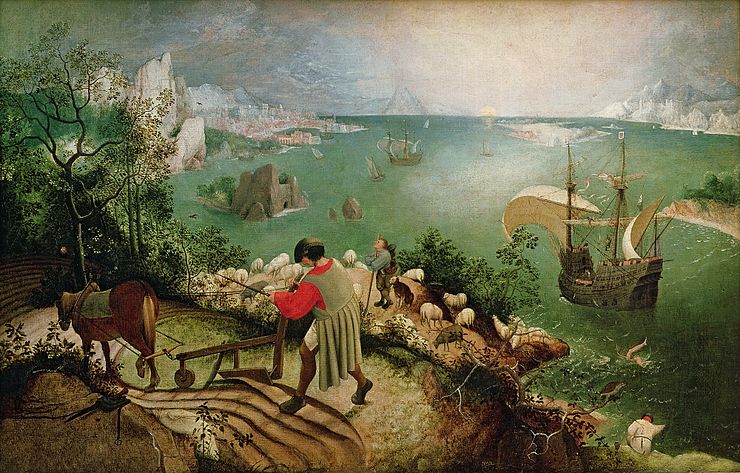
In both the poem and the painting, suffering happens elsewhere, off in “in a corner, some untidy spot” of the world distant from us. You scarcely notice the flailing legs of Icarus in the bottom right corner of the painting, your eyes drawn to the central figure of the plowman, who looks down at the ground, focused on his work. Like the speaker, he is “just walking dully along,” scarcely attending to a drama of mythical proportions unfolding beside him. “The ploughman may / Have heard the splash, the forsaken cry, /But for him it was not an important failure.” He “Had somewhere to get to and sailed calmly on”—not unlike Republican leaders today, who overlook impending disaster, focused on immediate goals of consolidating their own power. And sadly, not unlike me, who though opposed to current political trends, find it all to easy to go on with my doggy life, focused on the business of everyday life.

Auden’s poem responds to escalating political tensions and events in Europe by looking back, indirectly through art from long ago and far away, at his own nation’s response, examining the moral consequences of appeasement. And in that indirection, Auden both mirrors and critiques evasive political discourse. He doesn’t stand outside or above the problem; he acknowledges that he’s part of it. As a poet, he’s just as guilty of evasion and accommodation, finding it just as difficult to confront the political crisis directly and feeling helpless to do anything about it.

“Of suffering they were never wrong, the Old Masters”—and the old poets, too. Even as Auden acknowledges how difficult it is to remain focused and vigilant, he reminds us to pay attention. In the the familiarity of his colloquial language, the sharpness of his description, and the subtlety of his analysis, he awakens our attention. He makes us think again about the risks of appeasement and accommodation and the moral consequences of ignoring the suffering of others.

Works Cited

Chamberlain, Neville. “Radio Speech to the British People” (September 1938). The Past Speaks: Sources and Problems in British History. Volume II: Since 1688. 2nd edition. Lexington, MA, and Toronto: D. C. Heath & Co., 1993. 368-370.

“The Munich Agreement and the Anglo-German Declaration (September 1938). The Past Speaks: Sources and Problems in British History. Volume II: Since 1688. 2nd edition. Lexington, MA, and Toronto: D. C. Heath & Co., 1993. 370-71.

Filed Under: All Posts, History, Language, Poetry, Politics, Popular Culture

Make America Think Again

November 14, 2016 by Suzanne Churchill 3 Comments

I haven’t posted on this blog in months. Now that Mom’s gone and Dad’s remarried, I get an occasional urge to write, but lack the urgency.

…until this week, when the triumph of Trump convulsed me from low-grade anxiety to a fever pitch of terror and sadness. On Tuesday, November 8, 2016, I went to bed at 9:50 pm, unable to watch what already appeared inevitable. I tossed and turned in bed, my feet cramping. I tried to reassure myself that more than 50% of Americans can’t be bad or wholly wrong. I tried to breathe and adopt a mindfulness mentality and open my heart to greater trust and understanding.

Spoiler alert: none of these strategies are particularly effective at 3 a.m.

As morning dawned, I shuddered from my routine listening to NPR and reading the paper. Instead I trolled Facebook, relying on friends to direct me to articles, editorials, and blogposts that could help me make sense of this senseless turn of events.

Soon I turned to poetry. The first lines that came to mind were from W. H. Auden’s “September 1, 1939“:

All I have is a voice
To undo the folded lie,
The romantic lie in the brain
Of the sensual man-in-the-street
And the lie of Authority
Whose buildings grope the sky:
There is no such thing as the State
And no one exists alone;
Hunger allows no choice
To the citizen or the police;
We must love one another or die.

Auden wrote the poem at the outbreak of World War II, while sitting in a New York city gay bar, feeling maudlin and melancholic. Soon after publishing the poem, he disavowed it, probably because he felt embarrassed by its unabashed sentimentality and certainty. “We must love one another or die” is such a satisfying line—which is probably why Auden rejected it. It’s too gratifying. The stanza winds its way along a twisted path of physical images (“the sensual man in the street,” “buildings grope the sky”) and ambiguous abstractions (“romantic lie in the brain,” “no such thing as the State”). What does that mean? How can there be “no such thing as the State” when Fascism is marching across Europe? Never mind, the stanza rollicks to a close with its unequivocal affirmation of love, dispelling ambiguity with an easy, satisfying solution.

Although the line offers a reassuring (if guilty) pleasure in a time of dramatic uncertainty, it’s not the one I was drawn to. The words that echoed in my head were: “All I have is a voice / To undo the folded lie.” I felt lost, afraid, and powerless, and these lines suggested a way forward, encouraging me to speak out and undo the folded lies of racism, sexism, xenophobia, and bigotry.

Auden probably would cringe at such an earnest embrace of his words. He was a poet of ambivalence, as driven by political conviction as he was by skepticism about the poet’s ability to effect change. “For poetry makes nothing happen,” he famously declared in his poem, “In Memory of W. B. Yeats.”  People love to quote that line as an unequivocal disavowal of poetry, but they neglect what comes after:

For poetry makes nothing happen: it survives
In the valley of its making where executives
Would never want to tamper, flows on south
From ranches of isolation and the busy griefs,
Raw towns that we believe and die in; it survives,
A way of happening, a mouth.

Sure, “poetry makes nothing happen,” especially in the modern age. It doesn’t launch a thousand ships or incite countries to war. Yet “it survives, / A way of happening, a mouth.” Poetry is an ongoing response to loneliness (“ranches of isolation”) and loss (“busy griefs”). It doesn’t make things happen, but helps us live through their happening. It’s “a mouth” that enables us, literally, to come to terms with the chaos of our lives and extract meaning from the wreckage.

By Saturday morning, my terror had abated to a stunned recognition that the world hadn’t, in fact, ended. Undocumented people hadn’t been rounded up, marriage equality and reproductive rights hadn’t been revoked, and international environmental protections hadn’t been retracted. But all this could happen, and probably will, when Trump takes office. And who knows what will happen in terms of international diplomacy? How long will it take Putin, Kim Jong-Un, or IS to provoke Trump into flexing his military muscles? Two of our sons are already registered for the draft and the other is only 3 years from having to do so.

I drove the boys to a soccer tournament. After the game, we went to iHop, along with seemingly half the population of Rock Hill. It was a diverse crowd of diners, all eating piles of pancakes in harmony, seemingly indifferent to the imminent apocalypse. I thought of another Auden poem, “As I Walked Out One Evening“:

‘O look, look in the mirror,
   O look in your distress:
Life remains a blessing
   Although you cannot bless.

‘O stand, stand at the window
   As the tears scald and start;
You shall love your crooked neighbour
   With your crooked heart.'

In Auden’s homoerotic codes of desire, “crooked” signals homosexuality. What makes this poem resonate for me today is that it still has that valence, and also connotes “crooked Hillary.” The lines also remind me to try to love even those neighbors whose attitudes and beliefs I find truly crooked—the Trump supporters. And that’s a taller order.

Lest you think you’ve come to some reassuring and satisfying conclusion about loving thy neighbor, bear in mind that Auden gives those lines to the clocks that “whirr and chime.” Can we really trust mechanical instruments to teach us how to live humane lives? Auden maintains an ironic distance from any certainty that love trumps hate.

We should be wary, too. We should be skeptical of the calls to move beyond the divisiveness of the campaign, to join hands in unity and remember that “good people voted for Trump.” Undoubtedly, good people did vote for Trump, people who were not consciously motivated by racism or sexism, and who believed they had good reasons for voting for Trump. They must have believed that their reasons were more important than resisting racism, sexism, bigotry, bullying, greed, and ignorance. They didn’t support racism. But they also didn’t have to think about it. Maybe they were sick of thinking about it.

Here’s where I’m haunted by another poem, Claudia Rankine’s Don’t Let Me Be Lonely: An American Lyric. Rankine began the poem as a critique of the Bush administration (2000 – 2008). In lyrical prose, she reflects on how it feels to live in a country whose optimism for the future is greater than its concern about racism in the present day:

Cornel West makes the point that hope is different from American optimism. After the initial presidential election results come in, I stop watching the news. I want to continue watching, charting, and discussing the counts, the recounts, the hand counts, but I can­not. I lose hope. However Bush came to have won, he would still be winning ten days later and we would still be in the throes of our American optimism. All the non-reporting is a distraction from Bush himself, the same Bush who can’t remember if two or three people were convicted for dragging a black man to his death in his home state of Texas.
/
You don’t remember because you don’t care. Some­times my mother’s voice swells and fills my forehead. Mostly I resist the flooding, but in Bush’s case I find myself talking to the television screen: You don’t know because you don’t care.
/
Then, like all things impassioned, this voice takes on a life of its own: You don’t know because you don’t bloody care. Do you? 
/
I forget things too. It makes me sad. Or it makes me the saddest. The sadness is not really about George W. or our American optimism; the sadness lives in the recog­nition that a life can not matter. Or, as there are billions of lives, my sadness is alive alongside the recognition that billions of lives never mattered…

When I think about all those good people who voted for Trump, a voice swells and fills my forehead: “You don’t know because you don’t care. Do you?” You don’t have to care about racial injustice because you are white. You don’t have to care about undocumented people because you are lucky enough to be a citizen. You don’t have to care about the prison industrial complex because you’re not likely to be stopped, frisked, arrested, or jailed. You don’t have to care about marriage equality because you don’t stand to lose the 15 federal benefits of legal marriage, including parental custody and next-of-kin status. You don’t have to care about environmental protections because you can afford to water your lawn and turn up your AC.

As a white, documented, cis-gendered, legally married American citizen, homeowner, and professor with tenure and health insurance, I don’t have to care either. As my Republican brother reminds me, I also don’t have to worry about unemployment, stagnant minimum wage earnings, or diminishing career prospects, which are the genuine concerns of the white working class voters who helped elect Trump. These people aren’t stupid, and they have real fears about the future and legitimate gripes about the way they’ve been ignored. But are their diminished economic prospects a result of undocumented workers streaming in from Mexico, or of a widening gap between the very wealthy and the rest of Americans? Will lower taxes, the repeal of Obamacare, and a Great Trump Wall really help them?

I don’t know the answers. “I forget things too.” But I cannot forget and will not forget my sadness that billions of lives don’t seem to matter. I will not join hands and cooperate or compromise with policies that do further damage to the lives of the most vulnerable members of our society.

All I have is a voice to undo the folded lie that the rhetoric and policies touted by Trump will “Make America Great Again.” Last night, a candidate for a new, joint tenure track position in Africana Studies and English offered an alternative slogan, which he learned from a student: “Make America Think Again.” Poetry may make nothing happen, but it does make us think. So maybe it can help us make America think again.

If you disagree with me, please comment. Think out loud.

P. S. If you want to read some more poems that speak to our current predicament, check out the ones Austin Kleon gathers in this week’s newsletter, especially Emily Dickinson’s “We Grow Accustomed to the Dark,” Langston Hughes’ “Evil,” and Maggie Smith’s “Good Bones.” 


Filed Under: Language, Poetry, Popular Culture

On MindFULLness

May 26, 2015 by Suzanne Churchill Leave a Comment

Experts argue that we don’t read online: we skim, scan, or surf. This is mostly true for me. I prefer a book to a webpage, especially if I want to get absorbed in what I’m reading. When I read online, I have a harder time staying focused. My sabbatical project is an attempt to design a digital environment that can sustain close and deep reading. I’ve found a few websites that give me hope that it’s possible.

BrainPickings logoOne of the first websites that was able to grab and hold my interest was Maria Popova’s BrainPickings.org. Popova is a librarian by training and a reader by nature. In this blog, which really isn’t like any other blog I’ve encountered, she guides you on a journey through books she has read, serving up generous samples, explaining the ingredients that make them so scrumptious, and making you crave the book—dare I say, priming you for consumption, since the hyperlinks to Amazon.com and my Amazon Prime account make resistance futile.

As you read about one book, teasers appear in the left sidebar, whispering in your left ear, “you might also like…” And indeed, yes, I would like that book, and the next one, too. Gorging is easy on Popova’s site, which is exquisitely designed. I don’t care for the highlighter yellow and black color scheme, but it works, directing my attention to the right places, in the right order, so that while I can easily get lost in the ideas, I never get lost or stranded on the site.

I assumed Popova simply had great taste in books, a knack for identifying the best bits, and good web design skills. But after listening to the podcast of her interview with Krista Tippett on On Being, I realized that the book magic she works online isn’t simply the product of good taste: it’s the work of a great writer. Popova is astonishingly articulate, perceptive, and wise.

In response to Tippett’s invariable opening question, “was there as spiritual background to your childhood,” Popova replies without missing a beat:

I grew up with an attitude toward religion that can best be described as a cautious curiosity as a child. And then befitting the teenager’s typical distaste for nuance, it evolved into contemptuous curiosity.

To come up with such a pithy blend of alliteration, parallel structure, and self-deprecating insight to describe any aspect of my childhood would take me hours of painstaking revision (I’ve already revised this awkward sentence 5 times).

Popova spontaneously generates aphorisms that you can chew on for days, like: “critical thinking without hope is cynicism. But hope without critical thinking is naïveté.” She says she tries to “live in this place between the two,” but part of the pleasure of BrainPickings is that, even as it sharpens your critical faculties, it tips the scales toward hope. Popova leans toward hope in the interview, too. Reflecting on the news media’s penchant for horror, she says:

…Yes, people sometimes do horrible things. And we can speculate about why they do them until we run out of words and run out of sanity. But evil only prevails when we mistake it for the norm. And yet, the currency of news journalism is making it the norm.

Popova defies this norm, saying “to me, there is so much goodness in the world. And of course, we just kind of have to show up for it and refuse to leave.” BrainPickings refuses to leave no good stone unturned, especially when it’s inscribed with wisdom.

Reminiscing about her great grandfather, whom she met only through the “extraordinary” marginalia he inscribed in the English books he smuggled into Bulgaria, Popova says she felt a “strange kinship” with him—an attraction to “this sort of intellectual dance with another mind that you could see in the margins of his books.” This “intellectual dance with another mind” is what BrainPickings lets you see. It goes a step further and invites you to join the dance, demonstrating the steps so well that you naturally slip into a rhythm of deep and satisfying reading, feeling as graceful, articulate, and perceptive as Popova herself.

Listening to Popova made me want to be more like Popova. I mentally resolved to start a private blog of my own reading, a choreographic record of my intellectual dance with other writers. It would be, I imagined, a practice of mindFULLNESS. Rather than the mindfulness of meditation, in which you seek to empty your mind in order to be fully present in the sensations of the moment, I would record the FULLNESS of my mind just at the moment I finished reading something. I could visualize the posts—a string of endless glass beads, stretching out into the days ahead.

Then, I spent the next eight hours procrastinating, avoiding writing about the ways in which Popova’s words had inspired me. I took a shower, rode my bike to the office, replied to overdue email, including the one from a PhD student in India inquiring about little magazines and addressing me as “Dear Sir,” and the one from the scholar from New England, who asked me about research I’d done for my dissertation, 20+ years ago. I drove 2o minutes to  J. M. Alexander Middle School to get Zac after his E.O.G.’s, only to learn that early dismissal would be unexcused, and anyway, I’d forgotten my wallet, so I didn’t have any ID (a fact I couldn’t admit because there was a policeman behind the front desk, and I still had to drive home). I drove home, sticking to back roads and the speed limit. I even wrote three thank-you notes.

But here I am, refilling my mind with words I’d relished while listening to Popova and walking the dog this morning. We got back home just when Krista Tippett asked her the question that’s at the core of my sabbatical project: “do you have hope and confidence in the Internet, in our technology as a place where — perfection is a big word — but where the human spirit can be cultivated and deepened?”  Popova replied, “Well, the thing to keep in mind is that this is such a young medium, you know?”

I paused the podcast—eager to come back to it tomorrow.

Filed Under: Books, Language, Popular Culture

Favorite books for summertime reading

June 25, 2014 by Suzanne Churchill 1 Comment

Mary Cassatt. "Nurse Reading to a Little Girl." 1895. Pastel.
Mary Cassatt. “Nurse Reading to a Little Girl.” 1895.

It’s summertime, so my blog productivity has slowed as the thermometer inches into the 90s. Davidson College asked for Summertime Reading Picks, and since I managed to come up with a few, I thought I’d post them here to generate the specter of activity. But don’t be confused by Cassatt’s lovely pastel drawing (left): the books recommended here are not suitable for reading aloud to small children!

Irene Nemirovksy, Suite Francaise. A historical novel that was interrupted by history, Suite Francaise depicts the Nazi occupation of France with the richness and density that hearkens back to Tolstoy. Nemirovksy, a Russian-born Jew who converted to Catholicism when she married a Frenchman, worked on the novel up to the day she was arrested and sent to Auschwitz. The manuscript was preserved by her two daughters, who survived the war hiding in various convents. The English translation includes heartbreaking letters from Nemirovsky and her husband after her arrest, vainly attempting to secure her release.

Anything by British novelist Kate Atkinson. My favorite is her debut novel, Behind the Scenes at the Museum, a serio-comic tale of family inheritances and (mis)fortunes that taps into the tradition of Dickens’ Great Expectations. Atkinson’s When Will There Be Good News, one of a series of mysteries starring the endearingly defective detective Jack Brodie, is a great beach read. With enough references to Jane Eyre to make you feel literary, it is a page turner that’s hard to put down—a kinder, gentler (and more genuinely feminist) Girl With Dragon Tattoo. You have the plucky heroine beseiged by malevolent male predators, but the narrative excitement does not derive from scenes of salacious sexual torture.

Just after returning from a faculty trip to Russia last month (I blogged there instead of here), I happened to pick David Benioff’s City of Thieves off a bookstore shelf. “Oh, that’s a good one,” said the friendly proprietor, “It’s about the German seige of Leningrad in WWII.” Which was exactly the topic I’d come home wanting to learn more about! Turns out Benioff is the head writer of the HBO series Game of Thrones, so he knows how to put together a good story. He’s done his research, and though I don’t know how historically accurate some of the details are, I found the characters compelling and their exploits just far-fetched enough to stretch my imagination and make me believe. Another good book for the beach or plane ride.

Filed Under: Books, Popular Culture

The Fountain of Bakhchisarai

May 30, 2014 by Suzanne Churchill Leave a Comment

Russian ballet

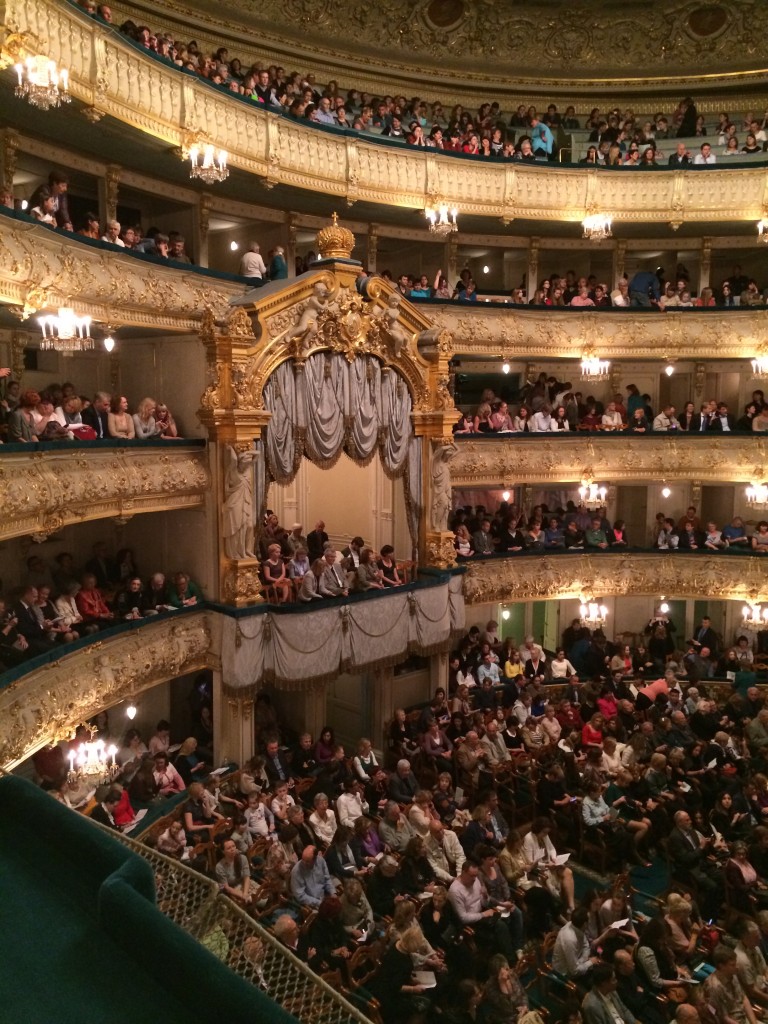
We saw “The Fountain of Bakhchisarai” at the Mariinski Theater in St. Petersburg, a ballet based on an 1823 narrative poem by Pushkin. The ballet debuted in 1934 in the same theater, which was then called the Kirov (and St. Petersburg was called Leningrad).  Alison, Mark, and Shaw have already posted vivid descriptions of the opulent theater and the gorgeous ballet. I’m adding on in an attempt to capture a thought-provoking conversation with Alison the next day. One of the great benefits of traveling with Davidson professors is that you get to reflect on what you see, augmenting your impressions with their rich insights and diverse perspectives.

Alison raised the question of why this particular Pushkin story was revived in 1934, during Stalin’s rule. What was it about the story that resonated in 1934?

The ballet begins with a scene of a sultan wracked in grief. It then dramatically shifts to a European palace, where a nobleman is hosting a ball to celebrate the engagement of his beautiful daughter Maria to the dashing young Vaslav. The festivities are interrupted by an attack by Tartars, who murder all the aristocrats and kidnap Maria, whisking her back to their Oriental palace.

Naturally, the sultan, Khan, is transfixed by Maria’s pure, celestial beauty, and immediately loses all interest in the erotic charms of Zarema, his harem favorite. Zarema stabs and kills Maria in a jealous rage. Khan, unable to bring himself to kill Zarema, has his minions push her over the walls of the palace. The ballet concludes where it began, with the sultan wracked in grief over the loss of his beloved.

There’s no obvious political allegory here, and the story can simply be interpreted as an Orientalist fantasy in which the Occident celebrates its own moral superiority by depicting the erotic excess and violent brutality of the Orient. Even though the ballet delivers this predictable lesson, however, it also exalts the sultan as a powerful ruler who controls, kills, and suffers. We are invited not to critique the sultan, but to marvel at his power and grandeur and to weep at his suffering. Perhaps in 1934, the ballet sent a message to the audience that a great leader suffers even more than the people he executes. In this way, the ballet’s powerful, mysterious, tragic aura may have helped consolidate and ennoble Stalin’s authoritarian rule.

Of course, it’s also possible that the ballet was produced not for any political resonance at the time, but because of the timeless popularity of Pushkin. As Amanda has explained, Russians have tremendous reverence for their great authors, who never seem to go out of print or production. Every square in Moscow seems dedicated to literary giant, with fresh flowers laid upon their statues.

When we asked Anatoly Smeliansky, the president of the Moscow Art Theater, why Bulgakov was so popular right now (we saw a play adaptation of his work at an artsy small theater, and the Moscow Art Theater had two of his plays in their current season), he explained that Bukgakov’s work was banned in the late 1930s, but revived in the 1960s and has been continuously popular since. There was no political reason for the current string of Bulgakov plays running in Moscow. It wasn’t that Bulgakov’s plays speak to the current moment, he implied, but that they speak to all times.

Filed Under: All Posts, Popular Culture, Russia Trip 2014

Women and Self-Fashioning in Moscow

May 23, 2014 by Suzanne Churchill 2 Comments


Amanda had warned us that women in Russia tend to dress up and dress fashionably. When we first got to Moscow, I didn’t notice the difference, because I was distracted by the wide variety of fashion, ranging from elegant dresses to jeans and even shorts. I couldn’t detect any dress code. But the more I people-watched, the more I was struck by the care and attention the women devoted to fashion and grooming.

The high standards were most clear at MGIMO university where the halls and classrooms were filled with young men and women. While the young men dressed well, the women were positively stunning, many wearing what I would call party dresses. Their makeup was exquisite. Most popular was the carefully lined “cat’s eye,” with the upturned curve at the outer corner of the upper lid, extending the lashes and widening the eyes. Shoes ranged from dainty ballet flats to strapping stilettos.

Back on the streets and metro of downtown Moscow, I realized that nearly every woman I saw, no matter how casually or formally dressed, appeared to have devoted a great deal of time and attention to her clothing, make-up, and hair.

Among women, grey hair is almost non-existent. Shelley and I have both had women who weren’t much younger than we are give us their seats on the metro. Call it vanity, but I could only conclude that they thought we were much older because of our grey hair. When I told Kristi my theory, she thought I said that they gave us their seats “because we have great hair.”  The look of perplexity on her face lasted only until we both dissolved in laughter. Later, when Shelley and Kristi both scored a seat on the metro, I told them they had great hair.

But I digress… Back to the Moscow women, who have great (not grey) hair… Whether the look is catwalk, corporate, goth, or gamine, it is decidedly feminine.  Like grey hair, androgyny has no place in Moscow.

Women seem to have plenty of freedom: they walk on the streets, in the metros, and through the halls of the university. They wear high heels, low heels, and sneakers. They bare cleavage and curves, or cover up. They travel alone and in pairs, with and without men and children (but mostly without). But despite their freedom of movement and wide range of stylistic choices, I can’t help feeling like the standards of femininity are limiting.

imageThis sneaking suspicion surfaced today during our tour of the Tretyakov State Gallery of Russian art. We looked at art spanning the 12th through the 19th century. Every work our guide directed our attention to was painted by a man. When at last we entered the early 20th century wing, just as we were leaving a room, Amanda pointed out a painting that was done by a women. It was a self-portrait by Z. Serebryakova, entitled “At the Dressing Table” (1909). The painting seemed surprisingly bold and modern, yet also distinctly feminine.  Was it celebratory or ironic? Her expression is coy; the hairpins are preposterously oversized. I don’t know enough about Serebryakova (our guide didn’t mention her), or about Russian women, to come to any  conclusion.

Filed Under: Popular Culture, Russia Trip 2014, Selfhood

“Everybody is wrong”

May 23, 2014 by Suzanne Churchill 2 Comments


In the weeks prior to our trip to Russia, the political crisis in Ukraine was front page news.  US coverage of the tensions between Russia and the Ukraine led me to believe that:

  1. Most Ukrainians desired independence from Russia.
  2. Aside from right-wing hard-liners, most Russians were (secretly) aghast at Putin’s despotic machinations (even if they are afraid to admit it publicly).
  3. Russians were as preoccupied with the East-West conflict as we were, if not more anxious and dismayed.

Now that I’ve been in Moscow for a few days, I get the sense that the Russians aren’t nearly as concerned about the US as the US is about the Russia, and they fear chaos much more than they fear Putin.

We first met with Russian businessman who is a Davidson alum.  When we asked his opinion on the Ukraine situation, he said,

Look, there’s no right or wrong in this situation. Everybody’s wrong.

In his view, political situations always complicate business transactions, and business is always political. The current crisis was no more critical than any other. The important thing was getting the deal done.

Later, on our tour of the Kremlin, our guide explained the four party system in Russia, explaining that two of them exist to create the illusion of democracy. “But we don’t have democracy in Russia,” she said cheerfully.

imageWe’ve also encountered evidence that plenty of Russians are quite content with the situation.  A dean at the university we visited (MGIMO) shrugged off our concerns, saying, “Everyone knows Crimea has always been a part of Russia.” In the theater district, next to the theater once famed for its political radicalism, was a huge billboard celebrating “Crimea and Russia, Together Forever.” Meanwhile, cars and busses sped by, and people passed without a glance.

Wherever we go and whomever we talk to, I get the sense of “business as usual.” The locals are aware of what is going on politically, but not particularly concerned, as long as it doesn’t disrupt the business of their lives.  Irina and Amanda explain that Russians remember all too well the economic collapse and deprivations after the dissolution of the Soviet Union in 1991. No one wants to return to that kind of “free state,” in which no one can afford anything. A strong ruler like Putin is preferable, even if “we don’t have democracy in Russia.”

Today we toured the Tretyakov Gallery of Russian art.  Our tour guide displayed the same cheerful cynicism, as he linked the habits of former rulers like Ivan the Terrible to more recent heads of state.  Even though Ivan the Terrible didn’t have the nationalist vocabulary, our guide said, he was the first to commission blatantly self-serving political propaganda. Our guide then directed our attention to an “impudent” painting depicting Ivan and his troops being welcomed into the gates of heaven (the panoramic scene naturally omitted any reference to the roughly 20% of the population Ivan had killed during his rule).

Later, in the 19th century wing, the guide directed our attention to a painting by Perov (aka Nikita Pustosvyat), called “Dispute About Faith.” The painting depicts the Schism between the old believers and the new believers in the Russian Orthodox Church.

Perov, “Dispute About Faith”

imageThe queen-like figure on the upper left who looks fearful and aghast is Sophia, the sister of Peter the Great. Neither she nor the other aristocratic figures on the left side of the painting look very sympathetic. Their stern faces and elegant clothing hardly make them seem like noble keepers of the faith. But the bearded rebel in the center of the painting, presumably the radical reformer, looks pretty crazy–not like a prophet I’d want to stand behind. And the people on his side don’t look very comfortable there either.

As I studied this painting, trying to figure out whose side Perov was on, it occurred to me that maybe he’s not worried about who is right and who is wrong, because he knows “everybody’s wrong.” Americans (like me) look for heroes and villains in history, but maybe Russians adopt a different perspective, in which the divisions aren’t so stark. Maybe for them, the greatest danger is neither the ruler nor the reformer, but the chaos that can come between them.


Filed Under: Popular Culture, Russia Trip 2014

Microaggressions and the Need to Know More

April 13, 2014 by Suzanne Churchill 1 Comment

Microaggressions are in the news, nationally and locally. In a recent New York Times piece, “Students See Many Slights as Racial ‘Microaggressions,'” Tanzina Vega describes microaggressions as “the subtle ways that racial, ethnic, gender and other stereotypes can play out painfully in an increasingly diverse culture.” The concept isn’t new. It was developed in the 1970s by Dr. Chester M. Pierce, a professor of education and psychiatry at Harvard University, to describe the “subtle, cumulative miniassault that is the substance of today’s racism” (qtd by Brockenbrough).  Common parlance among social scientists and critical race theorists, microaggressions have recently spread from the higher echelons of academic discourse into the mainstream, causing a stir even in the bubble of tranquility that is Davidson College.

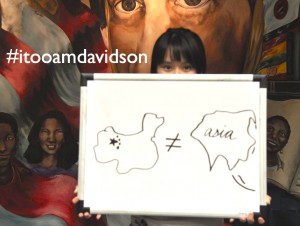
tumblr_n2yc7hTiIr1tw512jo1_1280Inspired by a Tumblr blog at Harvard University, students here have created their own Tumblr, I, Too, Am Davidson (echoing Langston Hughes’ “I, Too, Sing America“). Standing in front of the new mural depicting the College’s multicultural history, they hold signs citing microaggressions like, “After a party, the police stopped me and said, ‘Hurry up and get to your car and go back to your school.'”

Microaggressions may elicit shock, disbelief, anger, isolation, alienation, fear, shame, or any combination thereof. But as poet Claudia Rankine observed in her recent talk at Davidson, a victim’s response is often delayed. The immediate reaction tends to be silence.

Rankine explores this effect in her latest work, Citizen, a documentary prose poem that collects microaggressions from her own experiences and from interviews, such as this one:

You are in the dark, in the car, watching the black-tarred street being swallowed by speed; he tells you his dean is making him hire a person of color when there are so many great writers out there.
You think maybe this is an experiment and you are being tested or retroactively insulted or you have done something that communicates this is an okay conversation to be having.

Rankine uses the second-person “you” to put you, the reader, in the place of a microaggression victim. The use of “you” isn’t just a strategy for arousing empathy, however; it is also symptomatic of psychological alienation experienced by the victim who, instead of responding to the offender, goes silent, turning inward and questioning herself.

Rankine’s goal, she said, is to shorten the response time—that is, to offer language that may empower people to respond immediately and vocally to microaggressions, in order to promote healing and understanding.

In seeking to break the silence, Rankine’s experimental poetry is like the microaggression blogs (even if it doesn’t get as much internet traffic). Vivan Lu, co-creator of The Microaggressions Project, says the blog “gives people the vocabulary to talk about these everyday incidents that are quite difficult to put your finger on” (qtd by Vega). The blog testimonials are empowering acts of witnessing and protest: they allow people to assume ownership of damaging remarks, to reframe them, and to reverse the target. Contributing to a Tumblr may also replace feelings of marginalization and alienation with a sense of belonging to a community.

Athough these Tumblr sites are beneficial for the contributors, however, it’s less certain how much good they do for broader public discourse about race. Vega reports, “What is less clear is how much is truly aggressive and how much is pretty micro — whether the issues raised are a useful way of bringing to light often elusive slights in a world where overt prejudice is seldom tolerated, or a new form of divisive hypersensitivity, in which casual remarks are blown out of proportion.”

The concept of microaggression, by definition, does not imply intentional hostility or conscious racism. In Psychology Today, Derald Wing Sue and David Rivera define microaggressions as, “the brief and everyday slights, insults, indignities and denigrating messages sent to people of color by well-intentioned White people who are unaware of the hidden messages being communicated” [emphasis added]. Nevertheless, the term can lead to misunderstandings, in that it connotes aggression on the part of the microaggressor. From the Latin aggredi for “to attack,” the term aggression, even when miniaturized, doesn’t seem to allow for bumbling curiosity or hapless ignorance. For people unfamiliar with the social scientific definition who perceive themselves as implied offenders, the term microaggression may arouse defensiveness. “I hate the term microaggression,” I heard someone say, “it is itself a microaggression.”*

Which raises the question: are microaggressions reversible? This is a version of the controversial topic of reverse racism. My colleague Hilton Kelly, Associate Professor of Education Studies, who teaches courses on critical race theory, defines racism as “a system of advantages based on skin color.” He distinguishes racism from prejudice, the personal belief that one race is superior to another. Since racism is about deep-seated power inequalities, Kelly argues, it can’t be easily reversed. He offered the example of a white woman going to black nightclub, but feeling unwelcome and overhearing hostile remarks about her presence. Is this reverse racism? No, because the system still favors the white woman. As soon as she steps outside, who’s on her side? Whose side is the police and criminal justice system on? There may be prejudice the black nightclub, but it’s not racism unless it’s reinforced by a system of advantages based on skin color.

Okay, I said, but let’s take a local example: what about a black fraternity here at Davidson that won’t accept a white student? Kelly replied: “I’d need more information to respond to that question. For instance, I’d need to know, why is it that no one has asked the same questions about similar practices by white fraternities that went on for decades?” That’s not just a good point, I think; it’s good practice: ask for more information. Like racism, microaggressions aren’t reversible, but asking for more information is.

In my class the next day, when we’re scheduled to discuss Rankine, racism, and microaggressions, we start with an experiment. We stand in a circle and first identify our “triggers”: those remarks, attitudes, or behaviors that arouse anger and defensiveness, and shut down conversation about racism. Then we go around again and identify, “openers”: remarks, attitudes, or behaviors that encourage us to talk openly with each other. After we finish, one student observes:

Isn’t it interesting that our triggers are all different, but our openers are the same?

It’s a profound moment. Wow, I think, we’ve done it: we’ve broken through to a way we can talk openly about racism at Davidson.

Not so fast. A student raises the issue of affirmative action, asking if it is racist for positions to be taken away from whites and given to minorities. “Hmm,” I say, echoing Kelly: “I’d need more information to know if that’s racism. For instance, I’d need to know, why is it that no one complains about how many places were taken away from minorities and given to whites over the decades?”

“Good point,” someone murmurs.

The point isn’t mine, of course, and neither is the practice. But it is a good one. Instead of getting angry, try saying: I need to know more.

Take this example from the Davidson Tumblr, where a student makes the reasonable request, “Please stop asking why I can’t tolerate spicy food.” Presumably she’s been asked countless times, “Why don’t you like spicy food?” And she’s understandably annoyed by the question. But let’s reimagine that irritating encounter by applying Hilton Kelly’s approach:

— “Why don’t you like spicy food?”

— “That’s an interesting question. Why do you think I would like spicy food?”

— “Because you’re Asian.”

— “Asia’s a big, diverse continent. I wonder if tastes are consistent across any continent. Do you think North Americans like bland food?”

Is this approach putting more burden or responsibility on the minority? Maybe. But it’s also “shortening the response time” and giving everyone, including minorities, an opportunity to get beyond anger, and come to a greater understanding of the triggers that divide us and the openers that can bring us together.

And who knows? Maybe someday somebody will start a Tumblr, #NeedToKnowMore.


*The person who made this statement preferred not to be named, believing that openly expressing skepticism about the term microaggression would only incite more anger and resentment. This fear of reprisal reflects the polarizing effect the term can have: in this case, it foreclosed conversation.

Works Cited:

Brockenbrough, Ed, Ph.d. “Microaggressions: Conceptual Foundations.” Warner Graduate School of Education, Rochester University. Dec. 3, 2010. Accessed April 21, 2104.

I, Too, Am Davidson. Tumblr Blog. Accessed. April 13, 2014.

Kelly, Hilton. Personal Conversation. Summit Coffee House. Davidson College. March 20, 2014.

Sue, Derald Wing, Ph.D., and David Rivera, M.S. “Racial Microaggressions in Everyday Life.” Psychology Today. Published Oct. 5, 2010. Accessed April 21, 2014.

Vega, Tanzina. “Students See Many Slights As Racial Aggressions.” NewYorkTimes.com. May 21, 2014. Accessed April 13, 2014.

Filed Under: Language, Poetry, Popular Culture

  • Page 1
  • Page 2
  • Go to Next Page »

Copyright © 2026 · Infinity Pro on Genesis Framework · WordPress · Log in