• Skip to main content

Suzanne W. Churchill

  • DH Scholarship
    • Mina Loy
    • Gwendolyn Bennett
    • Modernist Magazines
  • Teaching
    • Recommendation Requests
    • Reading Tips
    • Secondary Source Reports
  • Writing
  • Painting
  • About Me
    • C.V.

Suzanne Churchill

You Don't Get What You Pay For

October 21, 2014 by Suzanne Churchill 4 Comments

One thing we’ve learned about Alzheimer’s care is that you don’t get what you pay for. Quality of care doesn’t correlate to cost of care.

For instance, my Mom was getting excellent care in the assisted living wing of the retirement village she lived in, a few buildings away from my Dad’s apartment. The facilities were lovely: she had a spacious, private room with an elegant seating area composed of Aunt Opal’s Queen Anne furniture. The staff was friendly and supportive, offering daily activities and keeping the place and residents clean and comfortable.

Despite the good care, in less than six months, Mom started falling. One of these falls happened when she was trying to stand up from a chair to her walker. She fell on her knee, fracturing her femur at the hip joint. From there, she went to the hospital, to surgery, and to the rehabilitation wing for physical therapy, costs mounting every roll of the wheelchair.

In physical therapy, she failed to make enough progress for the doctor to clear her for weight bearing activities, so in one of the great ironies of advanced modern medical care, the staff stopped exercising her, and the insurance company refused to pay for any more physical therapy.

Mom was left to lie in bed or lifted to sit in a chair. I don’t have photos from this hospital stay, but my sister’s report etched a vivid mental image of Mom slumping, bra-less in a loose shirt and stretch pants, her hair unwashed,  no makeup or jewelry, listless and incoherent. For my mother, who always cared so much about appearances, her unkempt state must have been viscerally disorienting. She could not have felt like herself. The physical inactivity further assaulted her cognitive functions, since, according to my friend and colleague Dr. Kristi Multhaup, an expert in the psychology of aging, the single most important thing you can to do improve cognitive functioning is to get aerobic exercise.

Fortunately, my watchdog Dad intervened and managed to get her more physical therapy. Eventually, she was approved to move back to the assisted living wing—provided that he hire a private caretaker to assist her 24/7, which would make the total cost of her care $20,000 a month. Obviously, this was untenable.

Never fear, the retirement facility assured us, we can offer a more affordable option: a quad room in the nursing wing could be had for a mere $12,000 a month. Even if we could afford this option, the idea of my Mom sharing a room with three strangers in a dreary facility whose halls smelled faintly of urine was appalling. Dad considered moving her back into his apartment. My sister and I pounced on that idea like two lionesses competing for the kill. No way.

10710561_4824328502323_3763052288889681166_n Then someone told Dad about another facility, Arden Courts, a  home for people with dementia in Hamden, Connecticut, about 20 minutes away and, coincidentally, across the street from Whitney Center, where my godmother Millie Reilly lived out her last days with Alzheimer’s. In this cheerful, clean, smaller facility, Mom could have a private room for $6000/month. For less than 1/2 the cost charged elsewhere, at Arden Courts, they dress her beautifully, do her hair, encourage physical activity, and make sure she participates in other activities. Even the food is better. You can see from this picture how lovely she looks, brightening with delight at a surprise visit from my brother and her youngest grandchildren.

Mom’s situation is not unusual. According to Jane Brody, the “quality and extent of services may still vary widely” among dementia wings in nursing homes. The price also varies, in no direct relation to the quality of the services.

As good as Arden Courts is, $6000 a month is hardly a bargain rate, and we are very lucky that Mom has long-term healthcare insurance. Others aren’t so lucky: my neighbor’s cousin just visited from New Hampshire. Her mother, who has Alzheimer’s, is being cared for by her 89-year-old father. She works full time and drives 1 1/2 hours round-trip to check on them every other day. New England winter weather only makes the drive more imperative, since she must shovel their driveway so that her father, who still drives, won’t slip and fall. They have no long-term health care insurance and can’t afford the kind of care my Mom enjoys. So the other lesson Alzheimer’s teaches us is: you don’t get what you can’t pay for.

AlzheimerscostofcareThere is a gaping hole in Alzheimer’s care, and at some point, we’re going to need to address this as a society. People are living longer, and people are living longer with Alzheimer’s. We need to find ways to make Arden Courts available to all families suffering from the ravages of this illness.


Filed Under: Alzheimer's, Family Tagged With: alzheimer's, family, health care costs, quality of care

Sending Kids to College for the First Time

August 25, 2014 by Suzanne Churchill 6 Comments

Luke enters Wash U

We  just moved one of our twin sons to Washington University in St. Louis, one time zone away. In two weeks, we’ll help set up his brother at Stanford University, three time zones away.

I’m thrilled for our sons, nervous about the challenges ahead, and excited about the marvelous opportunities that lie before them.  Distracting myself with organizational tasks and preparations, I’ve managed to avoid being maudlin, morose, sentimental, and weepy (most of the time).

Letting Luke go was harder than I expected. The 12-hour drive to St. Louis was long and dull. By about hour 9, when it was getting dark and we discovered we had only had a few miles of gas left, I hit my low point. There was no gas station to be seen…nothing…for miles. No street lights… no exit ramp… no billboards… no road signs. Since I’d never been to St. Louis, my mind was a blank, too. In such a vast and empty landscape, the demons began leering and taunting, “He gave up Duke for this? He could have been less than 3 hours from home, and he chose this?” “Why didn’t you try to intervene?” “You spoiled, elitist, East coast snob, how could you even think such questions?”

Fortunately, I kept quiet in the back seat, we found a gas station, and soon arrived in St. Louis, where the city lights cast the demons back into the shadows. Next morning, we drove on campus, to be greeted by adorable, friendly students directing us to the dorms and offering to help tote the baggage. The campus was so lovely, each building more impressive than the next, that I found myself brimming with enthusiasm, delighted that Luke belonged there. I managed to keep up my spirits up right until the goodbyes, when I hugged him tight and croaked, “I love you,” turning aside to hide my tears. Luke sauntered off to join his orientation group, and I climbed in the car and sobbed.

Only for a few minutes. Since then I have (mostly) refused to indulge  in sadness and sentimentality. I’m not the first person to send off a child to a far away place, and I know how lucky I am, and Luke is, to be at Wash U, especially when only 4 miles away in Ferguson, MO, the Brown family will not be sending their son Michael to college, because he was shot and killed by a policeman a few days before his semester started.

But I’m no holier than thou. Truth is, I feel as if a cavern has been carved in my heart. It IS really hard to let your child go away, even to such a good place.  Today, exactly one week since we said our goodbyes, I’m sitting on the couch, aimlessly web surfing, failing to summon motivation to read, work, exercise, clean, or organize. Feeling maudlin, morose, sentimental, and weepy.

I look like my Mom in this photo.
I’m standing just like she would,
literally in her shoes.

In that roundabout way I come to recognize grief, I’m realizing that I’m not just grieving the separation from Luke, but also missing my Mom. I really want to call and ask her how she managed when we left for college. I never thought about how my departure affected her. I was 18, self-centered, and preoccupied with my own new adventure. When my parents drove 9 hours round-trip to deliver me to Vermont, I didn’t recognize their effort as an act of love and generosity. It was just something they had to do—their job. Dad says Mom cried in the car on the way home, and he recalls me being pretty emotional when they left me. I don’t remember being upset. “Well, maybe you weren’t,” he concedes.

I can reconstruct memories with Dad, but now that I’m a mother, I want to hear firsthand how Mom felt. I can’t ask her because she can’t remember. If she could, she’d probably tell me what everyone else who has gone through this says: it’s hard at first, but you get used to it quickly. It’s not the message itself I want, but the act of knitting my experiences to hers, of comparing patterns.

I don’t know if talking to my Mom would make letting my sons go any easier. Probably not. What I do know is that letting my sons go is a kind of loss that taps a much bigger and harder loss, one I keep grieving and then shutting away. I live 17 hours drive from my Mom. I can’t talk to her on the phone or Skype with her anymore. I keep finding reasons to delay my next visit—good reasons, like taking our sons to college—but the truth is that I’m dreading seeing her and facing her further decline. It’s easier to practice avoidance. Until something else opens the wellsprings of grief—like taking our sons to college.

Come to think of it, in this way my life is knitted to hers, inextricably, if not in the way I would choose. The happy heartache of sending Luke and Thomas to college is entwined with the slow sorrow of losing Mom to Alzheimer’s. This rite of passage knits us together in a larger pattern, as we each adjust to new independent or assisted living conditions. The heart strings that tug and ache are physical reminders of the way I’m connected to my family. They also remind me of the song, “Oh My Heart,” from REM’s album, Collapse into Now:

Hear the song rearranged
Hear the tress, the ghosts and the buildings sing
With the wisdom to reconcile this thing

It’s sweet and it’s sad and it’s true
How it doesn’t look bitter on you

Oh my heart
Oh my heart
(oh my heart)
Oh my heart
Oh my heart
(oh my heart)

Mother and father
I stand beside you
The good of this world
Might help see me through

Filed Under: Alzheimer's, Family

Favorite books for summertime reading

June 25, 2014 by Suzanne Churchill 1 Comment

Mary Cassatt. "Nurse Reading to a Little Girl." 1895. Pastel.
Mary Cassatt. “Nurse Reading to a Little Girl.” 1895.

It’s summertime, so my blog productivity has slowed as the thermometer inches into the 90s. Davidson College asked for Summertime Reading Picks, and since I managed to come up with a few, I thought I’d post them here to generate the specter of activity. But don’t be confused by Cassatt’s lovely pastel drawing (left): the books recommended here are not suitable for reading aloud to small children!

Irene Nemirovksy, Suite Francaise. A historical novel that was interrupted by history, Suite Francaise depicts the Nazi occupation of France with the richness and density that hearkens back to Tolstoy. Nemirovksy, a Russian-born Jew who converted to Catholicism when she married a Frenchman, worked on the novel up to the day she was arrested and sent to Auschwitz. The manuscript was preserved by her two daughters, who survived the war hiding in various convents. The English translation includes heartbreaking letters from Nemirovsky and her husband after her arrest, vainly attempting to secure her release.

Anything by British novelist Kate Atkinson. My favorite is her debut novel, Behind the Scenes at the Museum, a serio-comic tale of family inheritances and (mis)fortunes that taps into the tradition of Dickens’ Great Expectations. Atkinson’s When Will There Be Good News, one of a series of mysteries starring the endearingly defective detective Jack Brodie, is a great beach read. With enough references to Jane Eyre to make you feel literary, it is a page turner that’s hard to put down—a kinder, gentler (and more genuinely feminist) Girl With Dragon Tattoo. You have the plucky heroine beseiged by malevolent male predators, but the narrative excitement does not derive from scenes of salacious sexual torture.

Just after returning from a faculty trip to Russia last month (I blogged there instead of here), I happened to pick David Benioff’s City of Thieves off a bookstore shelf. “Oh, that’s a good one,” said the friendly proprietor, “It’s about the German seige of Leningrad in WWII.” Which was exactly the topic I’d come home wanting to learn more about! Turns out Benioff is the head writer of the HBO series Game of Thrones, so he knows how to put together a good story. He’s done his research, and though I don’t know how historically accurate some of the details are, I found the characters compelling and their exploits just far-fetched enough to stretch my imagination and make me believe. Another good book for the beach or plane ride.

Filed Under: Books, Popular Culture

A Final Word

May 31, 2014 by Suzanne Churchill Leave a Comment


I took a Russian literature course in college taught by a visiting professor from what was then the USSR. With an authoritarian teaching style that was a marked contrast to the American liberal arts approach I’d become accustomed to, he interrogated us with questions like, “What’s the one word to describe Raskolnikov?” A student brave enough to posit an answer was pronounced, “WRONG.” I sat in silence, fearing humiliation and fuming at the poetic injustice of a question that reduced a complex character to a single word.

Yesterday, when my son Thomas asked me to sum up my trip to Russia in a single word, I felt no such resistance.

Transformative.

I replied, without hesitation.

“Studio R” has transformed my assumptions about Russia. Until I toured Moscow and St. Petersburg, I did not realize how much my imagination was dominated by vague, grim images of Soviet deprivation; Kruschev-era, cement block buildings; soggy cabbage and pickled radishes.

In the place of these dreary images, my memory is now full of pictures of bustling, vibrant city streets; ice-cream colored buildings that blend European style with Russian folk accents; and gleaming pastries, salty cheese breads, bliny filled with red caviar and sour cream, salmon salads with citron vinaigrette, beet-wrapped goat cheese, and other sweet and savory indulgences.

image18-1024x768As in the U.S., such plenty is often juxtaposed to poverty and want (see Shelley’s post), though homelessness and panhandling were less evident, perhaps because of communal housing and aggressive policing. Prices were high, especially for clothing and material goods, and I wondered how the working class managed to get by.

The people we met were lively and vocal, offering perspectives strikingly different from my own: strange mixtures of free speech and adherence to what to me sounded like authoritarian, party-line thinking. They did not seem to feel oppressed by the state, nor obsessed by the enemy (aka the USA), but primarily concerned with making and sustaining a good, stable lives for themselves, their families, and their country.

In part because the language barrier limited my interactions with locals and in part because I was traveling with such brilliant, knowledgeable, and perceptive companions, I learned most from my colleagues.

Amanda and Irina generously and continuously interpreted the language and culture for us, helping us to understand menus, street signs, buildings, monuments, gestures, behaviors, and customs. They gave spontaneous history lessons, too, allowing us to see both transformations and connections to the past.

Shelley offered comparative political insights, with her keen insights into Russian politics and American cultural blind spots and assumptions. Kristi made me aware of the both subtle and monumental ways that individual and cultural memory operated. Shaw taught me to see the transition from stage paintings to scene paintings in the Hermitage, while Sharon taught me about Bulgakov and his contributions to Russian theater, explaining the origins and impact of method acting. Mark not only contributed to my understanding of method acting, but also navigated the streets with his trusty laminated maps and opened my eyes to the melodramatic power of the ballet when he remarked, “It’s like a silent movie!” Alison enabled me to recognize the distinctively Russian aspects of the ballet and appreciate the value of discipline and tradition.

In our casual conversations, we exchanged ideas and reactions, so that at every turn, my fleeting impressions were transformed into more substantive understanding. Studio R has given us an opportunity for learning and reflection in a relaxed yet invigorating environment. This is the best of the liberal arts tradition, and I hope it’s the beginning of many faculty enrichment trips to come. The innovation grant that funded this trip was large, but the pay off was immeasurable.

Filed Under: All Posts, Language, Russia Trip 2014

The Fountain of Bakhchisarai

May 30, 2014 by Suzanne Churchill Leave a Comment

Russian ballet

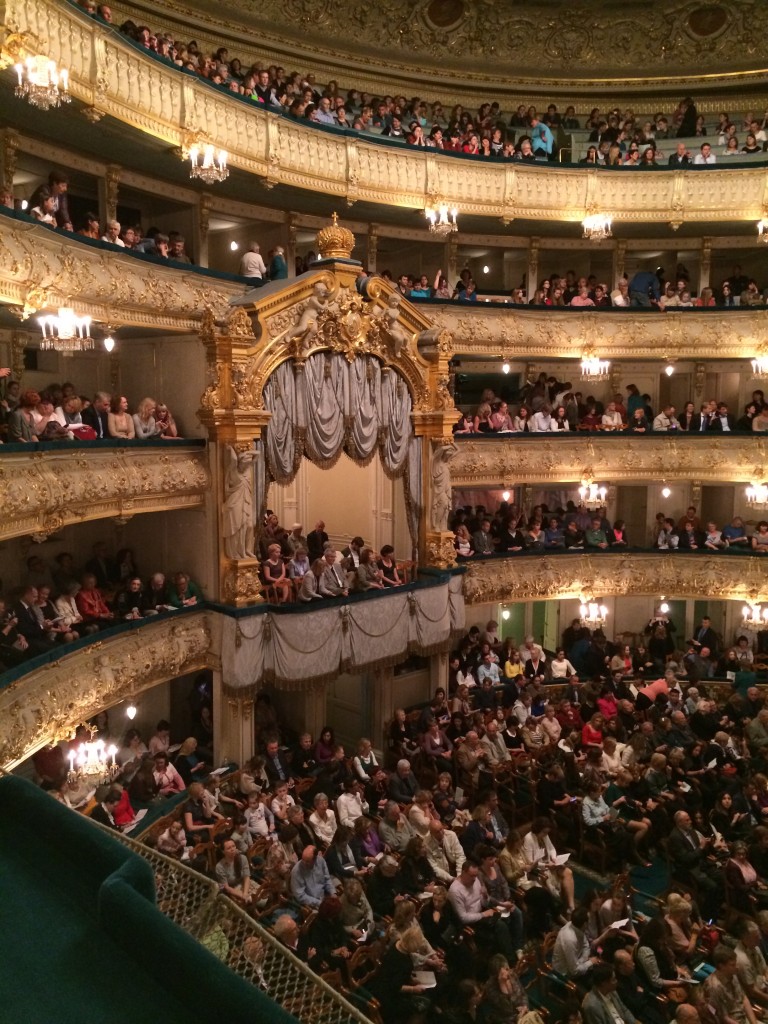
We saw “The Fountain of Bakhchisarai” at the Mariinski Theater in St. Petersburg, a ballet based on an 1823 narrative poem by Pushkin. The ballet debuted in 1934 in the same theater, which was then called the Kirov (and St. Petersburg was called Leningrad).  Alison, Mark, and Shaw have already posted vivid descriptions of the opulent theater and the gorgeous ballet. I’m adding on in an attempt to capture a thought-provoking conversation with Alison the next day. One of the great benefits of traveling with Davidson professors is that you get to reflect on what you see, augmenting your impressions with their rich insights and diverse perspectives.

Alison raised the question of why this particular Pushkin story was revived in 1934, during Stalin’s rule. What was it about the story that resonated in 1934?

The ballet begins with a scene of a sultan wracked in grief. It then dramatically shifts to a European palace, where a nobleman is hosting a ball to celebrate the engagement of his beautiful daughter Maria to the dashing young Vaslav. The festivities are interrupted by an attack by Tartars, who murder all the aristocrats and kidnap Maria, whisking her back to their Oriental palace.

Naturally, the sultan, Khan, is transfixed by Maria’s pure, celestial beauty, and immediately loses all interest in the erotic charms of Zarema, his harem favorite. Zarema stabs and kills Maria in a jealous rage. Khan, unable to bring himself to kill Zarema, has his minions push her over the walls of the palace. The ballet concludes where it began, with the sultan wracked in grief over the loss of his beloved.

There’s no obvious political allegory here, and the story can simply be interpreted as an Orientalist fantasy in which the Occident celebrates its own moral superiority by depicting the erotic excess and violent brutality of the Orient. Even though the ballet delivers this predictable lesson, however, it also exalts the sultan as a powerful ruler who controls, kills, and suffers. We are invited not to critique the sultan, but to marvel at his power and grandeur and to weep at his suffering. Perhaps in 1934, the ballet sent a message to the audience that a great leader suffers even more than the people he executes. In this way, the ballet’s powerful, mysterious, tragic aura may have helped consolidate and ennoble Stalin’s authoritarian rule.

Of course, it’s also possible that the ballet was produced not for any political resonance at the time, but because of the timeless popularity of Pushkin. As Amanda has explained, Russians have tremendous reverence for their great authors, who never seem to go out of print or production. Every square in Moscow seems dedicated to literary giant, with fresh flowers laid upon their statues.

When we asked Anatoly Smeliansky, the president of the Moscow Art Theater, why Bulgakov was so popular right now (we saw a play adaptation of his work at an artsy small theater, and the Moscow Art Theater had two of his plays in their current season), he explained that Bukgakov’s work was banned in the late 1930s, but revived in the 1960s and has been continuously popular since. There was no political reason for the current string of Bulgakov plays running in Moscow. It wasn’t that Bulgakov’s plays speak to the current moment, he implied, but that they speak to all times.

Filed Under: All Posts, Popular Culture, Russia Trip 2014

We’re in St. Petersburg

May 27, 2014 by Suzanne Churchill Leave a Comment


imageWe took the high speed train from Moscow to St. Petersburg this morning. Maybe it was the smooth traveling, the precipitous drop in temperature (from high 80s to high 40s), or the delicious lunch we had a cafe Amanda took us to when we got here, but we were quite giddy in the van on the way to our apartment. The driver told Irina (in Russian) that we were a “joyful group”: “you ladies are a fun bunch, so there are some dance clubs around here that you might want to know about.”

Despite the 4 flights of stairs and persnickety lock, we are delighted with our spacious new apartment–with two bathrooms!  We unloaded our baggage and went out to the little market across the street, where Irina picked up some meat dumplings, spicy mustard (Shelley looked at the container and said, “What’s that ham drink?”), and “Korean carrots.” She cooked us a delicious late afternoon dinner, which you can see her serving here. She’s giving us what she insists is the typical Russian expression for photos: no smile.

But if you were here, you would see lots of smiles, hear gales of laughter, and have trouble, as I am, focusing on what I’m writing in this post.

Filed Under: All Posts, Russia Trip 2014

Pushkiniana: “that’s a story”

May 27, 2014 by Suzanne Churchill Leave a Comment


Our Moscow guide speaks excellent English, with a delightfully idiosyncratic vocabulary. He speaks of “impudent” paintings and “violet” buildings in the skyline. As we approach the White House, he quips, “the closer you get to the government, the more forbidding the signs.”

He’s studied English all his life, but he acquired his marvelous vocabulary from an elderly Englishman who hired him to teach him Russian in the early 1990’s, when the USSR had dissolved and Russia was opening up to Western businesses. The Englishman would doze off shortly into the lesson. Then he would wake up from his nap and say, “Well, that’s enough for today; let’s go have a drink.” They would drink and converse about everything under the sun–in English. So the Englishman never learned any Russian: “He paid me to learn English,” our guide said, chuckling.

imageHe is also full of anecdotes, like the one he told in front of the church where Pushkin was married (there is the church, here is the steeple). Pushkin was of course brilliant, literary, intellectual, etc…, but he was also very short and not very attractive. He made the mistake of falling for a beautiful, shallow woman, who cared only about fashion and dancing at balls. Pushkin didn’t like dancing, because he was shorter than all the women. Despite their incompatible interests, he proposed to the beautiful young lady’s family, they accepted, and she was dragged reluctantly to the church.

Pushkin was normally very superstitious, but he ignored three signs that the marriage would be a disaster: [Read more…] about Pushkiniana: “that’s a story”

Filed Under: All Posts, Language, Russia Trip 2014

Moscow’s Wide Streets

May 25, 2014 by Suzanne Churchill Leave a Comment

image

Here’s picture of the building we (the women in the group) are staying in, taken from across the street. Further down, you can see the Foreign Ministry, one of the “Seven Sisters” buildings constructed under Stalin, which we affectionately call the Ministry of Magic. You can also see that the boulevard is extremely wide, with several lanes of traffic in each direction. To cross the boulevard, you have to walk to a corner with an underpass. This boulevard is one of the widest we’ve encountered, but it’s not exceptional. The streets of Moscow tend to be very wide. We thought this was odd because, until recently, not many Russians had cars. We asked our guide why the streets are so wide, and he said it was for parades. They must have had lots of parades, stretching for miles, but I haven’t seen one yet–except in a video of Red Square playing in the Museum of Contemporary Russian History. That military parade, celebrating the defeat of Germany in WWII, lasted for 8 hours–in pouring rain. I can only imaged what the boulevards looked like, with miles of officers and soldiers marching by.

Today Moscow is a huge, bustling city. It’s even harder to imagine what it looked like in the 18th century, when the establishment of St. Petersburg as the capital in 1703 reduced Moscow to a “provincial capital.” In his vivid cultural history of Russia, Orlando Figes described the character of Moscow then:

With its little wooden houses and narrow winding lanes, its mansions with their stables and enclosed courtyards, where cows and sheep were allowed to roam, Moscow had a distinct rural feel. It was called ‘the big village’–a nickname it has retained to this day. (153)

Moscow may have retained the nickname, but it doesn’t feel like a village anymore, at least not on the wide boulevards. But according to our able guide, the locals know how to find sheltered courtyards that no longer house cows and sheep, but do contain lively bars and restaurants. And last night after the theatre, we turned off Smolyenskaya Boulevard onto a side street, descending the steps into a charming restaurant that served food of the Caucuses (Georgian and Armenian). Alison had spotted it earlier because she liked the look of its sign. The waiter allowed us to sit downstairs near the open kitchen where it was less smokey, pulling together two rustic wood tables to accommodate us all. We ordered family style–khachupuri (a salty, sour, buttery cheese bread), pickles, a summer salad of fresh greens and beet-wrapped goat cheese, grilled lamb, nastoika (a thick fruit juice infusion), and Russian vodka. Our waiter was friendly and mischievous, speaking a few words of English and teaching us some Russian–teasing us when we wanted more water, because the word for “water” sounds like the word for “vodka,” which we didn’t need more of. In that setting, Moscow felt like a ‘big village,’ which may be why so many Russians feel at home here.

Filed Under: Russia Trip 2014

  • « Go to Previous Page
  • Page 1
  • Interim pages omitted …
  • Page 3
  • Page 4
  • Page 5
  • Page 6
  • Page 7
  • Interim pages omitted …
  • Page 11
  • Go to Next Page »

Copyright © 2026 · Infinity Pro on Genesis Framework · WordPress · Log in