• Skip to main content

Suzanne W. Churchill

  • DH Scholarship
    • Mina Loy
    • Gwendolyn Bennett
    • Modernist Magazines
  • Teaching
    • Recommendation Requests
    • Reading Tips
    • Secondary Source Reports
  • Writing
  • Painting
  • About Me
    • C.V.

Suzanne Churchill

1998 Holiday Letter

December 13, 2013 by Suzanne Churchill Leave a Comment

December 1998

Dear Family and Friends,

I almost didn’t think I’d get around to writing a letter this year, until I realized I could use it as an excuse to avoid grading papers.

The biggest events of our year occurred during the summer: my brother, Jonathan, married Meig Walz, a bright, fun-loving sister-in-law.  Their wedding in Connecticut culminated a whirl-wind bi-coastal family vacation, which began in San Francisco with my cousin Heidi’s wedding, and included a visit to southern California to see Matt’s grandmother and tour the San Diego Zoo with Uncle Bruce. (Despite panda, hippo, and tiger sightings, Luke and Thomas were most impressed by the safari busses.) We also bought a house in Davidson.  It’s a 100-year-old white clapboard house with a big front porch and a small, fenced-in backyard.  It’s in excellent condition—restored by the previous owner (perfect for “hire-someone-else-to-do-it-ers” like us). We’re only a block from the local Ben & Jerry’s, coffee shop, and bookstore, though for some reason we haven’t yet been able to make good on our plan to spend Sunday mornings at the coffee shop reading the NY Times.

…which brings me to Luke and Thomas.  At two years old, they are talking, playing, running, joking, and squabbling.  We play a “name game” called “Who loves you?”  The answer is supposed to be “Mommy,” but often Luke will say “Thomas,” or Thomas will answer, “Daddy” or “Danielle” (a favorite friend).  They’ve also started to answer, “Mommy loves Daddy,” which makes me think that being twins makes them aware they are part of a complex interpersonal web, where love doesn’t just go from parent to child, but flows back and forth among children, parents, family, and friends.

Thomas has a great sense of humor, delivering one liners on the changing table such as “‘Pee-yooo,’ said the poo-pee!”  He told his first joke the other morning as I was strapping him into his car-seat; turning from the bright sun, he looked at me a mischievous grin and said, “It’s dark outside.”  Luke’s sense of humor is more physical: he likes to play “chase Luke,” a game of skill in which he runs into the next room, stops, turns around, and waits to be caught—all the while giggling uproariously.  Both Thomas and Luke are typical two-year-olds when it comes to mealtime, taxing our ingenuity with eating games.  As soon as they grow bored feeding themselves, they ask for help, demanding that each spoonful be a new vehicle:  “I want a firetruck,” and we approximate a siren; “I want a dumptruck,” and we attempt a noisy engine; “I want a purple dumptruck,” and—well, you figure it out.

Luke and Thomas have started “school” two mornings a week.  The pre-school is across the street from my office, so the three of us walk together, noting every large vehicle on the way.  Melinda Smith, our loving, reliable nanny since the boys were 2 months old, picks them up after school.  One classmate concluded, “Luke and Thomas have two mommies.”

Matt is enjoying his job and feels lucky to have found a law firm that provides intellectually stimulating work in a relaxed atmosphere.  Working “North Carolina hours” gives him more time to spend with the kids, as well as to develop interests in mountain biking and taming the jungle that is our backyard.

My job continues to challenge and exhaust me, but I’ve taken a course reduction for the spring term, which makes it seem less overwhelming. This semester, my spirits were boosted by my composition class—a lively, interesting group of students who frequently had me laughing until I had tears in my eyes. I also team-taught the senior colloquium (a required course for all senior English majors) with a senior colleague.  It was an intellectual adventure of the sort one says, “I’m glad I did it, and I’m glad it’s over.”

By now, you are probably wondering when this letter will be over, so without further delay, I’ll conclude with best wishes for a wonder-full holiday and a happy new year.   Or, as Thomas put it, “I want to get in the car and go to Kiss-mas!”

Love,

Suzanne, Matt, Luke, and Thomas Churchill
Filed Under: Uncategorized

Are You My Mother?

December 12, 2013 by Suzanne Churchill

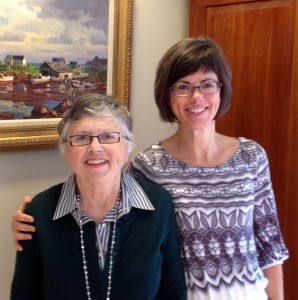
IMG_1612This photo was taken in October 2013, the last time I saw my mother. She looks just like herself, doesn’t she? That’s because I had just washed and styled her hair for her. (Although Dad had been reminding her to take showers, I’m not sure if or with what she’d been washing her hair.) I also picked out her outfit and helped her put it on in the right order. (She’d put on the wool cardigan without a blouse under it.)

I look like myself, too, if a bit red-nosed and puffy eyed. You see, I’d been crying. We’d just taken Mom on a tour of the assisted living wing, “The Hearth,” where she would be moving next week. I had willed myself to be strong and cheerful, but as soon as I walked through the door the tears brimmed up and over and would not stop. I wasn’t upset by my immediate surroundings. Rather, I was crying backwards, for my godmother Millie who died of Alzheimer’s in 2007, and forward, for my mother, whose Alzheimer’s guaranteed her the same fate.

The last time I visited Millie, she was in the assisted living wing of Whitney Center, sitting vacantly in a wheelchair. I had expected that she wouldn’t recognize me, but I thought she would still greet me with a jaunty, “Oh, hello!” Instead, she was utterly absent. Here, physically, was Millie. Yet she was gone.

At the time of this photo, Mom wasn’t gone yet. She still had her sweet, cheerful, anxiously do-gooding personality. She still recognized me. Speaking coherent sentences was difficult, as was comprehending anything but simple, concrete sentences. But she could still apprehend and communicate feelings: though her facts were often wrong, the emotions were true. Given how disoriented she was in time and space, however, I wasn’t sure she understood that she’d be moving to the Hearth—permanently and without Dad. But she knew that something was up, and she had mixed feelings about it. “I just want to make sure I can leave if I don’t like it,” she said in a jarring moment of clarity. “You’ll like it, Mom,” I replied evasively, more hopeful than confident, “You won’t be lonely here, and you and Dad can enjoy each other’s company again, without so much stress.”

Entering the Hearth with Mom felt like the first step in letting her go. Now, two months later, I feel like I’ve lost her because her new home has terrible cell phone reception and no WiFi. Cell phone service no longer matters: we’re past the point where we can communicate meaningfully by phone. But sitting face to face via Skype, I feel like I can still connect with Mom. No matter how garbled the words, we can still see each other’s expressions, gestures, and emotions. This will change, of course. The last time I Skyped with her, Mom told me I looked different. Meaning: I don’t look familiar to her. Meaning: soon she won’t recognize me.

“Gone” is the language we use to describe the effects of Alzheimer’s. After a bad patch, when Mom didn’t recognize Dad—thought he was the gardener, though we never had a gardener—he cried and said, “she’s really gone.” Then, on an another day, “she was almost like herself again.” But the following day, she chose to stay and finish watching a movie with her new companions, rather than joining him for their ritual glass of sherry. Was she turning down an invitation from her husband of 50 years, or from a strange man who, in that moment, she did not recognize? And if she didn’t recognize him, was it Mom who turned down the invitation, or someone else? Was Mom “gone” again? Will she reappear? When will she resurface for the last time?

These unanswerable questions suggest the inadequacy of our language, both for dealing with Alzheimer’s and for embracing the complexity of selfhood. Alzheimer’s is a disease that, in attacking the brain rather than the body, destroys what we think of as the essence of the self. How much of ourselves resides in memories of our life experiences and in our ability to recognize the people we love? If I can’t remember my life, my lover, or even my own name, am I still myself? If I’m “gone,” but my body still breathes, eats, and sleeps, who has that body become?

This fear of losing the self rests on a false understanding of selfhood as something bounded and constant, rather than permeable and changing. David Hilfiker, who writes a blog reflecting on his own Alzheimer’s, draws attention to this common misunderstanding of selfhood in Western culture:

Buddhist teachings remind us that there is no constant “self.”  (See my “Letting Go of Self.”)  The Western idea that our self stays the same throughout our life just isn’t very accurate.  In fact, our self changes continuously and dramatically throughout our life.  The Buddhist teachings point out that clinging to any particular self-image is sure to bring suffering because the self will not fit the desired image forever.  Let it go!

We change throughout our lives, in mind and body. Twenty years ago, I was not a mother or a professor, now I am both, and someday I will stop being a professor, but keep being a mother. My fear of heights has gotten worse, and my fear of embarrassing myself has lessened, though I’ve had plenty of practice with both. And I used to love chocolate, but hate wine and coffee; now, fortunately, I love them all. Have I mentioned my grey hair?

We are always changing, and Alzheimer’s accelerates the rate of change, rendering it more palpable and volatile. Other degenerative diseases have similar effects, diminishing the capacity of the body rather than of the mind. When a person with ALS wakes up one day and can’t move his arms or legs, we don’t say, “he’s gone.” So when my Mom wakes up one day and can’t recognize me, I won’t say, “she’s gone.”  I will know she’s changed, and so have I.

But the immeasurable ways in which we have changed each other—molded each other’s selves through the impressions (including the bumps and bruises) we’ve left upon each other along the way—cannot be undone. I like to think that, even when she can no longer recognize me, Mom is still carrying me with her, if only in her muscle memory. And I’ll carry her with me for as for as long as I can remember her and as long as my heart beats.

Filed Under: Alzheimer's, Family, Language, Selfhood Tagged With: alzheimer's, daughter, family, mother, self

Hard Rock Returns to the Panopticon

November 17, 2013 by Suzanne Churchill Leave a Comment

I’ve been teaching a unit on prisons in my first-year writing course, “Building Stories.” We read Michelle Alexander’s book The New Jim Crow, which offers a persuasive argument about how racial discrimination lies at the heart of the American prison system, even in the absence of explicit racial animus. Alexander doesn’t mention the French philosopher Michel Foucault, but when she describes the way in which our American disciplinary system has “perfected” itself, accomplishing social control in ever more subtle and insidious ways, she could be taking a page out of Foucault’s 1975 playbook, Discipline and Punish: the Birth of the Prison. Alexander and Foucault offer brilliant, eye-opening critiques of the criminal justice system, but in the immortal words of Carly Simon, “Nobody Does It Better” than poet Etheridge Knight, who, writing from prison in the 1960’s, tells us everything we need to know—and plenty that we might not want to know—about race and the American prison system.

320px-Presidio-modelo2To appreciate Knight’s genius, it helps to understand a bit of Foucault. In Discipline and Punish, Foucault develops a theory of “panopticism,” based on Jeremy Bentham’s 19th century model of the “panopticon,” a circular prison with a central watchtower. Foucault uses this prison prototype to illustrate a cultural shift in European disciplinary systems from the old, heavy style of thick-walled dungeons to a lighter and seemingly more enlightened style of perpetual surveillance. In this new model, prisoners assume they are under constant watch by the guards and thus begin to police themselves, or as Foucault puts it, “the major effect of the Panopticon” is “to induce in the inmate a state of conscious and permanent visibility that assures the automatic functioning of power” (319). By internalizing the condition of being watched, the inmates become part of a disciplinary system that controls not only their bodies, but also their minds; they become “caught up in a power situation of which they are themselves the bearers” and begin watching themselves (319).

Etheridge Knight’s 1968 poem “Hard Rock Returns to Prison from the Hospital for the Criminal Insane” offers a glimpse of a panopticist disciplinary regime from inside an American prison and from the perspective of its African American inmates. The poem depicts the way the inmates internalize a mode of surveillance, watching their folk hero Hard Rock and making assumptions about their own condition based on his behavior. What makes Knight’s poem so striking—and so disturbing—is that it reveals how the modern, “enlightened” system of criminal surveillance remains tied to the old system of whips and chains that disciplined black bodies during the era of slavery.

The unnamed speaker of the poem speaks in the first-person plural “we,” serving as a spokesman for the other inmates. He gets his authority from the common folk he cites, a collective voice who claims Hard Rock was “‘known not to take no shit / From nobody.’” Although we first learn of Hard Rock through word of mouth, the bulk of the first stanza is devoted to a visual description of the legendary hero. Folklore may proclaim his mythic status, but it is his visible “scars” that “prove” his greatness:

Split purple lips, lumbed ears, welts above
His yellow eyes, and one long scar that cut
Across his temple and plowed through a thick
Canopy of kinky hair.

The final detail, a “canopy of kinky hair,” is also the most significant racial marker, visually signaling the importance of race in defining Hard Rock’s defiant position within the disciplinary regime.

Although the “WORD” acquires significance through its capitalization, the act of watching dominates the poem: “we all waited and watched, like a herd of sheep,/To see if the WORD was true.” As in the first stanza, visual evidence assumes primacy over word of mouth. Power must be verified through a system of surveillance. Thus, when “the testing came,” it is a test “to see if Hard Rock was really tame” (emphasis added). The definitive answer to the test comes when Hard Rock returns from the “Hospital for the Criminal Insane,” after being subjected to a lobotomy as punishment for his defiance. He “just grinned and looked silly / His eyes empty like knot holes in the fence.” Deprived of sight, Hard Rock is dispossessed of power, reduced from his formerly heroic proportions to the pitiable object of the inmates’ collective gaze. Rather than being empowered by their own ability to watch Hard Rock, the inmates are shamed by his diminished status. They turn away, their “eyes on the ground. Crushed.” As the inmates see Hard Rock reduced from a “Destroyer” and “doer of things” to a passive, unseeing fool, they see themselves reflected in his tragically reduced image. Like Hard Rock, they are rendered powerless and incapable of doing anything:

We dreamed of doing but could not bring ourselves to do,
The fears of years, like a biting whip,
Had cut deep bloody grooves
Across our backs.

Here, the simile of the “biting whip” symbolically transports the inmates back to the conditions of slavery. The “fears of years…cut deep bloody grooves,” linking the system of panoptic surveillance to the violently racist regime that preceded it. Knight’s poem thus allows us to see what Foucault overlooks: the role of race in the systems of discipline and punishment that govern our modern, democratic society. Nearly half a century later, Michelle Alexander is drawing our attention back to a problem, which hasn’t gotten any better, even if it is less visible. Read her book, and see what you think.

Works Cited

Alexander, Michelle. The New Jim Crow: Mass Incarceration in an Age of Colorblindedness. New York: The New Press, 2010. Print.

Foucault, Michel. “Panopticism.” Ways of Reading. 5th ed. Ed. David Barholomae and Anthony Petrosky. Boston: Bedford/St. Martin’s, 1999. 312-342. Print.

Knight, Etheridge. “Hard Rock Returns to Prison from the Hospital for the Criminal Insane.” Poets.org. Academy of American Poets, 1997-2003. Web. 13 Nov. 2013.

Filed Under: Books, Poetry, Teaching

Basement Elegy

November 17, 2013 by Suzanne Churchill 1 Comment

A Christmas play staged in the basement, c. 1978 (the only basement photo I have).
A Christmas play staged in the basement, c. 1978
(the only basement photo I have).

My dad and siblings are cleaning out my parents’ basement this weekend. I get occasional texts from my sister with a photo of an Irish wool sweater, or the nurse’s costume Nana made me one Halloween, so tiny it looks like it was made for a doll: “Do you want this?” No, to the wool sweater (I’m allergic). Yes, to the nurse costume (I’m nostalgic). But I really don’t want anything that’s in the basement; I want the basement.

The basement has been such a basic fact of my existence that I didn’t recognize its significance until its dismantling. In my earliest memories, it was a dark, cool, mysterious place, reserved for my father’s tools and model train set. It was a dangerous place, too. We were forbidden from going barefoot, lest we step on a stray nail or fallen screwdriver. My father’s fraternity paddles hung ominously on the wall, marking his terrain. If we misbehaved, his deep voice threatened, “Do I have to go downstairs and get the paddles?” I later understood that Dad would have never hit us with the paddles, but at the time the threat convinced me that the paternal rule undergirding our household could extend its reach to the domestic realm upstairs, where my mother’s gentler authority reigned.

Although the basement was a shadowy place, its power was reassuring. It held everything my father needed to fix things; everything my mother needed to make holiday meals and wrap presents; everything we needed to go skating on Baummer’s Pond in winter, or for a picnic at Lake Quassapaug in summer, including the big, red plastic cooler with the initials HFW neatly printed in indelible blank ink. Once, when I was very small, I was in bed with stomach bug and Dad was in charge of my care. He was working on a project in the basement, and I called down to him to ask a question. He heard my voice, assumed I was throwing up again, and bounded up the stairs with the force of a giant. I was embarrassed by the misunderstanding, yet deeply reassured by the protection that rose up from below.

When I was in middle school, we moved to a bigger house with a bigger basement. This one had space for all my dad’s tools and my mom’s household supplies, as well as a play area for kids. We got the old day bed with the beige vinyl seat cushions and a barrel for the “dress ups”–a stash of 1950’s fancy dresses and shoes we’d acquired from church rummage sales. My sister and I would dress up, play Donna Summers on the speakers my father had rigged up in the ceiling, and twirl around the cement poles. Hot stuff, baby. I’m talking about the bad girls, yeah. My brother had his own area for Legos, the Fisher Price garage, town, and school, and all the accessories that went with them.

Just before I started high school, we moved to a new town and a smaller house with a basement and a crawl space. My parents took over the basement, and our dress ups and toys were relegated to the crawl space, where we would pull them out if they were needed for a skit, costume, or school project. But we’d outgrown our need for a play area and found the nooks of the crowded basement more useful for storing a small stash of illicit alcohol.

After my sister, brother, and I all moved out and established our own households, my parents paradoxically moved to a bigger house with the largest basement of all. My father’s workshop expanded, and my mom’s household supplies spread on expansive open shelves. The play area returned, now reserved for grandchildren, who received the same prohibition about not going barefoot or venturing into “Granu’s” territory.

Last September, we moved my parents to a retirement village, delighted that they’d secured a unit with two bedrooms and a full basement, brighter and more finished than any basement they’d had before. The place was beautiful, with lots of windows and a sun porch overlooking a meadow surrounded by woods. My mom, now diagnosed with Alzheimer’s, would have a smaller home to navigate and access to more activities and services. And my father would have his basement to work on his trains, knowing she was safe and comfortable upstairs. The haven lasted only a year. My mom’s illness advanced, and my father’s stamina eroded. This October, we moved her to assisted living, and now my father is moving to a smaller, less expensive apartment—without a basement.

I’ve been living in North Carolina for 18 years, where basements are rare. Our house has a small dugout for the furnace and hot water heater, accessible only through a trap door in the kitchen floor. We’ve no space to store the trappings of my parents’ household, and I wouldn’t want all that stuff, anyway. What I want is for the basement to be there—that non-magical, underground room of requirement, where I can find whatever I need, if ever I need it. And the next time I go to Connecticut to see my parents, the basement will be gone.

Filed Under: Alzheimer's, Family Tagged With: alzheimer's, basement, brother, childhood, dad, family, mom, sister

Fecturing: the female equivalent of mansplaining?

October 29, 2013 by Suzanne Churchill 6 Comments


I was introduced to the term “mansplain” by a colleague who posted a Facebook link to Academic Men Explain Things To Me. This Tumblr blog is a repository for anecdotes and complaints from academic women who have been the recipients of patronizing, infantilizing, or downright rude behavior from their male colleagues—that is, “mansplaining.” According the Urban Dictionary, “mansplain” means:

delighting in condescending, inaccurate explanations delivered with rock solid confidence of rightness and that slimy certainty that of course he is right, because he is the man in this conversation

Example: Even though he knew she had an advanced degree in neuroscience, he felt the need to mansplain “there are molecules in the brain called neurotransmitters.”

Although the term has evidently been around for some time (it was the “Word of the Day” on the Urban Dictionary back on February 4, 2011), it’s new to me. Yet the concept is all too familiar. Any academic, and especially a female one, is likely to feel a stab of recognition when she hears the definition of “mansplain,” for who among us hasn’t been talked down to, over, or out of the conversation?

I can easily summon examples, such as when a male colleague blithely announced that we had solved all the gender issues at our institution—this, after hijacking a lunch I was having with another male colleague to instigate a discussion that wholly excluded me. I wince at the memory of a committee meeting when I became so exasperated at a male colleague who kept interrupting me that I lashed out, hissing, “Let me finish my sentence THIS time.”

I may have been the victim of occasional mansplaining, but I’m no innocent. I think I represent my fair sex when I say that I am guilty of my own form of mansplaining: adopting a tone of moral superiority and presuming a stance of superior insight and vision based on my female experiences. (Warning: I might even be doing it in this post.)

In the interest of gender equality, we need a comparable term for the female version of mansplaining. I’d like to propose fecturing (etymology: female + lecturing). At first I thought of fectoring, but the word “hectoring”—with its connotations of shrill, bossy bitchiness—carries too much misogynist baggage. I prefer the word fecture because, like mansplain, it has vestiges of authority. No matter how objectionable the tone, when you fecture or mansplain, you have knowledge to share and the authority to do so. By suggesting this term, I’m not arguing that all things are equal, or that women don’t have good reason to protest gender inequalities at home and in the workplace. I’m simply saying that if we’re going to analyze the exercise of power through gendered discourse, we should adopt an equal opportunity approach to the subject.

Here’s a provisional definition of fecture:

delighting in condescending explanations delivered with moral superiority, confidence of rightness because of superior insight and exclusive experiential knowledge, and oracular certainty that of course she is right, because she is a woman.

Example: Even though she knew her baby would survive a few hours left alone with Daddy, she felt the need to fecture her husband about the precise schedule he must follow, as well as about the proper application of diaper rash ointment.

That’s a lowball example, for I, a professional working woman, appear to be attacking a most vulnerable target, the stay-at-home mom. But I stand here as living proof that professional working women treat their husbands and partners this way, too. I’ve seen it with my own eyes, though as a mother of twins, I regret that I didn’t get the chance to fecture in full glory. My husband and I each had to grab a baby and manage with the ointment as best we could, squirming to dodge the inevitable spray of pee in our faces. Definitely no moral superiority there.

Though I may have missed the opportunity for maternal fecturing, my husband will tell you that I have crafted my own form of the genre: a tone I adopt when I talk to him and our sons as if I were speaking to students in a classroom. It happens when I feel like I’m being ignored, interrupted, or dismissed by the male members of my family, who outnumber me by 4 to 1. Suddenly I become the righteous corrector, my “high disdain” fueled by what Milton called a “sense of injured merit.” (NB, Milton was describing Satan.)

There’s a lot of fecturing going on in  Academic Men Explain Things To Me as well. I’m not going to call any of my academic sisters out by their screen names, but if you read a sampling of the posts, you’ll get a sense of the tone and gist of them. There’s a palpable note of female superiority tumblring about, and I think it’s high time we called ourselves on it. Maybe once we’ve established terms for all the abuses we inflict on one another, we can put an end to both mansplaining and fecturing, and start a conversation.

Filed Under: Language, Popular Culture Tagged With: Academia, Academic, Discourse, Equity, fecture, Fecturing, gender, mansplain, Mansplaining, Men, Power, Women

The Strange, New World of Alzheimer’s

October 2, 2013 by Suzanne Churchill 3 Comments

Scan 3My mother was diagnosed with Alzheimer’s disease almost two years ago, and her cognitive functions have declined steadily ever since. The disease is relentless, incurable, and inscrutable, but—as my friend Kelly Chaston said of the nonsmoker’s lung cancer that took her life when she was only 48—her illness is not a tragedy. More than 5 million Americans over the age of 65 have Alzheimer’s, and my mother is one of the lucky few who, like Kelly, has excellent health care, financial resources, and a supportive network of family and friends to help her cope. Her situation is not tragic, but it still has pathos.

My mom was a reader and a talker. I don’t mean that she was a chatterbox, but rather than she lived in language. She read voraciously, preferring classic women novelists like Jane Austen and Barbara Pym, who were wise, witty, and wide-ranging, yet respected the limits of etiquette. She encouraged us to talk about our problems and express our feelings, and she loved to talk about and analyze interpersonal relationships. I suspect that in some ways life was for her an Austen novel, where relationships tip out of balance or fall off course, but the right dose of prose can set all things aright, especially if applied with a sense of humor.

My dad, on the other hand, is a fixer. He can fix just about anything, from a leaky faucet or a faulty wire, to the broken window panes of the dollhouse he built for me, after my two-year-old brother poked his stubby fingers through each window. My dad constructs elaborate model railroads, with tiny buildings, tunnels, and mountains; he built a dulcimer and learned to play it; and he and a friend built a steamboat, which he toots around a lake in Maine. After he retired, he learned to fix meals so well that we hardly noticed when, somewhere along the way,  my mom forgot how.

As mom was able to do less, my dad did more and more: not just the cooking, but the laundry and the housecleaning and the calendar-keeping and the birthday-present giving and the Christmas letter writing and the emailing and phone calling. He can do all these things, but he can’t fix mom’s Alzheimer’s. When she wants to go home, he can’t make her understand that she is home. When she wants to call her parents, he can’t make her understand that they’ve been dead for more than 20 years. When she’s looking for Fred, he often can’t make her recognize that he is Fred. He’s wracked with frustration and grief, and yet he can hardly finds words to express his emotions: my mom always did that for him. And now my mother can hardly find the words for anything. She doesn’t read much, and speaking gets harder every day. Thoughts flutter across her consciousness, darting away before the words can form. When the words come, they often form a familiar syntax, but don’t make semantic sense.

So that’s the pathos: a fixer who can’t fix, and a literary mind deprived of language. Their 50-year marriage, a partnership that withstood job losses, illnesses, depression, deaths, parenting crises, and alcoholism, seems at last to have met its match: a disease that upsets the balance between their complementary strengths.

It’s taking a toll on me, too. I’ve inherited my mom’s love of language and my dad’s drive to fix things. Most of my life, I’ve operated under the assumption that, if I can find the right words and arrange them exactly, I can fix anything. This disease has driven me off course into a strange, new world, where words, despite their magic and power, can’t fix the problem. I can’t think or talk my way out of this one. Instead I’ve got to feel my way through it.


Filed Under: Alzheimer's, Family, Language Tagged With: alzheimer's, dad, family, mom

What Does the Fox Say? Onomatopoeia & the myth of pure language

September 29, 2013 by Suzanne Churchill

This weekend my sons have been belting out lines from the Norwegian duo Ylvis’s viral video, “What Does the Fox Say?” Fortunately, a student in my seminar had introduced me to the video last week, so I was able to impress my sons by joining in. “You know that song?” Zac asked incredulously, to which I replied, “Joff-tchoff-tchoffo-tchoffo-tchoff!”

Like 3 million others, I found the video to be funny and infectious—an irresistible sing-along song the likes of which I haven’t enjoyed since my girl-scouting days. As Devon Maloney points out in Underwire, the song doesn’t just get stuck in your head, it messes with your head, raising existential questions that have troubled philosophers and poets for centuries:

Like, “Why am I still hopelessly stuck on the insanely catchy clutches of a song about animal noises?” and “Should I be reevaluating my own understanding of animal noises? Do elephants really go … “toot”? And of course, the most important question of all: “Wait, seriously, what sound does a fox make?”

According to my other son Luke, “We actually know what a fox says, Mom. It screams, and it sounds a lot like a human scream.”

Such an empirical solution to the song’s driving question may satisfy the scientifically minded, but it doesn’t solve the song’s semiotic mystery. “What does the fox say?” is not about animals that sound like humans, but about humans trying to sound like animals, or more precisely, humans trying to come up with words to represent animal sounds. The song captures our love affair with onomatopoeia, words that sound like the thing they refer to or describe. Animal noises are some of the most common onomatopoetic words and are often the first words acquired by babies, who learn to say “moo” and “quack” almost as soon as they say “mama” and “dada.” (The video’s scenes of an elderly man reading to a child seem particularly instructive here.) Part of what’s funny and pleasurable about the “What Does the Fox Say?” video is that adults at a cocktail party, champagne tulips in hand, are indulging in an infantile urge to mimic the animal world.

What makes the video even funnier is that the adults don’t really look like the animals they represent. This is not the cast of Cats, whose feline purring, pawing, and rubbing suggest a more disturbingly adult form of zoophilia. Rather, in the children’s picture-book world of “What Does the Fox Say?” the humans are clearly human. By the time the elephant man descends from the porch saying, “toot,” we recognize that his “toot” resembles an elephant about as much as his costume does, which is to say: not much. The animal costumes and sounds in “What Does the Fox Say?” are mimetic not of real animals, but of the simplified, cartoon-like icons that we use to represent animals.

In this way, “What Does the Fox Say?” delivers a sophisticated language lesson. It highlights the human desire for a pure language, in which words magically correspond to the things they represent. Yet it also exposes the myth of pure language. Linguists like Saussure teach us that language is arbitrary—that words have no innate connection to the things they represent. There’s nothing particularly catlike about the word “cat.” Instead, “cat” refers to a cat because it is not a “bat” or a “hat.” Similarly, the words “neigh” and “horse” are no closer to the equus feras than they would be if spelled out in “morse” code (here again, the video seems uncannily wise in asking if a h0-0-0-0rse would recognize its name in mo-0-0rse code). Words acquire meaning through their system in a chain of signifiers, not because of any innate connection to the things they represent. Because onomatopoeic words differ across languages (a dog says “ouah-ouah” in French and “kien-kien” in Japanese), we know that even these “sound-alike” terms conform to linguistic codes rather than to natural sounds.

Still from What Does the Fox Say videoOnomatopoeia comes from the Greek words for name + making. It reflects the basic human urge to name things—to capture and communicate the essence of things. Yet term’s root exposes the problem: we make the names; we don’t find or discover them. Although we want to know things as they are, our efforts to name them are mere approximations. Still the drive to know and name remains strong. “What is your sound… Will we ever know,” the lead singer croons, lamenting (or perhaps celebrating) that what the fox says “will always be a mystery.” In this way, the video really does entertain existential questions that philosophers and poets have been pondering for centuries.

Filed Under: Family, Language, Poetry, Popular Culture, Teaching Tagged With: language, onomatopoeia

Playing in the Dark with Whitman

September 13, 2013 by Suzanne Churchill

Walt Whitman’s “When Lilacs Last in the Dooryard Bloom’d” is a powerful elegy for Abraham Lincoln—a personal remembrance that also serves as a national memorial, uniting a deeply divided nation in a communal song of praise and mourning. As much as I love this poem, however, I am troubled by it. In sections 5 & 6, Whitman pans out to give us a vast panorama of the U.S., describing the land, cities, lanes, woods, fields, orchards, and streets through which Lincoln’s coffin passed. In Section 5, he catalogs the features of the natural world (grass, wheat, and apple trees), and in Section 6, he depicts the human landscape:

Coffin that passes through lanes and streets,
Through day and night with the great cloud darkening the land,
With the pomp of the inloop’d flags with the cities draped in black,
With the show of the States themselves as of crape-veil’d women standing,
With processions long and winding and the flambeaus of the night,
With the countless torches lit, with the silent sea of faces and the unbared heads

Why doesn’t Whitman include any African American laborers the fertile fields of section 5, or mention any African American faces or “unbared [brown] heads” in lines of mourning in section 6? Of course, you can argue (and probably will) that Whitman’s depiction of nature includes no people, that he is attempting to create a vision of natural bounty, in which nature’s plenty can nourish and replenish the war-torn land.  And you can argue (and probably will) that his portrayal of the American people is not race specific because he wants to project an image of national unity, in which “the thousand voices rising strong and solemn” sing together in unison. I won’t disagree with you on these points, yet I still think the absence of explicit racial signifiers is remarkable in a poem dedicated to the president who had just put an end to slavery. This absence is especially striking, given the symbolic presence of the “great cloud darkening the land.” There is darkness haunting the poem, and it is a darkness worth scrutinizing.

Toni Morrison’s essay “Black Matters”  helps explain how the repressed presence of African Americans returns in the form of a dark cloud that haunts the poem—what she would call an “Africanist presence.” Morrison rejects the assumption “that traditional, canonical American literature is free of, uninformed by, and unshaped by the four-hundred-year-old presence of first Africans and then African Americans in the United States” (31). Rather, she insists, an Africanist presence is crucial to the formation of American literature, although it often surfaces in oblique, coded ways. She introduces us to this troubling idea gently, writing:

I have begun to wonder whether the major, much celebrated themes of American literature—individualism, masculinity, the conflict between social engagement and historical isolation, an acute and ambiguous moral problematic, the juxtaposition of innocence with figures representing death and hell—are not in fact responses to a dark, abiding Africanist  presence. …A real or fabricated Africanist presence has been crucial to the writers’ sense of their Americanness. And it shows: through significant and underscored omissions, startling contradictions, heavily nuanced conflicts, and the way their work is peopled with the signs and bodies of this presence. (310)

African Americans are a “significant…omission” in Whitman’s elegy, but the poem is nevertheless “peopled with the signs and bodies of this presence.” The repressed African American people return in the symbolic form of the “Dark Mother always gliding near with soft feet” (line 143). This shadowy figure of death serves as the necessary darkness against which Whitman can recognize own vitality and affirm the continuity of a nation in crisis. The poem represses the race issues that divide the nation, only to resurrect them in a unifying symbolic figure of the Dark Mother. Perhaps we can appreciate the full power of Whitman’s great elegy only when we acknowledge the symbolic power of Africanism in his poetic restoration of American national identity.

Filed Under: Language, Poetry, Teaching

  • « Go to Previous Page
  • Page 1
  • Interim pages omitted …
  • Page 7
  • Page 8
  • Page 9
  • Page 10
  • Page 11
  • Go to Next Page »

Copyright © 2026 · Infinity Pro on Genesis Framework · WordPress · Log in