• Skip to main content

Suzanne W. Churchill

  • DH Scholarship
    • Mina Loy
    • Gwendolyn Bennett
    • Modernist Magazines
  • Teaching
    • Recommendation Requests
    • Reading Tips
    • Secondary Source Reports
  • Writing
  • Painting
  • About Me
    • C.V.

Suzanne Churchill

What Poetry Doesn’t Tell You

February 16, 2016 by Suzanne Churchill 2 Comments

Ok, this morning’s earlier post was the public story, but as you might of guessed, there’s a private story lurking behind it. Or more accurately, a story “Formerly Known as Private,” since I’m about to tell it. The public story was proper and tidy. This story is going to be messy, because I’ve just gotta get it down and then get on with grading all those papers.

What set off the explosion of gloom I alluded to was simply a bombed class. I had high hopes for a fun, lively debate about Marcel Duchamp’s Fountain (an overturned urinal), William Carlos Williams’ “This Is Just To Say” (a refrigerator note), and the limits of art and poetry. But whether I pitched it wrong, blithered on too long, or failed to account for the dreary weather, my students wouldn’t play. I called on one, wrapped up in her shawl, who confessed she’d been falling asleep. Later, I called on another, who had lost track of the discussion because he was reading his classmate’s blog post.

Don’t make excuses for me: these are the telltale signs of poor teaching. Which means I suck as a teacher and the class is a failure. I can see the rest of the semester trailing ahead as the barometer of student engagement continues to fall steadily, relentlessly. One corner of mind flings about wildly for ingenious games and activities I might use to win them back, while the other sulks in despair, contemplating early retirement.

Thanks in part to writing this blog, I’ve learned to recognize that when I find myself caught in such cycles of self-loathing and recrimination, there is usually something deeper contributing to my distress. For the past few years, that something has been grief about my losing my Mom, which is apparently a pain so unfathomable that I can’t confront it directly. Until I dig it out of hiding, I remain tangled in exhausting spirals of anxious thinking.

The pattern is now familiar, and it didn’t take much digging this time. I knew right away that my over-reaction to a bad class was triggered by my Dad’s announcement that he and his new lady-friend Ruth were planning to move in together. This isn’t a secret or a surprise: Dad has brought Ruth to church, introduced her to my siblings and their families, and taken her out to dinner with his closest friends. By all accounts, she is a lovely person. Although I haven’t met her yet, Dad told me about her, and I knew things were headed in this direction. Still, the news hit me with a wallop, and it didn’t help that he made the announcement by e-mail.

Don’t get me wrong: I have no objection to the lady-friend or even to the apartment-share. A little over a year ago, when Mom turned catatonic and was lingering on her deathbed, I secretly hoped that Dad would find a lady-friend to keep him company and hold his hand. Actually, I didn’t even keep my hope secret: I told Dad he had my blessing.

Retrospectively, I think that what I really wanted was relief from his misery—relief for me, perhaps, more than for him. It was so hard to see him weeping and wracked with grief. I felt awkward and helpless. It was much more pleasant to imagine him enjoying the companionship of a new lady friend—and much less of a responsibility for me.

At the time, Dad couldn’t even fathom my suggestion, and he grieved so hard all year that I decided that maybe he would do so for the rest of his life—that being wedded to Mom was his identity and life calling. So when he told me his feelings for Ruth had turned romantic, I felt my guts lurch. Why? Rationally, I knew Ruth could never replace Mom in our hearts, and she has no desire to do so. I was happy for Dad—I’m happy for them both that they’ve found each other. Yet in the days following his revelation, I was swept over by waves of grief, missing Mom more than ever, wanting to call her, talk to her, and have her back in my life.

It seems too fast for my grieving heart that their relationship has moved so quickly from romance to live-in partnership, but who am I to judge time for septuagenarians? If they were in their twenties and had their whole lives unfolding before them, maybe it would be appropriate for me to caution them to slow down. But I don’t sit at the seat of 75; what seems fast to me at 49 may seem to them like wasted precious time.

I’m trying to take a broad view, one that encompasses my own grief, acknowledges Dad’s and Ruth’s perspective, and incorporates my 14-year-old son’s point of view (but excludes my shitty teaching). When we told Zac that Granu had a new girlfriend and they might be moving in together, he smiled and said: “Good for him. It was a lot harder to see him suffering than it would be to see him happy with a new girlfriend.” He’s right. Good for him is good for us, too. I’m pretty sure Mom would smile and say the same thing.


Filed Under: All Posts, Family, Teaching

Poetry Makes Something Happen

February 16, 2016 by Suzanne Churchill Leave a Comment

This morning, as I struggled to drag my mind out of a mire of missing my mother and regretting my own misfires in the classroom, I watched two videos by Davidson college alums that snapped me out of my solipsism and reminded me what poetry can do to change our perspectives and broaden our minds. (Go English majors!)

Clint Smith (’10) is a poet and teacher who uses poetry to change the narratives we tell about kids and poverty in inner city public schools. Watch his TED-X talk and celebrate resilience:

It’s a little early in the season for Will Reese’s Free Word poem, with icy rain falling from the sky, instead of the reign of the inchworms soon to befall us in North Carolina. But you won’t regret listening to Reese (’14), who steers this poem along funny, surprising twists and turns, moving you from laughter to outrage to introspection so fast you’re not sure what hit you. Was it an inchworm in your face, or a ear-worm in your mind that you can’t shake off?

W. H. Auden famously declared that “Poetry makes nothing happen.” Maybe he was mired in grief and hopelessness as he wrote his poem “In Memory of W. B. Yeats.” Or maybe he was hinting that poetry turns nothing into something—into a “way of happening, a mouth.” Admittedly, it takes an act of conscious will to turn a baldly cynical statement like “poetry makes nothing happen” into a hint of hope. And yet, for all his cynicism, Auden concludes his poem with a resounding prayer to the poet:

Follow, poet, follow right
To the bottom of the night,
With your unconstraining voice
Still persuade us to rejoice;

With the farming of a verse
Make a vineyard of the curse,
Sing of human unsuccess
In a rapture of distress;

In the deserts of the heart
Let the healing fountain start,
In the prison of his days
Teach the free man how to praise.

In the call to “Follow, poet,” you can almost hear an echo of a spoken word audience member, snapping fingers and saying, “Go, poet!” Auden cannot suppress his appetite for poetry, despite its apparent uselessness, nor can he suppress his own power to write poetry that can make something happen. In this case, the trochaic tetrameter and ingenious rhymes prod the grieving “heart” to “start” and convert sorrow-bound “days” to “praise.” And in doing so, the poem lets the healing begin.


Filed Under: Language, Poetry

Valediction: Forbidding Mourning

January 2, 2016 by Suzanne Churchill 4 Comments

Today is the first anniversary of my mother’s death, and so it seems like an appropriate, necessary time for a valediction—a farewell address reflecting on how I’ve fared without her in the past year. The word “valediction” even contains her name, “Val,” making it seem meet and proper to do so.

Less has changed than I expected—the anguished, desolate waste land I expected to be stranded in after her death never materialized. Instead, my grief has erupted in short bursts: in a sudden memory of her that forms in sharp relief against her absence, in the throb of desire to call her, or a groundswell of emotion when I put on a piece of her jewelry or try to read aloud “Christmas through the Knothole.” My emotions are closer to the surface, but my experience of grief is gentler, more akin to what John Donne describes in his “Valediction: Forbidding Mourning.” Donne tells his beloved that they should not mourn their physical separation, because their souls remain entwined:

Our two souls therefore, which are one,
   Though I must go, endure not yet
A breach, but an expansion,
   Like gold to airy thinness beat.

Maybe one bright side of dementia is that the relentless progress of the disease produces not the violent breach of a swift, untimely death, but a thinning, dwindling of connection that could be reframed more positively as an expansion, in which a once close, tight bond is “like gold to airy thinness beat.”

Given how thin my connection to Mom felt in the final years of her illness, this first year without her doesn’t feel much different. We still can’t talk on the phone, yet she remains a strong presence in my life. She occasionally visits me in a dream, and it is her voice I hear most vividly. In her most recent dream visitation, she and my Dad were standing together looking at the hutch, and she was asking him about his arrangement of the items on display, curious about the changes he’d made in the short time she’d been gone. This was no angelic visitation delivering wisdom from beyond—just an ordinary appearance from Mom, who was still interested in the same things she’d always been interested in, including making sure everything in her home was artistically arranged.

One thing that has changed is her diagnosis. It turns out that she did not die from Alzheimer’s, but instead was afflicted by Lewy Body dementia—the second most common, but much less well known form of progressive dementia. It’s only recently gained a modicum of fame when Robin Williams was diagnosed with it.

My family members had different reactions to the autopsy report. Dad was fairly uninterested: it didn’t change the irrevocable fact of her death, or the inconsolable nature of his grief. My sister was relieved, because the researcher Dad spoke to said that Lewy Body dementia was rare in women and not hereditary. Not good news for my brother, so I didn’t ask him. I was curious, though, and immediately started researching, because medical knowledge always gives me a satisfying illusion of control over the disorderliness of human mortality.

Lewy Body’s dementia is probably more common than we think because it’s often misdiagnosed as Alzheimer’s or Parkinson’s, diseases with overlapping symptoms and brain deposits. No one knows what the cause, but according to the Mayo Clinic, the risk factors are:

  • Being older than 60
  • Being male
  • Having a family member with Lewy body dementia

Although these factors imply that women are at less risk, the Lewy Body Dementia Association reports that the disease affects only “slightly more men than women.”

Which is to say that Mom’s postmortem diagnosis is not unusual or gender discriminate, and probably hereditary. It doesn’t improve the outlook for me or my siblings. If anything, our prospects may be bleaker, since less research is being conducted on Lewy Body dementia than on Alzheimer’s, so there may be less hope of a cure in our lifetimes.

The Lewy Body’s diagnosis doesn’t change the fundamental reality of my situation, which is this: I’ve gotta use my brain while I have it. No amount of worrying about glitches, lapses, and tip-of-the-tongue delays is gonna prevent the onslaught of the disease, if it’s headed my way. So carpe diem, Suzanne, and go hug someone you love.

The Lewy Body diagnosis doesn’t change much, but it does help me understand the progress of Mom’s disease, which was rapid, relentless, and unheroic. I remember reading an essay by a guy describing how his mother, though ravaged by Alzheimer’s, could still play the piano beautifully. I was pierced by what can only be called “affliction envy”: why couldn’t our Mom, who could play piano by ear ever since she was a child, continue to enjoy that gift in her illness? Instead of enjoying piano recitals in her final years, we got “organ recitals”—tedious recitations of every twinge and sensation in her irritable bowel.

Turns out that may have been the Lewy Bodies talking, as the disease affects digestion and bowel function. In fact, it affects not only the mind, but also a whole range of body functions, including motor coordination, sweating, sleeping, and heart rate. It made her hands shake and her feet unsteady. She was dizzy, dozy, and prone to falling, physically insecure and emotionally anxious. It can also induce hallucinations, which explains why Mom so often was visited by her long dead parents, or convinced that there was another Fred in the house.

Some of the behaviors that were most frustrating and symptoms that difficult to deal with can now be explained by the proteins clogging her brain. And knowing that gives me a sense of acceptance. I can let go of my affliction envy, because I know her illness followed its own natural course.

040_40But I’m not completely sanguine in my grief. What I miss most is the intrusiveness of her love—the nosy way she would want to know everything that was going in her children and grandchildren’s lives. The expansion of our bond “to an airy thinness beat” can feel natural and peaceful. But there is no substitute for the full force of a mother’s love, however uncomfortable, intrusive, or annoying it might feel. Because who else would be interested in how you were coping with your college-aged kids nocturnal schedules, or why you were annoyed with your sister, or even how you rearranged your hutch—even when you don’t feel like talking about it?


Filed Under: Alzheimer's

2015 Holiday Letter (by Matt Churchill)

December 22, 2015 by Suzanne Churchill 1 Comment

Holiday2015

Filed Under: Holiday Letters

The Work of Scholarship in the Age of Digital Reproduction

October 11, 2015 by Suzanne Churchill

Introduction

Who, What, and How

My title makes an appeal to humanities scholars who are uncertain about the survival of time-honored, print-based scholarly practices in the digital age of information abundance and attention deficits.

The argument laid out before you concerns not only the eponymous subject matter of the work of scholarship in the age of digital reproduction, but also the potential for undergraduates to make original contributions to humanities research. My focus on undergraduate participation is likely to appeal to a smaller subset of humanities scholars who are eager to involve students in research in their fields. Yet this more narrow focus is, in fact, a gesture toward a wider audience. Because undergraduates qualify as “non experts,” my emphasis on their participation is tied to a crucial component of my agenda: re-imagining humanities scholarship in the digital age to involve a broad public of experts and non-experts—and in the process, to dislodge hierarchies that currently divide these constituencies.

Hence my publishing here, on Atavist, a digital storytelling platform geared toward “a new genre of nonfiction, a digital form that lies in the space between long narrative magazine articles and traditional books and e-books” (qtd by Butler). Can a work of scholarship in the age of digital reproduction inhabit such a free, open space?

So much for the subject matter and platform, and on to methodologies. Like a three-legged stool, my argument rests on three methodological principles for humanities scholarship in the digital age:

1. bibliography,2. design, &3. collaboration.

The ideas I am about to unfold are not original to me. Rather, I will gather and arrange arguments made by scholars whose writings inspired me as I began my own path from a solid grounding in print-based scholarship and pedagogy into the uncharted terrain of digital humanities. In curating other scholars’ ideas here, I am effectively doing the work of bibliography, gathering sources on a subject and arranging them in an accessible, intelligible form.

Design is crucial to this effort. If I am going to capture and hold your attention, so that you ignore the new message alert that just popped up on the smartphone, tablet, or laptop on which you are reading, then I must deliver these ideas in a stylish, easily navigable, minimalist, and immersive format that reduces distractions and rewards concentration. (Thanks, Atavist.)

Collaboration will ensue when you use the comment function to critique my argument and make suggestions about how it might be refined and improved. Based on your suggestions, I will make corrections and improvements, so that this argument will remain a living, changing, unfolding statement of principles and practices concerning the work of scholarship in the age of digital reproduction.

___________________________________________________________________

WORKS CITED

Butler, Kirsten. “7 Platforms Changing the Future of Publishing and Storytelling.” Brain Pickings. N.p., n.d. Web. 12 Oct. 2015.

From Print Culture to the Digital Age

pieterdeho-1444781540-82.jpg10102090525-1444781219-46.jpg

The tectonic shift from print culture to the digital age is transforming practices of reading and writing, turning a once solitary endeavor into an interactive, multimedia activity. The shift is also affecting scholarly practices, albeit more gradually. Humanities professors, rooted as we are in print-based traditions and methodologies, tend to approach the digital revolution with attitudes ranging from healthy skepticism to horror. The popular “blog,” for example, seems the antithesis of the thoroughly researched, well-reasoned, expertly vetted analysis that we expect in academia.

As Scott Pound explains in “The Future of the Scholarly Journal,” these expectations arise from a system for producing and disseminating scholarly knowledge that dates back to the seventeenth century and is rooted in print cultural practices and values such as individuality, permanence, hierarchy, linear thinking, scarcity, and depth. According to this model, a lone scholar painstakingly researches and writes an academic book that takes years to prepare and requires the approval of two experts in the field before being published by a prestigious university press, issued in hard copy for $100+, purchased primarily by academic libraries, and reviewed in subscription based, peer-reviewed academic journals read only by professionals in the field.

The digital age has ushered in a new system for producing and disseminating knowledge, and with it, alternative practices and values such as collective intelligence; networks; divergent, lateral, systemic thinking; abundance; and breadth (Pound). In this model, anyone with access to a computer can publish online about any topic—climate change, You-Tube, Twitter, or twerking; research questions can be crowd-sourced on sites like Ask.com; community members can submit content to online bulletin board systems such as Reddit; and the general public can contribute to the expansion and regulation of free, open-access informational resources like Wikipedia, where you can learn about any subject in minutes, click on links, and surf across the World Wide Web to related (and unrelated) sites. 

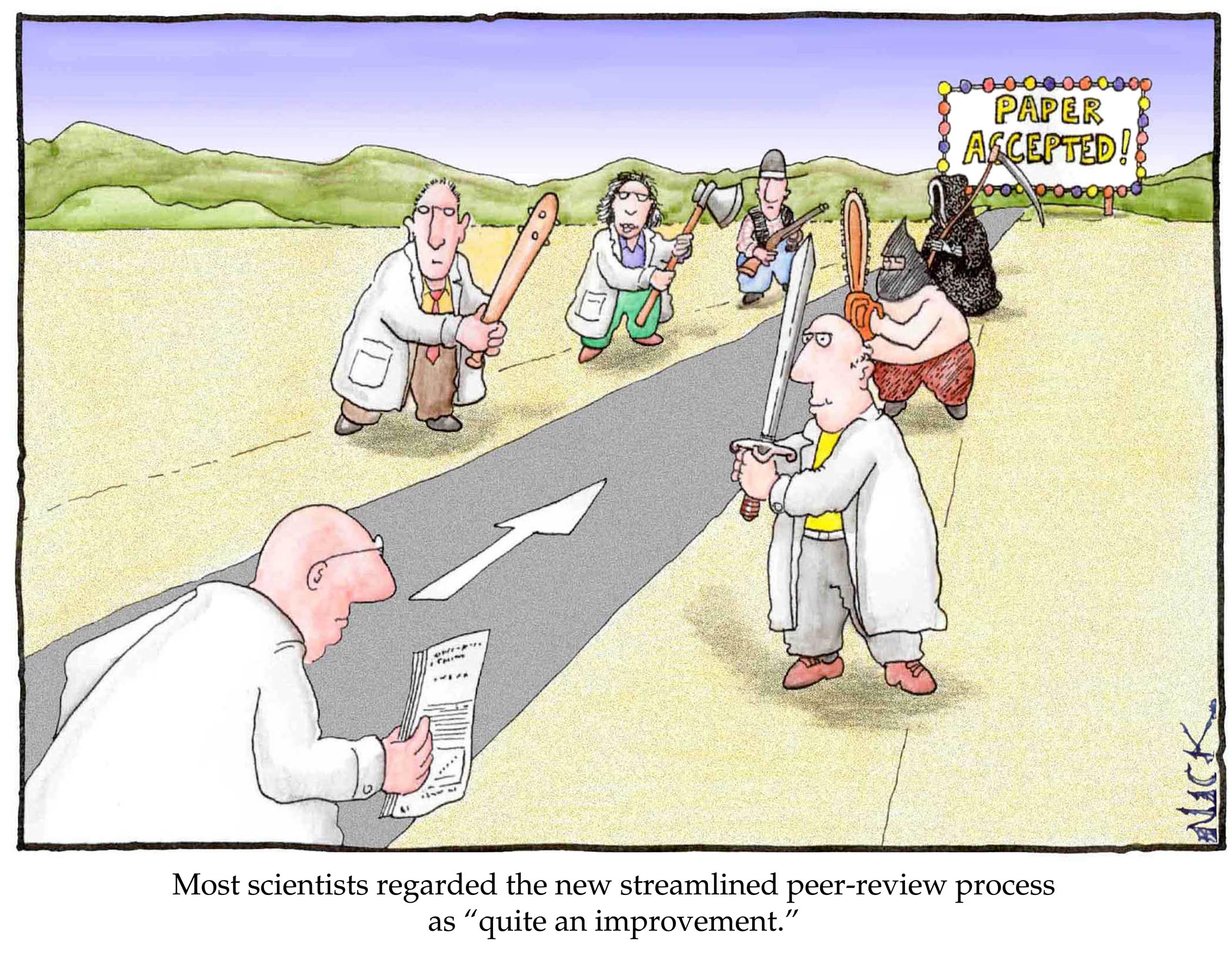
The typical scholarly response has been to resist the tide of information abundance, as Pound explains: “For the most part, the scholarly community has managed to artificially maintain its traditional grounding in information scarcity through hefty subscription rates, low acceptance rates, and slow mechanisms for vetting research.” Innovation in scholarly vetting procedures can a slow, arduous, and painful process, as Nick D. Kim’s cartoon shows.

But not all scholars resist the change. Pioneers in digital studies have begun to utilize digital tools and platforms for academic writing and research, with promising results. These innovators recognize that in the scholarly enterprise, as in book publishing, we must avoid simply relocating print-based practices to the digital realm. In this regard, we can take lessons from non-academics like independent writer, designer, and publisher Craig Mod:

Everyone asks, “How do we change books to read them digitally?” But the more interesting question is, “How does digital change books?” (2)

Academics may be similarly inclined to wonder, “How do we change our scholarship to publish it digitally?” But the more interesting question is: “How does digital change scholarship?” Rather than simply uploading our articles as PDFs, we must put our minds and imaginations to the task of using digital platforms to invent new methods and forms of scholarship—forms capable of presenting long and deep inquiry, fostering intellectual exchange, and maintaining rigorous standards of peer review.

Kathleen Fitzpatrick, co-founder of the digital scholarly network MediaCommons, is a leader in the effort to adapt digital tools and platforms to serve the highest standards of scholarly inquiry and communication. “The blog is not a form but a platform,” she argues, explaining that the blog is not a genre that precludes sustained analysis or concentrated attention, but a “stage on which material of many different varieties—different lengths, different time signatures, different modes of mediation—might be performed” (48).

“The blog is not a form but a platform.”

El Ponderoso platform shoe, “The Heights of Fashion: Platform Shoes Then and Now,” Mint Museum, Charlotte, NC.

The next two chapters discuss two different applications of blog platforms for academic research involving undergraduates. The first emphasizes the importance of bibliography and the second, the importance of design. But despite the difference in emphasis, both case studies reflect the three methodological principles of bibliography, design, and collaboration. And both offer models that you can adapt to involve your students in original research in your field using digital tools and platforms.

___________________________________________________________________

WORKS CITED

Fitzpatrick, Kathleen. “Reading (and Writing) Online, Rather Than on the Decline.” Profession (2012): 41-52. Web. 15 Sep. 2013.

Kim, Nick D. Peer Review Cartoon. Strange-Matter Archive. Web. 13 Oct. 2015.

Mod, Craig. “Post-Artifact Books and Publishing.” @craigmod (June, 2011). Web. 15 Sep. 2013.

Pound, Scott. “The Future of the Scholarly Journal.” Amodern. N.p., n.d. Web. 27 Mar. 2015.

Sapiens de Mitri, Nichola. “Studying at Starbucks.” (2013). Creative Commons licensed. Web. 13 Oct. 2015.

ja;fksdf lsf;lksjdf;lasflasdf

sa[s;dj;sodfj;soifjsdfj;soifjsdalkf ;ldskjf;lksadjc’dkf

sap;dkf’l;sadkfj;laksdfzj ;alksdfdszkbvlkjd

What did Surrealism offer women like Loy?

Filed Under: Language, Teaching

Grading with Love: an open letter to my first-year writers

September 21, 2015 by Suzanne Churchill Leave a Comment

I hate grading papers. This revulsion led me to innovate, so maybe misery is the real mother of invention. My thought process went like this:

Papers:
they hate writing them;
we hate reading them.
What’s wrong with this picture?

So I tried to change the picture. I turned to WordPress, a platform whose beauty and flexibility I hoped would make students more excited about writing, so that I could be more excited about grading.

It’s not a perfect fix, but with with practice, I’ve learned ways to use the platform to motivate students to take more interest in their writing. Your curation essays are a case in point: these are interesting essays because you are interested—not only in what you’re writing about but also in how you’re writing.

But I still hate grading. I can step into an essay and immediately get tripped up by tangled syntax, awkward grammar, and improper punctuation, so that I fail to see the idea straining for articulation.

I’m trying to change this process, too. I asked advice from Dr. Elizabeth Mills, a wise English professor who just retired from Davidson.

Me: “How do you approach grading essays? How do you keep from getting irritated and distracted by bungled grammar, clutter, and clichés?”

E. M.: “I try to see the person behind the essay. I try to think about what he or she is trying to accomplish and get across.”

As I turned that idea over in my mind, like a floury wad of dough between my hands, a realization began to rise: Dr. Mills grades with love.

When I read your curation essays, I tried to look for you and figure out what you were trying to say. Because if you have put something of yourself into an essay, there will be something to love in it. There will also be flaws, which are part of your humanness and your growing as a writer, and are therefore also something to love. Poet and playwright Kevin Kling tells a story about a cracked pot that reminds us why we should love the flaws. Listen:


drought-277453_640When I read your essays, I look for you. But when I attach the grade, I don’t grade you, I grade the essay, based on the extent to which it achieves the goals outlined in the assignment. You may not have achieved all those goals, but in attempting to meet them, I hope you have discovered something that more valuable than an A on an essay.


Filed Under: Language, Selfhood, Teaching

Home is So Sad

August 24, 2015 by Suzanne Churchill 4 Comments

This summer we laid Mom to rest. A gentle euphemism—”laid to rest.” What I mean is that we buried her ashes. We did it twice, actually, because Mom wanted to be buried next to her beloved parents, Dad wants to have his ashes scattered at their beloved lake cottage, and they both wanted to be together forever. So we split the difference, and put half of Mom’s ashes in a cemetery in Malden, Massachussetts, and half in Highland Lake in Bridgton, Maine.

As you may guess, I don’t have a very reverent attitude toward human remains. Raised a good New England Protestant, I learned to deny the physical body, with all its extravagant odors, noises, and folds, in favor of the pure, ineffable spirit. For Mom, the body was something to be slimmed down, smoothed over, and made to look neat and pretty. If I was her easiest child, it may have had less to do with my disposition than with the fact that I was skinny. I never have had much of a body to contend with, and for Mom that was a dream come true.

I wasn’t looking forward to the burial services. Not only would I have to join a ritual that had no particular religious significance for me, but also I would face a groundswell of emotion, a PDW (public display of weeping) that would be embarrassing and exhausting.

So I was surprised by how meaningful and right the ritual felt. It was softly raining  when we arrived at the cemetery. A small hole in the ground awaited our attention, and Dad had brought red roses, one for each of us to lay upon her ashes, and one yellow one—the symbol of the Naugatuck women’s Study Club and a remembrance of her intellect. As we sprinkled earth and laid a flower over her grave, I thought of the lines from W. H. Auden’s “In Memory of William Butler Yeats”:

Earth, receive an honoured guest:
William Yeats is laid to rest.
Let the Irish vessel lie
Emptied of its poetry.

Actually, I slightly mis-remembered the lines, but even if I got the words a little wrong, what remained right was their weighty music. You can hear the steady beat of  trochaic tetrameter, which puts a heavy stress on the first syllable of every foot, as if to better feel the earth under your own shoes. Four beats per line, like a box, or a coffin.

IMG_6425It felt good to return Mom to the earth, knowing her name would be etched in stone, next to her parents and waiting for her husband to join her. From there we made our way to the cottage.

Going to Maine meant returning for the first time to a home  Mom had once lived in, but was no longer there. In fact, I had never stayed at the cottage when she wasn’t there. And here was the cottage, just as she left it—except for fingerprints on the kitchen cabinets, dead bugs in the windowsills, and dust mildewed on bathroom fixtures. Dad, Peter, Alex, and Noah, the most frequent visitors, had done an admirable job maintaining it, but they didn’t have Mom’s fluttery, meticulous touch or attention to detail.

It was the sameness of the place, coated with the residue of time, that made her absence most palpable. Early morning was the worst. I woke up and tiptoed out to the main room, where the bright sun flooded the windows, almost blinding as it reflected off the glassy lake. Mom wasn’t there, padding around in her bathrobe and slippers, fussing at the dead bugs and wiping off the spots on the counters. The room was just as she’d left it, but emptied of her poetry.

Home is so Sad

Home is so sad. It stays as it was left,
Shaped to the comfort of the last to go
As if to win them back. Instead, bereft
Of anyone to please, it withers so,
Having no heart to put aside the theft

And turn again to what it started as,
A joyous shot at how things ought to be,
Long fallen wide. You can see how it was:
Look at the pictures and the cutlery.
The music in the piano stool. That vase.

– Philip Larkin, from Collected Poems,
Copyright © 1988, 2003 by the Estate of Philip Larkin.

For Larkin, the punctum—the detail that stabs the heart—is “that vase.” For me, it was a piece of paper stuck on the refrigerator with a magnet, where Mom kept her grocery list. But instead of milk, bread, and coffee, the note held only one word penned in her shaky hand: “dementia.”

It may seem morbid that Dad had left the note there and nobody had the courage to remove it. Yet I understood why. The note was a desperate last effort at connection. Mom was trying to hold onto to a memory, knowledge, or understanding of the condition that was evacuating her mind. The note on the refrigerator reminds us how she was. That note.

In the evening, Dad fired up the steamboat so we could spread Mom’s ashes on the lake. A family of loons came to pay their respects, and the lake and sky dressed in their best. The sunset was gentle and beautiful. Highland Lake received an honored guest, and Valerie Wintsch was laid to rest.

11180641_10207225654789998_8143604367905698365_n

Filed Under: Alzheimer's, Family, Poetry

The Originality of Ideas and Other Scholarly Myths

July 30, 2015 by Suzanne Churchill 4 Comments

I’ve been sitting with Andrew Rikard (Davidson class of 2017) in a classroom all morning. We’re attending ILiAds (Institute for Liberal Arts Digital Scholarship) at Hamilton College to work on our digital Mina Loy project. We’ve spent most of the week attending presentations, exchanging ideas with other teams, and tinkering with our website.  This morning, we sequestered ourselves in order to write. We wanted to reflect on the collaborative process and on the ways in which digital tools can transform how we teach, learn, research, and communicate. We each decided to write our own blog posts.

Andrew put in his earbuds so that he could focus and not be distracted when I mutter aloud to myself, as I invariably do when I’m concentrating. But every so often, he’d pull out an earbud and ask me a question, wanting to talk through his argument to make sure it made sense. He would say something that would trigger an idea in my mind or echo something I’d been thinking about in another context. I’d listen, take notes on the white board, ask questions, and map out connections and parallels. Andrew was developing a brilliant argument about how digital domains (students designing and managing their own web presences) could transform pedagogical practices in ways that would allow students to have ownership not just of data, but also of the creative production of original ideas.

Here’s a example of our dialogue:

Andrew: I’m starting to think that a “domain of one’s own” is a misnomer, because it implies an ownership over ideas, which isn’t what we’re actually after. We want more of an emphasis on methods, research, exploration, and process.

Suzanne: That’s right, and the metaphors we’ve been using to describe domains emphasize walled, bounded repositories and individual ownership more than creative processes and collaborative exchanges.

Andrew: Yes, because “domain of one’s own” draws upon Virginia Woolf’s A Room of One’s Own, and she’s not really talking about the same thing. But how can I say that when I don’t know enough about her argument?

Suzanne: Woolf was referring to the way, historically, women have been denied access to the material spaces and economic privileges associated with the production of knowledge: they didn’t have access to libraries, offices, or to the quiet and solitude such spaces provided. It’s not that they didn’t have the intelligence or imagination to write, think, and produce knowledge, but they lacked the material resources to do so.

Andrew: Okay, so this situation is different. I want to emphasize that a “domain of one’s own” shouldn’t be an isolated space for individual contemplation, but a space of connectivity and creative exchange.

In this conversation, whose idea is it that the metaphors we use to describe intellectual property are bound by architectural models of walled spaces and by economic notions of individual ownership? Is it Andrew’s or mine? He was first to protest the limitation of the language, “domain of one’s own,” and if he didn’t say that, I wouldn’t have thought to extend his concern to a more general epistemological problem with how we conceive of originality and ownership of ideas.

Here’s the problem as I see it (after talking with Andrew):

share_ideaIdeas do not form in my head, and I don’t think they form in Andrew’s or yours either. They form in the space between us—in the synapses between two (or more) minds at work. Andrew was sitting across the table from me when I explained this idea, pointing to the empty space between our two laptops: that‘s where the ideas happen. Ideas occur not within but between minds. If you’re perceptive and alert, you’ll grab the idea as it spawns and put it in a book, article, or blog post. (If, as Virginia Woolf reminds us, you have the material resources to do so.) But the print or digital document you create is not so much your idea bank, as it is a point of contact between you and other minds. When you grab an idea and put it in writing, you’re putting that idea between two minds. It’s not in your head; it’s in a space between you and your reader(s).

Originality means newness and creativity; it’s tied to the notion of origin or source. But if the origin or source of ideas is the space between minds at work, how can we claim individual ownership of those ideas? Everything I’ve ever thought, said, or written has in some way been shaped by something someone else said or wrote. Even if I have a “new” idea about a Mina Loy poem—an idea no other scholar has published—I wouldn’t have thought of that idea if Loy hadn’t written the poem, and probably wouldn’t have thought of it if I hadn’t read what Roger Conover, Carolyn Burke, and Cristanne Miller, and a host of others have written about Loy, modernism, and women writers.

Academic scholarship, especially in the U.S., is obsessed with the idea of ownership and copyright. When I presented our digital Mina Loy project at a recent academic symposium, I was surprised by the level of fear and resistance. The concerns centered on questions of ownership: What if someone steals your ideas? If published online, will your work be protected by copyright? Those are legitimate concerns that I should think about, embedded as I am in an academic economy where status and value are premised upon the quantity and quality of scholarly publications. But what I really wanted to say was: How valuable are my ideas if they don’t exist where others can interact with them? Or if they appear only in a prestigious, expensive, hardcover book owned only by university libraries and a few scholars? And are they really my ideas in the first place? Or are they ours?

Of course, as Andrew points out, it’s easy for me to promote a collective ownership of ideas when I’m a tenured professor. As an undergraduate, he has a lot more to lose if he doesn’t lay claim to his ideas, or if I run off with ideas from our conversation and publish them without attribution to him.

The whole notion of attribution, so central to the scholarly enterprise, is premised on a notion of intellectual property. An original idea belongs to a particular thinker, so you must attribute it to him or her. Attribution is vital to the scholarly enterprise, but perhaps not because an individual originated or owns an idea, but because the apparatus of citation and attribution reminds us that we are all embedded in a network of ideas. We are always in conversation with the people who came before us, are with us now, and those who will come after us.

I’m all for documenting the conversation. What we write and publish is stronger when we acknowledge its ties to others, not when we claim sole ownership. I’m also hopeful that the digital humanities can broaden our understanding of original scholarship in ways that emphasize the collaborative origins of intellectual thought.


Filed Under: Language, Selfhood, Teaching

  • « Go to Previous Page
  • Page 1
  • Page 2
  • Page 3
  • Page 4
  • Page 5
  • Interim pages omitted …
  • Page 11
  • Go to Next Page »

Copyright © 2026 · Infinity Pro on Genesis Framework · WordPress · Log in