• Skip to main content

Suzanne W. Churchill

  • DH Scholarship
    • Mina Loy
    • Gwendolyn Bennett
    • Modernist Magazines
  • Teaching
    • Recommendation Requests
    • Reading Tips
    • Secondary Source Reports
  • Writing
  • Painting
  • About Me
    • C.V.

Popular Culture

Fecturing: the female equivalent of mansplaining?

October 29, 2013 by Suzanne Churchill 6 Comments


I was introduced to the term “mansplain” by a colleague who posted a Facebook link to Academic Men Explain Things To Me. This Tumblr blog is a repository for anecdotes and complaints from academic women who have been the recipients of patronizing, infantilizing, or downright rude behavior from their male colleagues—that is, “mansplaining.” According the Urban Dictionary, “mansplain” means:

delighting in condescending, inaccurate explanations delivered with rock solid confidence of rightness and that slimy certainty that of course he is right, because he is the man in this conversation

Example: Even though he knew she had an advanced degree in neuroscience, he felt the need to mansplain “there are molecules in the brain called neurotransmitters.”

Although the term has evidently been around for some time (it was the “Word of the Day” on the Urban Dictionary back on February 4, 2011), it’s new to me. Yet the concept is all too familiar. Any academic, and especially a female one, is likely to feel a stab of recognition when she hears the definition of “mansplain,” for who among us hasn’t been talked down to, over, or out of the conversation?

I can easily summon examples, such as when a male colleague blithely announced that we had solved all the gender issues at our institution—this, after hijacking a lunch I was having with another male colleague to instigate a discussion that wholly excluded me. I wince at the memory of a committee meeting when I became so exasperated at a male colleague who kept interrupting me that I lashed out, hissing, “Let me finish my sentence THIS time.”

I may have been the victim of occasional mansplaining, but I’m no innocent. I think I represent my fair sex when I say that I am guilty of my own form of mansplaining: adopting a tone of moral superiority and presuming a stance of superior insight and vision based on my female experiences. (Warning: I might even be doing it in this post.)

In the interest of gender equality, we need a comparable term for the female version of mansplaining. I’d like to propose fecturing (etymology: female + lecturing). At first I thought of fectoring, but the word “hectoring”—with its connotations of shrill, bossy bitchiness—carries too much misogynist baggage. I prefer the word fecture because, like mansplain, it has vestiges of authority. No matter how objectionable the tone, when you fecture or mansplain, you have knowledge to share and the authority to do so. By suggesting this term, I’m not arguing that all things are equal, or that women don’t have good reason to protest gender inequalities at home and in the workplace. I’m simply saying that if we’re going to analyze the exercise of power through gendered discourse, we should adopt an equal opportunity approach to the subject.

Here’s a provisional definition of fecture:

delighting in condescending explanations delivered with moral superiority, confidence of rightness because of superior insight and exclusive experiential knowledge, and oracular certainty that of course she is right, because she is a woman.

Example: Even though she knew her baby would survive a few hours left alone with Daddy, she felt the need to fecture her husband about the precise schedule he must follow, as well as about the proper application of diaper rash ointment.

That’s a lowball example, for I, a professional working woman, appear to be attacking a most vulnerable target, the stay-at-home mom. But I stand here as living proof that professional working women treat their husbands and partners this way, too. I’ve seen it with my own eyes, though as a mother of twins, I regret that I didn’t get the chance to fecture in full glory. My husband and I each had to grab a baby and manage with the ointment as best we could, squirming to dodge the inevitable spray of pee in our faces. Definitely no moral superiority there.

Though I may have missed the opportunity for maternal fecturing, my husband will tell you that I have crafted my own form of the genre: a tone I adopt when I talk to him and our sons as if I were speaking to students in a classroom. It happens when I feel like I’m being ignored, interrupted, or dismissed by the male members of my family, who outnumber me by 4 to 1. Suddenly I become the righteous corrector, my “high disdain” fueled by what Milton called a “sense of injured merit.” (NB, Milton was describing Satan.)

There’s a lot of fecturing going on in  Academic Men Explain Things To Me as well. I’m not going to call any of my academic sisters out by their screen names, but if you read a sampling of the posts, you’ll get a sense of the tone and gist of them. There’s a palpable note of female superiority tumblring about, and I think it’s high time we called ourselves on it. Maybe once we’ve established terms for all the abuses we inflict on one another, we can put an end to both mansplaining and fecturing, and start a conversation.
Filed Under: Language, Popular Culture Tagged With: Academia, Academic, Discourse, Equity, fecture, Fecturing, gender, mansplain, Mansplaining, Men, Power, Women

What Does the Fox Say? Onomatopoeia & the myth of pure language

September 29, 2013 by Suzanne Churchill

This weekend my sons have been belting out lines from the Norwegian duo Ylvis’s viral video, “What Does the Fox Say?” Fortunately, a student in my seminar had introduced me to the video last week, so I was able to impress my sons by joining in. “You know that song?” Zac asked incredulously, to which I replied, “Joff-tchoff-tchoffo-tchoffo-tchoff!”

Like 3 million others, I found the video to be funny and infectious—an irresistible sing-along song the likes of which I haven’t enjoyed since my girl-scouting days. As Devon Maloney points out in Underwire, the song doesn’t just get stuck in your head, it messes with your head, raising existential questions that have troubled philosophers and poets for centuries:

Like, “Why am I still hopelessly stuck on the insanely catchy clutches of a song about animal noises?” and “Should I be reevaluating my own understanding of animal noises? Do elephants really go … “toot”? And of course, the most important question of all: “Wait, seriously, what sound does a fox make?”

According to my other son Luke, “We actually know what a fox says, Mom. It screams, and it sounds a lot like a human scream.”

Such an empirical solution to the song’s driving question may satisfy the scientifically minded, but it doesn’t solve the song’s semiotic mystery. “What does the fox say?” is not about animals that sound like humans, but about humans trying to sound like animals, or more precisely, humans trying to come up with words to represent animal sounds. The song captures our love affair with onomatopoeia, words that sound like the thing they refer to or describe. Animal noises are some of the most common onomatopoetic words and are often the first words acquired by babies, who learn to say “moo” and “quack” almost as soon as they say “mama” and “dada.” (The video’s scenes of an elderly man reading to a child seem particularly instructive here.) Part of what’s funny and pleasurable about the “What Does the Fox Say?” video is that adults at a cocktail party, champagne tulips in hand, are indulging in an infantile urge to mimic the animal world.

What makes the video even funnier is that the adults don’t really look like the animals they represent. This is not the cast of Cats, whose feline purring, pawing, and rubbing suggest a more disturbingly adult form of zoophilia. Rather, in the children’s picture-book world of “What Does the Fox Say?” the humans are clearly human. By the time the elephant man descends from the porch saying, “toot,” we recognize that his “toot” resembles an elephant about as much as his costume does, which is to say: not much. The animal costumes and sounds in “What Does the Fox Say?” are mimetic not of real animals, but of the simplified, cartoon-like icons that we use to represent animals.

In this way, “What Does the Fox Say?” delivers a sophisticated language lesson. It highlights the human desire for a pure language, in which words magically correspond to the things they represent. Yet it also exposes the myth of pure language. Linguists like Saussure teach us that language is arbitrary—that words have no innate connection to the things they represent. There’s nothing particularly catlike about the word “cat.” Instead, “cat” refers to a cat because it is not a “bat” or a “hat.” Similarly, the words “neigh” and “horse” are no closer to the equus feras than they would be if spelled out in “morse” code (here again, the video seems uncannily wise in asking if a h0-0-0-0rse would recognize its name in mo-0-0rse code). Words acquire meaning through their system in a chain of signifiers, not because of any innate connection to the things they represent. Because onomatopoeic words differ across languages (a dog says “ouah-ouah” in French and “kien-kien” in Japanese), we know that even these “sound-alike” terms conform to linguistic codes rather than to natural sounds.

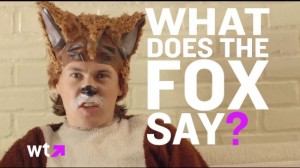
Still from What Does the Fox Say videoOnomatopoeia comes from the Greek words for name + making. It reflects the basic human urge to name things—to capture and communicate the essence of things. Yet term’s root exposes the problem: we make the names; we don’t find or discover them. Although we want to know things as they are, our efforts to name them are mere approximations. Still the drive to know and name remains strong. “What is your sound… Will we ever know,” the lead singer croons, lamenting (or perhaps celebrating) that what the fox says “will always be a mystery.” In this way, the video really does entertain existential questions that philosophers and poets have been pondering for centuries.

Filed Under: Family, Language, Poetry, Popular Culture, Teaching Tagged With: language, onomatopoeia

  • « Go to Previous Page
  • Page 1
  • Page 2

Copyright © 2026 · Infinity Pro on Genesis Framework · WordPress · Log in