• Skip to main content

Suzanne W. Churchill

  • DH Scholarship
    • Mina Loy
    • Gwendolyn Bennett
    • Modernist Magazines
  • Teaching
    • Recommendation Requests
    • Reading Tips
    • Secondary Source Reports
  • Writing
  • Painting
  • About Me
    • C.V.

Poetry

Of Mere Being

November 16, 2014 by Suzanne Churchill 5 Comments

I’ve just returned from a much anticipated, much dreaded three-day sojourn in Connecticut, where I saw Mom for the first time in her new living quarters, an extended care facility called Arden Courts. My family had given me a pretty clear picture of what to expect, but they couldn’t prepare me for the emotional wallop of seeing her, dozing in the common room, wheelchair-bound, listing to the side, head tilted back, arms stiff, legs atrophied, feet puffy in her unused shoes. She rouses when prodded, but mostly stares off in the distance. When she looks at you, her brown eyes seem glazed, as if milk has been added to the coffee she always preferred black and hot.

In past visits, I  found it challenging and even amusing to analyze Mom’s speech as if it were modernist poetry, with its odd juxtapositions and parataxis. I got satisfaction from trying to piece together the associative logic of whatever constellation of phrases she managed to utter. What my poetry reading training didn’t help me with, however, was her performance of the poems. When she strained and grunted to get words out, it was so excruciating that my intellect and imagination failed, and I was wrecked by a complex of grief (desire to hold on) and desire to flee.

IMG_5516But now Mom scarcely speaks at all, and when she does, she is barely audible. There is no longer any trace of associative logic. Just flutterings of weightless words, like dust bunnies that hop away when you try to sweep them into a dustpan. Language eludes her going in as well as coming out: she got no pleasure from listening to me read Jane Austen aloud. She seems remote and distant, like a cuckoo tucked away in an elaborately carved wooden clock. She chirped up when I talked about her grandsons, Luke, Thomas, and Zac, and she sang along to a couple of children’s songs that she used to sing to them at bedtime, “Jack Was Ev’ry Inch a Sailor” and “Edelweiss.” She couldn’t get out all the words, but her sweet, pure voice came through here and there, marred only by my quavering pitch.

Although she said little, she knew who I was. When I told her I loved her on the first day, she replied, “I love you, too, Suze.” On the second day, she didn’t seem to recognize me, but on the third, when I said, “Do you know who I am?” She said, “Of course I do.” “Who am I?” “You’re Suzanne Churchill.” When I cried (admittedly often), she smiled more, as if trying to cheer me up. Her strongest sentence, the one she can articulate most clearly and at appropriate times, is: “I love you very much.” One could do worse for famous last words.

It was hard to see her so altered, hard to realize that her caregivers would never know her as she had been—a lover of books and music; intellectually curious, meticulously dressed, and sociable; an ardent wife, devoted mother, loyal friend, anxious perfectionist.

Mark Olsen and Will Scheffer, creators of the HBO series “Getting On,” talk about these hard losses in an interview with Terry Gross on NPR’s Fresh Air. The show (which I haven’t seen but want to) is set in a women’s extended geriatric care facility, and the writers draw upon their own experiences caring for their aging mothers. Olsen’s description of his grieving process struck a chord:

I had that poetic little moment that was quite narcissistic that, oh my God, there will come a day when she says I love you for the very last time. And that was sort of my self-involvement with it initially.

But over the course of those years, I certainly learned that – that day did come, certainly, but the relationship did not die in any way, shape or form. It continued and progressed and had great value. … but when my mother finally lost the capacity to speak – because she was a very articulate woman, a very verbal woman with a very storied past – when she lost that ability to speak, and she was left with caretakers, it saddened me tremendously.

And it didn’t matter who the caretaker was, good caretaker, bad caretaker. It didn’t matter – that they would never know who this woman was.

That’s the bald reality of dementia: so much just doesn’t matter anymore. Even if her caretakers could know who she was, she wouldn’t know the difference.

You’d think losing language would make it harder to be with Mom, but strangely, I found it easier. My plan had been to visit twice a day, stopping in for a few minutes on my way to do research at the Beinecke Library and again at the end of the day. I thought short visits would be better—and probably all I could bear.

But now that she can barely speak, the only thing I can do is be with her, sitting beside her repeating stories about my life and hers, holding her hand, wheeling her around the halls and courtyard, and breathing with her when she gets agitated. An hour passed yet I had no desire to leave.

I didn’t understand my strange sense of quietude until I heard Will Scheffer’s explanation on Fresh Air:

I think what caring for our mothers really taught us, all the way up through the hospice experience was…that this part of life… that so many people are afraid of, and for good reason, it’s kind of a privilege to be able to be there when you can.

…that act of carrying on conversations with someone who can’t speak to you and being with them as they’re dying, there was a kind of sense of privilege that we began to feel and sort of a sense that gosh, you know, I was so afraid of this, I didn’t want to do it. I didn’t want to be here.

But being here is starting to feel like a good thing, a good part of life, something that we avoid in this culture but that actually is a rich experience, albeit painful. It actually is so much a part of life. And so many people never get to be in it.

I didn’t want to be here either. None of us did. I only get to be in it with Mom for a a handful of visits, a few times a year, so it is a privilege—”a rich experience, albeit painful”—to be with her as she withdraws, as her brain shrinks and the channels widen between its folds. As she diminishes into a state of mere being, all I can do is be with her—just be. That’s what my yoga teacher, Amy Schneider, invites us to do; she asks us to set aside our thoughts and feel “how good it feels to just be.” It’s a kind of meditative state, this mere being, one that makes me wonder what it feels like to be Mom, as she reaches the end of cognition and finds herself on the outskirts of language.

Wallace Stevens tried to imagine this state in his late poem, “Of Mere Being”:

Of Mere Being

The palm at the end of the mind,
Beyond the last thought, rises
In the bronze distance.

A gold-feathered bird
Sings in the palm, without human meaning,
Without human feeling, a foreign song.

You know then that it is not the reason
That makes us happy or unhappy.
The bird sings. Its feathers shine.

The palm stands on the edge of space.
The wind moves slowly in the branches.
The bird’s fire-fangled feathers dangle down.

~Wallace Stevens, 1954~

PiB_PET_Images_AD
PET scan of a brain with Alzheimer’s.

Stevens combines gleaming imagery and gorgeous alliteration to transport us beyond reason and emotion into a realm of pure sight and sound. I try to imagine what it’s like in Mom’s mind—”at the end of her mind,/ beyond the last thought.” She is moving to a state “without human meaning, / Without human feeling,” and it’s a “foreign song,” one I don’t understand and can’t sing. But there is a kind of grandeur to the utter, defiant loneliness of “mere being,” a primal beauty in the isolate calm. When Mom stares out into the distance, maybe she is seeing “fire-fangled feathers dangle down.” Or maybe she sees nothing at all. In any case, it is good to just be with her.

 

Filed Under: Alzheimer's, Family, Language, Poetry, Selfhood

Break a Leg

May 10, 2014 by Suzanne Churchill 2 Comments

As I said on Facebook, my folks can’t seem to get a break—well, they got one, but not the kind we wanted. A couple of weeks ago, Mom fell and broke her femur, near the hip joint. She may have had a second fall, but we don’t know the details. A caregiver found her, and my Dad spent another day in ER, while they took x-rays and CT-scans, eventually coming to the conclusion that she would need surgery. After surgery, she would need physical therapy and an extended stay in the Masonic hospital rehab wing, before she could return to the Hearth.

The doctor’s reports were more optimistic than I felt. Sure, they could screw the bone back into place, but how would Mom be able to manage with physical therapy? Even before the fall, she could scarcely follow directions to stand or sit. Another disorienting hospital stay was likely to wreak more havoc on her dwindling cognitive functions. How could her plaque-ridden brain possibly learn to walk again?

Doubts like these breed terrible thoughts like: why bother repairing the body when the mind is so damaged? Wouldn’t it be better if she could catch pneumonia and go swiftly, saved from the discomfort and indignities of hospitalization? Wouldn’t it be better if (Write it!) if she could just die?

There, I’ve written the unthinkable. It can’t get any worse, can it? To understand hopelessness, to fully inhabit despair, there’s no better place to turn to than the “terrible sonnets” of Gerard Manley Hopkins. Take this excerpt from “No worst, there is none“:

No worst, there is none. Pitched past pitch of grief,
More pangs will, schooled at forepangs, wilder wring.
Comforter, where, where is your comforting?
Mary, mother of us, where is your relief?
My cries heave, herds-long; huddle in a main, a chief
Woe, wórld-sorrow; on an áge-old anvil wince and sing —
Then lull, then leave off. Fury had shrieked ‘No ling-
ering! Let me be fell: force I must be brief.”‘
Hopkins cries out for relief from the burden of his own life. The pain is different, however, when your mind is silently shrieking, “No lingering! Let her be fell,” about your own mother. It’s less wild and turbulent, more muted and weighty—a dull, intermittent ache, a deadly desire that seems at once utterly human and miserably inhumane.

I used to think T. S. Eliot’s “Portrait of a Lady” was a miserably inhumane poem. It enacts a series of one-sided conversations between the speaker and the eponymous lady. She’s needy and suffocating, and he’s desperate to elude her emotional demands. After several evasive maneuvers, the speaker imagines the ultimate escape:

Well! and what if she should die some afternoon,
Afternoon grey and smoky, evening yellow and rose;
Should die and leave me sitting pen in hand
With the smoke coming down above the housetops;
Doubtful, for quite a while
Not knowing what to feel or if I understand
Or whether wise or foolish, tardy or too soon …
Would she not have the advantage, after all?

…And should I have the right to smile?

The speaker’s lack of empathy—his calculated distance from his own emotions—always struck me as cruelly misogynist. But now his imagined relief at the prospect of the lady’s death seems more human and uncomfortably familiar. When intimacy cannot be reciprocated—whether because of a disease of the psyche (Eliot’s modern condition) or the brain (Mom’s Alzheimer’s)—the relationship can feel oppressive and burdensome. You just want to escape, and death beckons slyly, like a guilty pleasure.

Yet with Alzheimer’s, another apparition also beckons: the glimpse of the person as you once knew her. She appeared to my brother one day, when she was lying in the hospital bed, dozing off mid-sentence, unable to focus. Then, suddenly, she looked at him and said, “I just don’t want to disappoint you.” Voila, there she is, as anxious to please as ever. A few days ago, on the phone with me, she asked, “So have they made their decisions?” clearly referring to Thomas and Luke’s college plans. As I rambled on in enthusiastic detail, she seemed to disappear and go silent. “Mom, are you there?  Mom? Hello? Can you give the phone to Dad, Mom?” Silence. TV noise in the background. “Give the phone to Dad, Mom. I’ve got to go. I love you.” Silence. “Mom? I’ve got to go. I love you.” Then, suddenly, she replies, “I love YOU very much,” so ardently and intentionally that I feel cradled in a blanket of maternal love. I tell her I love her and say good bye again. Another pause, and then she scrapes the most wrenching, “Goodbyyeeee,” from her throat. It sounds like ripping apart industrial strength Velcro.

In those rare, unexpected moments of connection, I feel as if Mom is still there, intact, but able only on fleeting occasions to break through the thick fog and express herself. She’s moved past that horrifying stage of the disease when she couldn’t recognize her own husband. She knows, trusts, and loves us. And at those moments when she manages to reach us, I know that when she dies, it will be much worse than I have imagined. So I want her to live.

Filed Under: Alzheimer's, Family, Poetry, Uncategorized

Microaggressions and the Need to Know More

April 13, 2014 by Suzanne Churchill 1 Comment

Microaggressions are in the news, nationally and locally. In a recent New York Times piece, “Students See Many Slights as Racial ‘Microaggressions,'” Tanzina Vega describes microaggressions as “the subtle ways that racial, ethnic, gender and other stereotypes can play out painfully in an increasingly diverse culture.” The concept isn’t new. It was developed in the 1970s by Dr. Chester M. Pierce, a professor of education and psychiatry at Harvard University, to describe the “subtle, cumulative miniassault that is the substance of today’s racism” (qtd by Brockenbrough).  Common parlance among social scientists and critical race theorists, microaggressions have recently spread from the higher echelons of academic discourse into the mainstream, causing a stir even in the bubble of tranquility that is Davidson College.

tumblr_n2yc7hTiIr1tw512jo1_1280Inspired by a Tumblr blog at Harvard University, students here have created their own Tumblr, I, Too, Am Davidson (echoing Langston Hughes’ “I, Too, Sing America“). Standing in front of the new mural depicting the College’s multicultural history, they hold signs citing microaggressions like, “After a party, the police stopped me and said, ‘Hurry up and get to your car and go back to your school.'”

Microaggressions may elicit shock, disbelief, anger, isolation, alienation, fear, shame, or any combination thereof. But as poet Claudia Rankine observed in her recent talk at Davidson, a victim’s response is often delayed. The immediate reaction tends to be silence.

Rankine explores this effect in her latest work, Citizen, a documentary prose poem that collects microaggressions from her own experiences and from interviews, such as this one:

You are in the dark, in the car, watching the black-tarred street being swallowed by speed; he tells you his dean is making him hire a person of color when there are so many great writers out there.
You think maybe this is an experiment and you are being tested or retroactively insulted or you have done something that communicates this is an okay conversation to be having.

Rankine uses the second-person “you” to put you, the reader, in the place of a microaggression victim. The use of “you” isn’t just a strategy for arousing empathy, however; it is also symptomatic of psychological alienation experienced by the victim who, instead of responding to the offender, goes silent, turning inward and questioning herself.

Rankine’s goal, she said, is to shorten the response time—that is, to offer language that may empower people to respond immediately and vocally to microaggressions, in order to promote healing and understanding.

In seeking to break the silence, Rankine’s experimental poetry is like the microaggression blogs (even if it doesn’t get as much internet traffic). Vivan Lu, co-creator of The Microaggressions Project, says the blog “gives people the vocabulary to talk about these everyday incidents that are quite difficult to put your finger on” (qtd by Vega). The blog testimonials are empowering acts of witnessing and protest: they allow people to assume ownership of damaging remarks, to reframe them, and to reverse the target. Contributing to a Tumblr may also replace feelings of marginalization and alienation with a sense of belonging to a community.

Athough these Tumblr sites are beneficial for the contributors, however, it’s less certain how much good they do for broader public discourse about race. Vega reports, “What is less clear is how much is truly aggressive and how much is pretty micro — whether the issues raised are a useful way of bringing to light often elusive slights in a world where overt prejudice is seldom tolerated, or a new form of divisive hypersensitivity, in which casual remarks are blown out of proportion.”

The concept of microaggression, by definition, does not imply intentional hostility or conscious racism. In Psychology Today, Derald Wing Sue and David Rivera define microaggressions as, “the brief and everyday slights, insults, indignities and denigrating messages sent to people of color by well-intentioned White people who are unaware of the hidden messages being communicated” [emphasis added]. Nevertheless, the term can lead to misunderstandings, in that it connotes aggression on the part of the microaggressor. From the Latin aggredi for “to attack,” the term aggression, even when miniaturized, doesn’t seem to allow for bumbling curiosity or hapless ignorance. For people unfamiliar with the social scientific definition who perceive themselves as implied offenders, the term microaggression may arouse defensiveness. “I hate the term microaggression,” I heard someone say, “it is itself a microaggression.”*

Which raises the question: are microaggressions reversible? This is a version of the controversial topic of reverse racism. My colleague Hilton Kelly, Associate Professor of Education Studies, who teaches courses on critical race theory, defines racism as “a system of advantages based on skin color.” He distinguishes racism from prejudice, the personal belief that one race is superior to another. Since racism is about deep-seated power inequalities, Kelly argues, it can’t be easily reversed. He offered the example of a white woman going to black nightclub, but feeling unwelcome and overhearing hostile remarks about her presence. Is this reverse racism? No, because the system still favors the white woman. As soon as she steps outside, who’s on her side? Whose side is the police and criminal justice system on? There may be prejudice the black nightclub, but it’s not racism unless it’s reinforced by a system of advantages based on skin color.

Okay, I said, but let’s take a local example: what about a black fraternity here at Davidson that won’t accept a white student? Kelly replied: “I’d need more information to respond to that question. For instance, I’d need to know, why is it that no one has asked the same questions about similar practices by white fraternities that went on for decades?” That’s not just a good point, I think; it’s good practice: ask for more information. Like racism, microaggressions aren’t reversible, but asking for more information is.

In my class the next day, when we’re scheduled to discuss Rankine, racism, and microaggressions, we start with an experiment. We stand in a circle and first identify our “triggers”: those remarks, attitudes, or behaviors that arouse anger and defensiveness, and shut down conversation about racism. Then we go around again and identify, “openers”: remarks, attitudes, or behaviors that encourage us to talk openly with each other. After we finish, one student observes:

Isn’t it interesting that our triggers are all different, but our openers are the same?

It’s a profound moment. Wow, I think, we’ve done it: we’ve broken through to a way we can talk openly about racism at Davidson.

Not so fast. A student raises the issue of affirmative action, asking if it is racist for positions to be taken away from whites and given to minorities. “Hmm,” I say, echoing Kelly: “I’d need more information to know if that’s racism. For instance, I’d need to know, why is it that no one complains about how many places were taken away from minorities and given to whites over the decades?”

“Good point,” someone murmurs.

The point isn’t mine, of course, and neither is the practice. But it is a good one. Instead of getting angry, try saying: I need to know more.

Take this example from the Davidson Tumblr, where a student makes the reasonable request, “Please stop asking why I can’t tolerate spicy food.” Presumably she’s been asked countless times, “Why don’t you like spicy food?” And she’s understandably annoyed by the question. But let’s reimagine that irritating encounter by applying Hilton Kelly’s approach:

— “Why don’t you like spicy food?”

— “That’s an interesting question. Why do you think I would like spicy food?”

— “Because you’re Asian.”

— “Asia’s a big, diverse continent. I wonder if tastes are consistent across any continent. Do you think North Americans like bland food?”

Is this approach putting more burden or responsibility on the minority? Maybe. But it’s also “shortening the response time” and giving everyone, including minorities, an opportunity to get beyond anger, and come to a greater understanding of the triggers that divide us and the openers that can bring us together.

And who knows? Maybe someday somebody will start a Tumblr, #NeedToKnowMore.


*The person who made this statement preferred not to be named, believing that openly expressing skepticism about the term microaggression would only incite more anger and resentment. This fear of reprisal reflects the polarizing effect the term can have: in this case, it foreclosed conversation.

Works Cited:

Brockenbrough, Ed, Ph.d. “Microaggressions: Conceptual Foundations.” Warner Graduate School of Education, Rochester University. Dec. 3, 2010. Accessed April 21, 2104.

I, Too, Am Davidson. Tumblr Blog. Accessed. April 13, 2014.

Kelly, Hilton. Personal Conversation. Summit Coffee House. Davidson College. March 20, 2014.

Sue, Derald Wing, Ph.D., and David Rivera, M.S. “Racial Microaggressions in Everyday Life.” Psychology Today. Published Oct. 5, 2010. Accessed April 21, 2014.

Vega, Tanzina. “Students See Many Slights As Racial Aggressions.” NewYorkTimes.com. May 21, 2014. Accessed April 13, 2014.

Filed Under: Language, Poetry, Popular Culture

Lay Back the Darkness

March 27, 2014 by Suzanne Churchill 2 Comments

If I’d read Edward Hirsch’s “Lay Back the Darkness” before writing my previous post, maybe I could have laid back some of my own darkness. Hirsch read the poem at Davidson a few years ago, but it didn’t speak to me then. That was well before Mom’s Alzheimer’s diagnosis. I’m a firm believer that poems open up to you when you need them, and shun you—sometimes quite rudely—when you don’t. Yesterday, watching the video of Hirsch’s talk at Davidson, I clearly needed this poem, because it not only opened up to me, but also extended its hands, saying, “Here’s another way, Suzanne, here’s another way to look at the situation.”

Lay Back the Darkness


My father in the night shuffling from room to room
on an obscure mission through the hallway.


Help me, spirits, to penetrate his dream
and ease his restless passage.


Lay back the darkness for a salesman
who could charm everything but the shadows,


an immigrant who stands on the threshold
of a vast night


without his walker or his cane
and cannot remember what he meant to say,


though his right arm is raised, as if in prophecy,
while his left shakes uselessly in warning.


My father in the night shuffling from room to room
is no longer a father or a husband or a son,


but a boy standing on the edge of a forest
listening to the distant cry of wolves,


to wild dogs,
to primitive wingbeats shuddering in the treetops.

Before he read this poem, Hirsch talked about poetry, saying, “I don’t know if you’ve ever had the experience—I hope you have—of sometimes reading a poem that is so… personal to you, so strong that it feels almost as if you’re writing the thing to which you’re actually only responding.” Hirsch then quoted the great Argentine writer, Jorge Louis Borges, who wrote in his own first book of poems:

Dear Reader,

Please forgive me for having written these poems first. It’s only something of an accident that I’m the unsure, ardent writer of these verses and you’re the reader.

It’s a strange plea, but what Borges alludes to, and what Hirsch underscores, is that uncanny feeling you get when you read a poem that speaks so exactly to your thoughts, feelings, and experiences that you could have written it yourself. When I listened to Hirsch read “Lay Back the Darkness” yesterday, I got that feeling.

If I did write that poem for Mom, it might go like this:

Play Back the Music


Dear Ed Hirsch,

Please forgive me for having rewritten your poem. It’s only something of an accident that I’ve become the unsure, ardent writer of your verse.


My mother in the Hearth shuffling from room to room
on an obscure mission through the hallway.


Help me, spirits, to penetrate her dream
and ease her uncertain passage.


Lay back the darkness for a lady
who could tidy everything but the shadows,


a musician who stands on the threshold
of a vast hall


without her walker or her heels
and cannot remember what she meant to say,


though her smile is bright, as if in greeting,
while her hands shake uselessly in worry.


My mother in the Hearth shuffling from room to room
is no longer a mother or a daughter or a wife,


but a girl standing on the edge of a dance
listening to the stirring thrum of song,


to young suitors,
to amorous heartbeats murmuring in the music.


800px-Olympic_Gardens_Dance_Hall,_Hunter_Street,_Halifax,_Nova_Scotia,_Canada,_ca-1._1948

Olympic Gardens Dance Hall, Hunter Street, Halifax, Nova Scotia, Canada, ca. 1948 [public domain].

Filed Under: Alzheimer's, Poetry

One Wild and Precious Life?

March 23, 2014 by Suzanne Churchill 6 Comments

IMG_1589Something there is that doesn’t love a post, that sends me off to Facebook, Buzzfeed, and email, even when I know I need to write. It’s been more than two weeks since I flew home to Connecticut to visit my folks, seeing them, for the first time, living in separate quarters: Dad in his new apartment; Mom in assisted living. There was so much to take in that I didn’t even miss the basement. Dad has turned the master bedroom into a workshop, and it’s so full of train paraphernalia, tools, boxes, and scrap materials that it feels a lot like the basement anyway. Outside the workshop, his apartment looked much better than I expected. He’s got it decorated with paintings, family photographs, and even a sconce holding a mint green candle. A woman in his bridge group told him, “You can tell this is a man’s apartment,” but I disagreed, saying the sconce alone was grounds for recalling his man card. The punctum (to borrow a term from Roland Barthes)—the detail that shot out like an arrow and pierced me—was not the sconce, however, but the corner cupboard. There was no room for it in the living room, so Dad put it in his bedroom, asking my sister to arrange Mom’s china collection just as she’d had it. There’s no language for love like that.

When we got to the Hearth, Mom recognized me from across the activity room, brightening when she saw me. I wonder what I looked like when I saw her there, sitting in a string of chairs lining the periphery of the room, supporting timeworn bodies of various  shapes, sizes, and degrees of motor control. My face, answering hers, must have mingled shock with recognition and relief as I compelled a smile. How many times in my childhood had I been among children’s choirs and Girl Scout troops paraded through nursing homes to cheer the elderly residents? Yet never once did I imagine my own parent sitting in one of those chairs.

I don’t think my Mom ever imagined playing Bingo either—or rather, trying to play Bingo, but having difficulty following the logic of the game and struggling with her shaky finger to slide the red plastic window across the number. Mom never liked Bingo, but now she joins whatever group activities are offered. She accepts a snack of three Lorna Doones, tasting one and saying, “Oh, that’s dry.” She eats them anyway, then swallows the juice from the Dixie cup delivered a few minutes later.

Stiff and unsteady, she walks slowly with a walker and needs help to stand and sit. When she’s moving by instinct, she can be quite agile: once she dropped a Kleenex, bent down, and retrieved it without a wobble. But if she has to think about what she’s doing or follow instructions, all systems overload, the mind freezes, and the body balks. I imagine moving through the world for her is like it would be for me if I lost my glasses: blurry, uncertain, and unnavigable.

Her cheeks are soft, smooth, and pink. She’s ready with a smile or laugh, and likes to give and receive compliments. She remains preoccupied with her own symptoms and ailments, giving unsolicited “organ recitals,” especially when Dad is around. She enjoys food without the fear of weight gain that haunted her all her life, and once, when Dad put his arm gently around her, she exclaimed, “That’s WONderful!”

There are jarring moments of clarity. When my sister and I were driving her to the nail spa for a manicure, she said, “I just hope I don’t give you both the disease I have.” Did she mean Alzheimer’s? Most of the time she no longer seems aware of her dementia, though she did qualify one remark, saying, “The thing that stands out most in my mind, and I don’t know if this is true…” The vision—of my sister as a toddler trying to run away—was probably true.

Most of what she says makes no sense. She mixes memory, imagination, and perception in an irrational blend. We try to find humor in the way she imagines suitors everywhere, wanting to marry her. Dad says, “Well, you can see why they would want to be with her. She’s a very attractive woman.” He says this without irony (another punctum). We no longer correct Mom or try to decipher her logic. Instead we just pick up a piece of something she says and thread it into something that makes sense to us, as if we were picking up a nightgown blown off the clothesline and pinning one corner back on, leaving the rest tossing in the wind.

Truth is, it’s not much fun spending time with her in the Hearth. You can’t have a real conversation, and there’s not much to do. Flip through photo albums, play a Broadway show CD, or take her down to the activity room to listen to a middle-aged guy play Irish songs on his keyboard. Pass a woman in the hall on the way who complains, “They say it was Irish music. That is NOT Irish music! It makes me sick to my stomach.” Sit next to another lady who seems much sharper than Mom. She looks right at you and says, “I am NOT happy.” You say, “I hope the music cheers you up,” and indeed it does, because during a jig, she’s singing along, tapping her feet, bobbing out of her seat; then a waltz makes her weep. You wish Mom would respond more to the music: she seems so vacant. When a male resident shuffles into the room, the lady next to you leaps up, exclaiming, “That’s my father!” She sits down, caught up in the next tune. You tell Mom you have to go and kiss her goodbye. She doesn’t seem sad.

Taking Mom out of the Hearth isn’t much fun, either. When you do, she’s so disoriented that she scarcely knows where she is or who you are. You steer her into the nail spa, and she stiffens in her seat. You have to stand behind her to keep her chair from rolling backward, and every so often, you prop her back up in her seat. You gently massage her arms and shoulders, trying to relax her muscles, but she doesn’t respond to your touch. When she gets back to the Hearth, she sleeps all afternoon.

You just want to avoid the situation. You’ve finally accepted that there’s nothing you can do, nothing you can fix. You can’t even soothe her. She will be happy to see you, but she won’t be unhappy when you leave. So leave. Get away. Put it out of your mind.

Because you’re thinking terrible thoughts: what is the point of such a life? Each day, a pattern of dull, meaningless activities, punctuated by snacks, meals, and bathroom breaks. Visits from family members, old friends, a doctor, nurse, an attendant blur together. Is she just filling space, killing time, waiting for the next small pleasure that’s offered to her—a sip of juice after a dry Lorna Doone?

And then you get really morbid: Is her life really so different from yours? Sure, you have more control, more agency, and decision-making power. You’re a productive citizen. But in her own way, she’s a productive citizen who also contributes to the economy: think how many jobs depend on her needs—cooks, caretakers, nurses, administrators. And aren’t you just living your own routine, waiting for the next pleasure that falls within your own, slightly larger orbit? What makes your life any more meaningful? What keeps you living, knowing that you’re on the same path of inevitable decline, leading inexorably to death?

See Robert Penn Warren, “American Portrait: Old Style“:

“But Jesus,” he cried, “What makes a man do what he does—

Him living until he dies!”

Suddenly, in these words, you see something not morbid but heroic in the human will to live. It’s a marvelous mystery, this impulse to go on, whether you’re confined to the Hearth or free to roam the earth. “Doesn’t everything die at last, and too soon?” Mary Oliver writes in “The Summer Day,” insisting that mortality renders life more piquant and precious, asking, “Tell me, what is it you plan to do / with your one wild and precious life?” Maybe, as Oliver suggests, our greatest task is to figure out “how to be idle and blessed,” as Mom surely is, secure in the Hearth.

IMG_1820I try to make peace with thoughts of heroic endurance and blessed idleness. Dad and I go to see Mom for the last time before he drives me to the airport to catch my flight home. Before I even get there, the wisdom of the poets is drowned out by the throbbing thought, “This may be the last time I see her that she recognizes me.” The visit isn’t any different from any other, except that I can’t stop thinking, “this may be the last time,” and I can’t stop weeping. The visit isn’t any different from the last; my sorrow stems from the sentimental frame I impose on the encounter. If only I could change the frame. Instead I kiss her goodbye and fly away.


Featured Image:  Steven Craven, “Christmas Day in a nursing home.” 24 December 2008. Geograph.org.uk. Creative Commons 2.0 licensed.

Filed Under: Alzheimer's, Family, Poetry, Uncategorized

Woman much missed

March 1, 2014 by Suzanne Churchill Leave a Comment

In Thomas Hardy’s poem, “The Voice,” repetition and rhyme create a haunting echo, sounding out a persistent tugging of desire that can neither be escaped nor fulfilled:

Woman much missed, how you call to me, call to me,
Saying that now you are not as you were
When you had changed from the one who was all to me,
But as at first, when our day was fair.

Read this stanza once, and the earworm will burrow into your mind. You can’t not feel the pain of longing in the repetition of the phrase, “call to me, call to me,” which is subsequently rhymed and ironically reduced to “all to me”—an echo of a former fullness that may never come again. You might not realize that you’re hearing a dactylic meter (“CALL to me, CALL to me”), but your body feels the strong beat that diminishes over time. Hardy’s sound patterns rehearse the inevitability of loss and the persistence of desire.

Today we received some good news about our sons Thomas and Luke on the college admissions front (nothing’s final until April, but they’re going to college!).  I’ve shared the news with my father and in-laws, because telling grandparents never feels like boasting. It feels more like giving them compliment—a way of saying, “Look who you helped bring into the world! Look who is carrying on your legacy!”

SCAN0001While I am bursting with joy and pride, I’m gutted by longing. I want to call my mother and tell her the news, too, because one else on earth would be more pleased than she.* My mom would remember holding those tiny babies in the hospital just after they were born, marveling at their big, bony heads and thin, fragile limbs, wondering how they ever came into being and how we would ever manage to keep them alive. My mom would feel the way I feel: a curious mixture of surprise and awe, combined with a sense of deja-vu, because we should have known and always have known how marvelous are these beings who have somehow, miraculously, become young men.

I don’t know if my longing is any different because my mom is still alive but prevented by Alzheimer’s from comprehending the news. I do know that, even though she’s alive, I’m already much missing her:

 Thus I; faltering forward,

      Leaves around me falling,
Wind oozing thin through the thorn from norward,
      And the woman calling.

In this case, though, I’m faltering forward, and I’m the woman calling. Thank goodness those boys are marching on.


*I say “on earth” in deference to my mother-in-law, Jane Churchill, who would be thrilled, too, though she probably would have been just as delighted by the “artistic” arrangements of laundry Luke and Thomas have left on the floor of their room.  Jane had a knack for finding beauty in things as they are, whereas my mom has always preferred things in their best form, especially when folded and neatly arranged.

Filed Under: Alzheimer's, Family, Poetry

Speak to me : Take my hand : What are you now?

January 19, 2014 by Suzanne Churchill 5 Comments

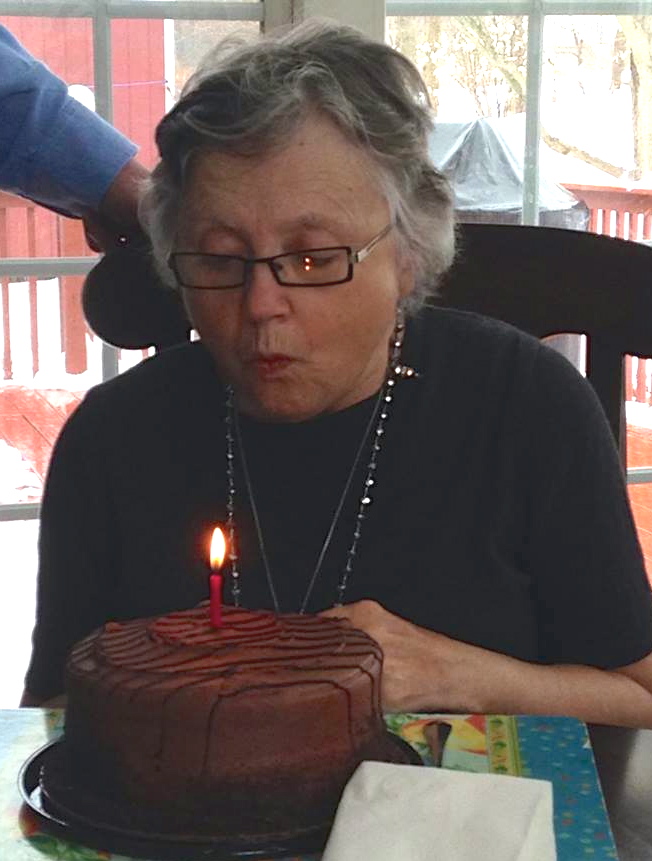
1532116_10202895045715800_602969367_nWhen I FaceTimed with my mom on January 5th—her 75th birthday—she was surprisingly “good.” I put that word in quotations marks because I’m uncomfortable with the moral judgment it seems to place on the natural course of her disease. Yet that’s the word that come to mind, and she was really, pretty good: she knew it was her birthday, she said she was 75, and she asked me (un-prompted), “What’s Matt doing?” The question meant that she not only knew who I was, but also remembered who I was married to. Conversation seemed pleasurable but tiring: by the time I summoned the kids to the screen to wish her a “Happy birthday,” she resorted to echolalia, wishing them “Happy Birthday” back, even though it wasn’t their birthday. She was cheerful and smiley. She seemed to be enjoying herself and the attention, not to mention the chocolate cake.

1557651_10202895045755801_1173266732_nIn our Face-Time encounter today, two weeks later, things weren’t so good. My sister reported last week that Mom had started exhibiting a strange symptom of straining to get words out, as if she had to wrench them out of her throat. I didn’t need to hear the guttural straining to know what my sister meant. I saw an early stage of the symptom in an expression that began appearing on Mom’s face last summer. A shadow would rise up on her face, lifting her eyebrows and wrinkling her forehead in a paralyzed anguish (you can see it happening in the photo on the left). “What does that expression on your face mean, Mom?” I asked, describing and mimicking it for her. She said she knew her face was doing that, but didn’t seem to know why. It was as her face was expressing things that her brain could no longer comprehend or control. Was it anxiety? Pain? Or just a neurological reflex?

Now the facial expression coordinates with speech, or rather, with the anguished effort to produce speech. She strains as if she has tear the words out of her body. Often words won’t come, or when they do, they stop mid-sentence. If you question her about the end of her sentence, or try to suggest a destination, she’s already forgotten it. In these moments, the effort to make conversation is futile, no matter how much we both want it to happen.

Our fragmented conversation reminds me of a fragmented scene in T. S. Eliot’s, The Waste Land, in which two lovers are bound in a fraught, intimate exchange. The first speaker desperately pleads for conversation, and the other lover refuses:

“Speak to me. Why do you never speak. Speak.
  “What are you thinking of? What thinking? What?
“I never know what you are thinking. Think.”
  I think we are in rats’ alley
Where the dead men lost their bones.

When I tried to talk to my Mom today, I felt as if I was silently urging her, “Speak to me. Speak. Speak.” It seemed as if her own mind was urging the same thing, pressing her to “Speak” and “Think.” And her own mind—or some other part of it—was as recalcitrant in refusing to cooperate as the lover in Eliot’s poem. Her mind had become a rat’s alley, and no matter how much she pressed it to speak, it would not give.

But maybe it’s not so bad for her. Psychologist Alan Dienstag, who conducts support groups for early Alzheimer’s patients, offers a reassuring perspective on the disease. Although Alzheimer’s is the disease Americans fear most, he says, it’s actually not the worst way to go, at least not for the patient. He tells this story about a workshop he ran:

There were about 20 people in the room and we were…going around the circle and people with early Alzheimer’s were talking about their lives and what they do to…give their lives meaning, find stimulating things to do, and so on. This man started talking about his experience as somebody with early Alzheimer’s, and he was painting a very…benign picture of it all. He said, “Well, you know, it’s difficult not to be able to remember, but I get up and I can do this and I can do that.” Basically he was just saying he’s fine, he’s OK. And over his shoulder, sitting behind him, was his wife. And she was crying…And I knew just how much he’d lost, how much she had lost.


…But there he was. He wasn’t uncomfortable. He really wasn’t. And so I think we project our feelings onto them, and we assume that they are suffering some terrible thing, but in fact that’s not necessarily the experience of it.

Listening to Dr. Dienstag’s interview helped me accept my Mom’s diagnosis: it was comforting to think that she wouldn’t suffer great pain—that for her, the worst was over. But now I’m not so sure. As I watch her on the screen, straining to extricate words, the effort appears agonizing. Maybe it isn’t physical pain. Maybe it’s emotional. Whatever it is, I can’t stand to see that look on her face and hear the words torn from her throat and shredded in the process. I feel like I’m not just witnessing pain, but actually inflicting it. By asking her questions and telling her about our lives, I’m putting her in a situation where she is compelled to speak, but cannot.

Our relationship has always been based on talking. Mom started reading aloud to my older sister and me well before I could understand the words. We spent the hot, humid summer days sitting in the living room in front of the fan as she read and read. When I was older, she would drive me places and tell stories about people’s lives and relationships—about marriage break ups, nervous breakdowns, jealousies and rivalries I was too young to understand but still fascinated by. I would ask questions, and she would always answer. Conversation became the fabric of our relationship.

So when she sees me, she knows, instinctively, that conversation should happen. And she can no longer make it happen. I can chatter on to fill the silence, but I’m not alleviating the pain that comes from the absence of reciprocation. Whose pain is it? Am I projecting my pain onto her, assuming she is “suffering some terrible thing,” as Dr. Dienstag says, when her experience is different? Her expression tells me I’m not projecting pain, though I’m probably mirroring it.

A few months ago, seeing her face on the screen gave me a sense of emotional connection, even when words faltered. But today, the effort of speech is too painful. I want to shut down the screen, to sit next to her and hold her hand, so that she won’t see me and feel like she has to speak.

Thinking about the effort of speech made me think of Muriel Rukeyser’s poem, “The Effort at Speech Between Two People.”  So I looked it up, and in one of those uncanny acts of grace, the poem handed me the very guidance I was looking for. Its recurrent refrain is:

:  Speak to me.          Take my hand.            What are you now?

In juxtaposing these phrases, the poem suggests that speaking to someone is analogous to taking that person’s hand. Both are reciprocal gestures of contact and communication. The poem also delivers a lesson I thought I’d already learned: we are always changing in relation to one another. So as my Mom and I continue to change (she on a more rapid course than I), I’m going to have to let go of speech and take her hand. That gesture may be my only answer to the question, “What are you now?” For now, anyway.

Filed Under: Alzheimer's, Family, Language, Poetry, Selfhood

Hard Rock Returns to the Panopticon

November 17, 2013 by Suzanne Churchill Leave a Comment

I’ve been teaching a unit on prisons in my first-year writing course, “Building Stories.” We read Michelle Alexander’s book The New Jim Crow, which offers a persuasive argument about how racial discrimination lies at the heart of the American prison system, even in the absence of explicit racial animus. Alexander doesn’t mention the French philosopher Michel Foucault, but when she describes the way in which our American disciplinary system has “perfected” itself, accomplishing social control in ever more subtle and insidious ways, she could be taking a page out of Foucault’s 1975 playbook, Discipline and Punish: the Birth of the Prison. Alexander and Foucault offer brilliant, eye-opening critiques of the criminal justice system, but in the immortal words of Carly Simon, “Nobody Does It Better” than poet Etheridge Knight, who, writing from prison in the 1960’s, tells us everything we need to know—and plenty that we might not want to know—about race and the American prison system.

320px-Presidio-modelo2To appreciate Knight’s genius, it helps to understand a bit of Foucault. In Discipline and Punish, Foucault develops a theory of “panopticism,” based on Jeremy Bentham’s 19th century model of the “panopticon,” a circular prison with a central watchtower. Foucault uses this prison prototype to illustrate a cultural shift in European disciplinary systems from the old, heavy style of thick-walled dungeons to a lighter and seemingly more enlightened style of perpetual surveillance. In this new model, prisoners assume they are under constant watch by the guards and thus begin to police themselves, or as Foucault puts it, “the major effect of the Panopticon” is “to induce in the inmate a state of conscious and permanent visibility that assures the automatic functioning of power” (319). By internalizing the condition of being watched, the inmates become part of a disciplinary system that controls not only their bodies, but also their minds; they become “caught up in a power situation of which they are themselves the bearers” and begin watching themselves (319).

Etheridge Knight’s 1968 poem “Hard Rock Returns to Prison from the Hospital for the Criminal Insane” offers a glimpse of a panopticist disciplinary regime from inside an American prison and from the perspective of its African American inmates. The poem depicts the way the inmates internalize a mode of surveillance, watching their folk hero Hard Rock and making assumptions about their own condition based on his behavior. What makes Knight’s poem so striking—and so disturbing—is that it reveals how the modern, “enlightened” system of criminal surveillance remains tied to the old system of whips and chains that disciplined black bodies during the era of slavery.

The unnamed speaker of the poem speaks in the first-person plural “we,” serving as a spokesman for the other inmates. He gets his authority from the common folk he cites, a collective voice who claims Hard Rock was “‘known not to take no shit / From nobody.’” Although we first learn of Hard Rock through word of mouth, the bulk of the first stanza is devoted to a visual description of the legendary hero. Folklore may proclaim his mythic status, but it is his visible “scars” that “prove” his greatness:

Split purple lips, lumbed ears, welts above
His yellow eyes, and one long scar that cut
Across his temple and plowed through a thick
Canopy of kinky hair.

The final detail, a “canopy of kinky hair,” is also the most significant racial marker, visually signaling the importance of race in defining Hard Rock’s defiant position within the disciplinary regime.

Although the “WORD” acquires significance through its capitalization, the act of watching dominates the poem: “we all waited and watched, like a herd of sheep,/To see if the WORD was true.” As in the first stanza, visual evidence assumes primacy over word of mouth. Power must be verified through a system of surveillance. Thus, when “the testing came,” it is a test “to see if Hard Rock was really tame” (emphasis added). The definitive answer to the test comes when Hard Rock returns from the “Hospital for the Criminal Insane,” after being subjected to a lobotomy as punishment for his defiance. He “just grinned and looked silly / His eyes empty like knot holes in the fence.” Deprived of sight, Hard Rock is dispossessed of power, reduced from his formerly heroic proportions to the pitiable object of the inmates’ collective gaze. Rather than being empowered by their own ability to watch Hard Rock, the inmates are shamed by his diminished status. They turn away, their “eyes on the ground. Crushed.” As the inmates see Hard Rock reduced from a “Destroyer” and “doer of things” to a passive, unseeing fool, they see themselves reflected in his tragically reduced image. Like Hard Rock, they are rendered powerless and incapable of doing anything:

We dreamed of doing but could not bring ourselves to do,
The fears of years, like a biting whip,
Had cut deep bloody grooves
Across our backs.

Here, the simile of the “biting whip” symbolically transports the inmates back to the conditions of slavery. The “fears of years…cut deep bloody grooves,” linking the system of panoptic surveillance to the violently racist regime that preceded it. Knight’s poem thus allows us to see what Foucault overlooks: the role of race in the systems of discipline and punishment that govern our modern, democratic society. Nearly half a century later, Michelle Alexander is drawing our attention back to a problem, which hasn’t gotten any better, even if it is less visible. Read her book, and see what you think.

Works Cited

Alexander, Michelle. The New Jim Crow: Mass Incarceration in an Age of Colorblindedness. New York: The New Press, 2010. Print.

Foucault, Michel. “Panopticism.” Ways of Reading. 5th ed. Ed. David Barholomae and Anthony Petrosky. Boston: Bedford/St. Martin’s, 1999. 312-342. Print.

Knight, Etheridge. “Hard Rock Returns to Prison from the Hospital for the Criminal Insane.” Poets.org. Academy of American Poets, 1997-2003. Web. 13 Nov. 2013.

Filed Under: Books, Poetry, Teaching

  • « Go to Previous Page
  • Page 1
  • Page 2
  • Page 3
  • Go to Next Page »

Copyright © 2026 · Infinity Pro on Genesis Framework · WordPress · Log in