• Skip to main content

Suzanne W. Churchill

  • DH Scholarship
    • Mina Loy
    • Gwendolyn Bennett
    • Modernist Magazines
  • Teaching
    • Recommendation Requests
    • Reading Tips
    • Secondary Source Reports
  • Writing
  • Painting
  • About Me
    • C.V.

All Posts

2014 Holiday Letter (by Matt Churchill)

February 14, 2014 by Suzanne Churchill 3 Comments

February 14, 2015

Dear friends and family,

Happy Valentines Day! 2014 was an eventful year in the Churchill household, with each kid hop-skipping off to new schools, and Suzanne leaping into a sabbatical, while I learned the old age shuffle. Yes, the “highlight” of my year was arthroscopic knee surgery.

Now I’m not one to complain, but you would think that when I’m going under the knife, Suzanne would be clutching her rosary beads and praying for my welfare. Instead, when I come out of the general anesthetic, I find that she’s been posting to Facebook about the lawn mower and polyp removal conversations she’s overheard in the waiting room and debating with her friends as to whether I’d be able to meet my weekend cooking obligations (not a chance!).

10731069_10205188736868323_6438003542574538943_nBut I have to forgive Suzanne. She was probably distracted by her upcoming 2-week trip to Russia as part of a Davidson College-sponsored faculty study tour (read about the experience on the “Studio R” blog), or the subsequent weeklong digital studies course in Victoria, British Columbia, or the potential “trials” of a year long sabbatical, or preparing for our Halloween trip to New Orleans for my brother Ian’s marriage to Pamela Waggoner (though as you can see from this photo, we didn’t dress up much). I recently asked Luke whether he had any inkling as to future career possibilities, and his reply was something like, “Well, Mom’s job seems pretty good right now!” Heck yeah.

I have to admit that I also enjoyed a work sabbatical last summer. Every 5 years my law firm allows for a 3-week “vaccatical” that we used to take a family trip to Italy and Switzerland. We feasted with Suzanne’s sister’s family for a week in Tuscany, toured 1,000 or so churches in Rome and enjoyed the extraordinarily generous hospitality of Suzanne’s Swiss relatives. Robin, Pat and Florence Alder hosted us at their vacation place on Lake Lugano in Southern Switzerland, took us on a tour of the Wallis Valley (including an unforgettable sunrise cable car ride to the top of the Eggishorn mountain and a day-long hike along the Aletsch glacier), and suffered through our gallant, but generally failed, attempts at water skiing. It was a real treat. The Schollenbergers also hosted us in Kusnacht, treating us to delicious meals and a guided family history tour of the town (with ice cream).

IMG_3668
Despite a significant amount of parental angst, Thomas and Luke appear to have both found ideal college situations, which makes it a lot easier for their parents to bear the long distance separation.

Thomas, 18, set his sights on Stanford early, and I thought his application was pretty strong, except for the “letter to your future roommate” essay. Thomas chose to tie this essay to the T.V. sitcom, “How I Met Your Mother” and the “Bro-Code” modeled therein (which I loosely interpret as a vow to lie to your parents to protect your brother). He also borrowed the main character’s trademark expression of describing any “legendary” experience as, “legen . . . wait for it . . . dary.”   I was pretty dead set against this essay and told Thomas that I thought it was going to be “legen . . . wait for rejection . . . dary,” but he stuck to his guns. And of course, when the acceptance letter came, the admissions officer told him she thought his time at Stanford would be “legen . . . wait for it . . . dary.”

Luke, 18, chose Washington University in St. Louis, which has a stellar academic reputation, a beautiful campus, and one of the worst names since Beaver College (my and Suzanne’s study abroad alma mater). Now I can understand adding a geographic descriptor if you need to distinguish between UNC Chapel Hill and UNC Wilmington, but do we really need to highlight St. Louis here? Our friend, Kristi, thinks my reaction stems from an anti-Midwest bias, but I beg to differ. I really like Chicago! Just to get on Luke’s nerves, I’m trying to convince members of my family to add geographic locators to their schools as well. So Suzanne could say she sent to Middlebury College in Middlebury and teaches at Davidson College in Davidson.

Zac, 13, is in 8th grade at J.M. Alexander Middle School (in Huntersville), which feeds into the I.B. program at North Mecklenburg High School (in Huntersville), from which Luke and Thomas graduated in the spring. When queried about the adjustment he’s had to make due to his older brothers’ departures, Zac opined that, “it’s no different” and promptly returned to Insta-gramming all of the other 13-year-olds that now dominate our neighborhood. Zac’s grown about 6 inches in the past 3 weeks (and added a bit of teenage attitude), but he still maintains a happy-go-lucky vibe that we treasure.

This year was not without significant loss. Suzanne’s Mom, Valerie Wintsch, suffered through the end stages of Alzheimer’s disease and just died peacefully early this January. Suzanne has written blog entries about Valerie and Alzheimer’s that I recommend to you (click on the topic “Alzheimer’s” in the right sidebar). We’ll all miss Valerie’s sparkle, warm chuckle, and fierce love for and devotion to her family.

Moments like this remind us of how important you, our friends and family, are to us, and how lucky we are to have you in our lives. We hope to see many of you in 2015, and we now even have a few extra bedrooms if you’d like to visit us in North Carolina. We promise that your visit with us will be legen . . . wait for it . . . dary!

Lots of love,

Matt, Suzanne, Thomas, Luke and Zac
 

Filed Under: Holiday Letters

Speak to me : Take my hand : What are you now?

January 19, 2014 by Suzanne Churchill 5 Comments

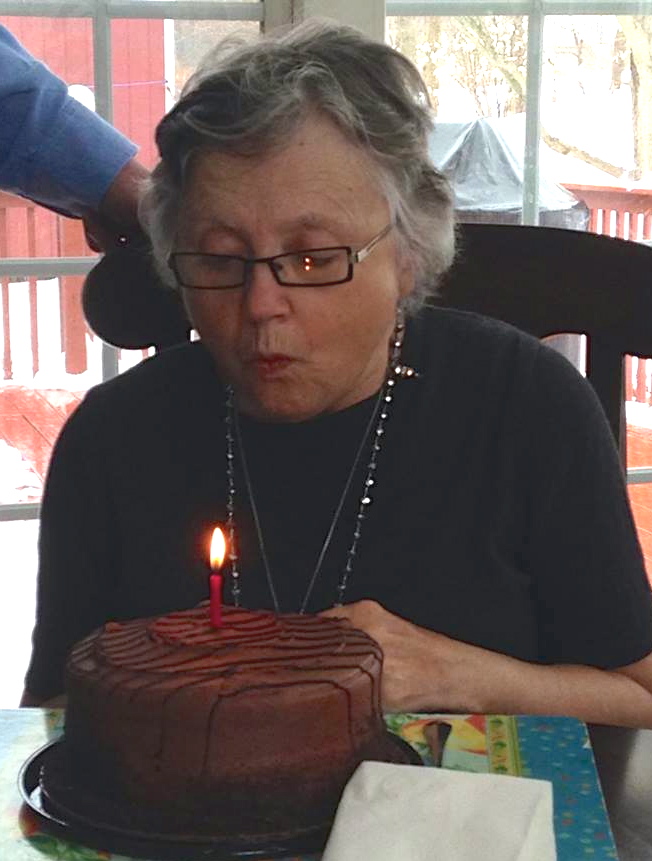
1532116_10202895045715800_602969367_nWhen I FaceTimed with my mom on January 5th—her 75th birthday—she was surprisingly “good.” I put that word in quotations marks because I’m uncomfortable with the moral judgment it seems to place on the natural course of her disease. Yet that’s the word that come to mind, and she was really, pretty good: she knew it was her birthday, she said she was 75, and she asked me (un-prompted), “What’s Matt doing?” The question meant that she not only knew who I was, but also remembered who I was married to. Conversation seemed pleasurable but tiring: by the time I summoned the kids to the screen to wish her a “Happy birthday,” she resorted to echolalia, wishing them “Happy Birthday” back, even though it wasn’t their birthday. She was cheerful and smiley. She seemed to be enjoying herself and the attention, not to mention the chocolate cake.

1557651_10202895045755801_1173266732_nIn our Face-Time encounter today, two weeks later, things weren’t so good. My sister reported last week that Mom had started exhibiting a strange symptom of straining to get words out, as if she had to wrench them out of her throat. I didn’t need to hear the guttural straining to know what my sister meant. I saw an early stage of the symptom in an expression that began appearing on Mom’s face last summer. A shadow would rise up on her face, lifting her eyebrows and wrinkling her forehead in a paralyzed anguish (you can see it happening in the photo on the left). “What does that expression on your face mean, Mom?” I asked, describing and mimicking it for her. She said she knew her face was doing that, but didn’t seem to know why. It was as her face was expressing things that her brain could no longer comprehend or control. Was it anxiety? Pain? Or just a neurological reflex?

Now the facial expression coordinates with speech, or rather, with the anguished effort to produce speech. She strains as if she has tear the words out of her body. Often words won’t come, or when they do, they stop mid-sentence. If you question her about the end of her sentence, or try to suggest a destination, she’s already forgotten it. In these moments, the effort to make conversation is futile, no matter how much we both want it to happen.

Our fragmented conversation reminds me of a fragmented scene in T. S. Eliot’s, The Waste Land, in which two lovers are bound in a fraught, intimate exchange. The first speaker desperately pleads for conversation, and the other lover refuses:

“Speak to me. Why do you never speak. Speak.
  “What are you thinking of? What thinking? What?
“I never know what you are thinking. Think.”
  I think we are in rats’ alley
Where the dead men lost their bones.

When I tried to talk to my Mom today, I felt as if I was silently urging her, “Speak to me. Speak. Speak.” It seemed as if her own mind was urging the same thing, pressing her to “Speak” and “Think.” And her own mind—or some other part of it—was as recalcitrant in refusing to cooperate as the lover in Eliot’s poem. Her mind had become a rat’s alley, and no matter how much she pressed it to speak, it would not give.

But maybe it’s not so bad for her. Psychologist Alan Dienstag, who conducts support groups for early Alzheimer’s patients, offers a reassuring perspective on the disease. Although Alzheimer’s is the disease Americans fear most, he says, it’s actually not the worst way to go, at least not for the patient. He tells this story about a workshop he ran:

There were about 20 people in the room and we were…going around the circle and people with early Alzheimer’s were talking about their lives and what they do to…give their lives meaning, find stimulating things to do, and so on. This man started talking about his experience as somebody with early Alzheimer’s, and he was painting a very…benign picture of it all. He said, “Well, you know, it’s difficult not to be able to remember, but I get up and I can do this and I can do that.” Basically he was just saying he’s fine, he’s OK. And over his shoulder, sitting behind him, was his wife. And she was crying…And I knew just how much he’d lost, how much she had lost.


…But there he was. He wasn’t uncomfortable. He really wasn’t. And so I think we project our feelings onto them, and we assume that they are suffering some terrible thing, but in fact that’s not necessarily the experience of it.

Listening to Dr. Dienstag’s interview helped me accept my Mom’s diagnosis: it was comforting to think that she wouldn’t suffer great pain—that for her, the worst was over. But now I’m not so sure. As I watch her on the screen, straining to extricate words, the effort appears agonizing. Maybe it isn’t physical pain. Maybe it’s emotional. Whatever it is, I can’t stand to see that look on her face and hear the words torn from her throat and shredded in the process. I feel like I’m not just witnessing pain, but actually inflicting it. By asking her questions and telling her about our lives, I’m putting her in a situation where she is compelled to speak, but cannot.

Our relationship has always been based on talking. Mom started reading aloud to my older sister and me well before I could understand the words. We spent the hot, humid summer days sitting in the living room in front of the fan as she read and read. When I was older, she would drive me places and tell stories about people’s lives and relationships—about marriage break ups, nervous breakdowns, jealousies and rivalries I was too young to understand but still fascinated by. I would ask questions, and she would always answer. Conversation became the fabric of our relationship.

So when she sees me, she knows, instinctively, that conversation should happen. And she can no longer make it happen. I can chatter on to fill the silence, but I’m not alleviating the pain that comes from the absence of reciprocation. Whose pain is it? Am I projecting my pain onto her, assuming she is “suffering some terrible thing,” as Dr. Dienstag says, when her experience is different? Her expression tells me I’m not projecting pain, though I’m probably mirroring it.

A few months ago, seeing her face on the screen gave me a sense of emotional connection, even when words faltered. But today, the effort of speech is too painful. I want to shut down the screen, to sit next to her and hold her hand, so that she won’t see me and feel like she has to speak.

Thinking about the effort of speech made me think of Muriel Rukeyser’s poem, “The Effort at Speech Between Two People.”  So I looked it up, and in one of those uncanny acts of grace, the poem handed me the very guidance I was looking for. Its recurrent refrain is:

:  Speak to me.          Take my hand.            What are you now?

In juxtaposing these phrases, the poem suggests that speaking to someone is analogous to taking that person’s hand. Both are reciprocal gestures of contact and communication. The poem also delivers a lesson I thought I’d already learned: we are always changing in relation to one another. So as my Mom and I continue to change (she on a more rapid course than I), I’m going to have to let go of speech and take her hand. That gesture may be my only answer to the question, “What are you now?” For now, anyway.

Filed Under: Alzheimer's, Family, Language, Poetry, Selfhood

2013 Holiday Letter (by Matt Churchill)

December 26, 2013 by Suzanne Churchill

bridge
Luke, Suzanne, Thomas, Matt, and Zac
on a college tour in New England.


December 2013

PO Box 2143
Davidson, NC 28036


Dear friends and family,

‘Tis the season of college applications, and our children are nestled all snug at their laptops, while visions of essay prompts dance in our heads:

What’s the first thing that comes to mind when you see the word “Future”?

Suzanne’s Answer: Tense.

But I reject that pessimistic attitude.  When I see the word, “Future,” I think: Digital Age. And in that spirit, I offer this guide to the actual and virtual worlds we’ve explored in the past year.

If you haven’t joined the digital world yet, don’t worry.  I’m just baby-steps ahead of you.  I did manage to join Facebook on December 1, 2012 (thanks to my brother-in law, Scott) but forgot my password within a month and only managed to recover it a few days ago. So I must have missed out on a ton, right?!  Let’s see . . . brother Andy is drinking too much Stag’s Leap ’97 at a restaurant in Amherst; brother Ian has changed his profile picture to a clown face; and brother Bruce is eating lunch at the Museum of Fine Arts in Boston but skipping the art.  Hmm – and they say teenagers should clean up their digital footprints!

Fortunately, Suzanne is on the cutting edge of the digital world, writing a blog on high-minded topics like the viral, pop song sensation, “What Does the Fox Say?”  She’s also featured quite prominently (in a hot, polka-dot dress I might add) in Davidson College’s website news release on a digital studies grant.

Kennesia
Kennesia and Zac

But I learn the most useful digital tidbits from the young people in my life – and we’ve had a couple of new additions to our family this year (intriguing, no?).  Kennesia Martin, who became part of our family when she was a student at Davidson, moved in with us this fall as she began her career as a middle school math teacher in the Charlotte-Mecklenburg public school system. Kennesia not only teaches her students algebra and geometry M-F, but also, on holiday occasions, leads them in line dances like the “Stanky Legg.”

One of the highlights of my 2013 was to injure my left knee during an early morning workout.  I went to an orthopedic surgeon for a diagnosis of the dramatic swelling – Did I blow out my ACL or MCL or break my lateral tibia plateau like Kobe Bryant?  No, the surgeon replied, you’ve just been born with a slightly misaligned kneecap.  Yes, folks, it turns out that I was born with a stanky legg.

Flo  Ra
Florence and Rachel practicing
the universal language of laughter.

Our 14-year old Swiss cousin, Florence, who stayed with us for 3 weeks over the summer to improve her English language skills, has no such issue.  A snowboarding whiz, she zipped around on a ripstik and danced along the ropes course at the Charlotte Whitewater Center. Florence was a joy to be around and, along with our 14-year old neighbor, Rachel, proved that uncontrollable giggling is a trait of adolescent girls worldwide.  Suzanne has enjoyed the influx of estrogen into the household, watching classic chick flicks like “Safe Haven” while we were staying in a beach house near where the movie was filmed.

Luke and Thomas, 17, are seniors in high school and have the pleasure of spending their Christmas vacations answering college essay prompts like, “What would you hope to find at the other end of the rainbow?”  Thomas’ response:  “Breakfast.”  While neither has created his own nonprofit nor solved any previously unanswerable mathematical proofs, they did recently collaborate to build a life-sized, gingerbread house, decorated with Christmas lights, fake snow, and math equations, for a school project—an artistic achievement topped only by their performances in the classic film short, “Can We Have Our Ball Back?”

Zac, 12, and in 7th grade, is eagerly anticipating his older brothers’ departure for college (he has great plans for converting their bedroom into a rec-room of his own). Always trying to keep up with his brothers’ high standards, he’s written his first screenplay, “Rescuing Ricardo” (running time: 120 seconds). Plot synopsis: mean-spirited Ricardo has a moral awakening when he goes into the twilight forest in pursuit of his neighbor, Bill, the dumpster-diver. Ricardo first encounters the great ninja Ishikushu, whom he vanquishes with his super laser gun, only to face four, highly trained army men with knives, guns, and black belts in karate.  As the army men charge him, he calls for backup on his walkie-talkie, and a helicopter drops two AK-47s, which he uses to mow down his adversaries.  Ricardo rescues Bill and apologizes for his past, rude behavior, pledging, “Now I will be nice to everyone because I do not want this to happen again.”

Now you may be having a similar reaction to this letter, but there are some things in life that are worth repeating, like childhood photographs and visits to Davidson, NC. As much as we love stalking your Facebook pages, we’d rather see you in person.  We’ll have an extra room when Luke & Thomas (hopefully) matriculate in the fall, and the dance floor will always be open.  In fact, if you are lucky, we might even teach you the Stanky Legg.

Happy New Year!

Matt, Suzanne, Thomas, Luke, and Zac

Filed Under: Holiday Letters

Are You My Mother?

December 12, 2013 by Suzanne Churchill

IMG_1612This photo was taken in October 2013, the last time I saw my mother. She looks just like herself, doesn’t she? That’s because I had just washed and styled her hair for her. (Although Dad had been reminding her to take showers, I’m not sure if or with what she’d been washing her hair.) I also picked out her outfit and helped her put it on in the right order. (She’d put on the wool cardigan without a blouse under it.)

I look like myself, too, if a bit red-nosed and puffy eyed. You see, I’d been crying. We’d just taken Mom on a tour of the assisted living wing, “The Hearth,” where she would be moving next week. I had willed myself to be strong and cheerful, but as soon as I walked through the door the tears brimmed up and over and would not stop. I wasn’t upset by my immediate surroundings. Rather, I was crying backwards, for my godmother Millie who died of Alzheimer’s in 2007, and forward, for my mother, whose Alzheimer’s guaranteed her the same fate.

The last time I visited Millie, she was in the assisted living wing of Whitney Center, sitting vacantly in a wheelchair. I had expected that she wouldn’t recognize me, but I thought she would still greet me with a jaunty, “Oh, hello!” Instead, she was utterly absent. Here, physically, was Millie. Yet she was gone.

At the time of this photo, Mom wasn’t gone yet. She still had her sweet, cheerful, anxiously do-gooding personality. She still recognized me. Speaking coherent sentences was difficult, as was comprehending anything but simple, concrete sentences. But she could still apprehend and communicate feelings: though her facts were often wrong, the emotions were true. Given how disoriented she was in time and space, however, I wasn’t sure she understood that she’d be moving to the Hearth—permanently and without Dad. But she knew that something was up, and she had mixed feelings about it. “I just want to make sure I can leave if I don’t like it,” she said in a jarring moment of clarity. “You’ll like it, Mom,” I replied evasively, more hopeful than confident, “You won’t be lonely here, and you and Dad can enjoy each other’s company again, without so much stress.”

Entering the Hearth with Mom felt like the first step in letting her go. Now, two months later, I feel like I’ve lost her because her new home has terrible cell phone reception and no WiFi. Cell phone service no longer matters: we’re past the point where we can communicate meaningfully by phone. But sitting face to face via Skype, I feel like I can still connect with Mom. No matter how garbled the words, we can still see each other’s expressions, gestures, and emotions. This will change, of course. The last time I Skyped with her, Mom told me I looked different. Meaning: I don’t look familiar to her. Meaning: soon she won’t recognize me.

“Gone” is the language we use to describe the effects of Alzheimer’s. After a bad patch, when Mom didn’t recognize Dad—thought he was the gardener, though we never had a gardener—he cried and said, “she’s really gone.” Then, on an another day, “she was almost like herself again.” But the following day, she chose to stay and finish watching a movie with her new companions, rather than joining him for their ritual glass of sherry. Was she turning down an invitation from her husband of 50 years, or from a strange man who, in that moment, she did not recognize? And if she didn’t recognize him, was it Mom who turned down the invitation, or someone else? Was Mom “gone” again? Will she reappear? When will she resurface for the last time?

These unanswerable questions suggest the inadequacy of our language, both for dealing with Alzheimer’s and for embracing the complexity of selfhood. Alzheimer’s is a disease that, in attacking the brain rather than the body, destroys what we think of as the essence of the self. How much of ourselves resides in memories of our life experiences and in our ability to recognize the people we love? If I can’t remember my life, my lover, or even my own name, am I still myself? If I’m “gone,” but my body still breathes, eats, and sleeps, who has that body become?

This fear of losing the self rests on a false understanding of selfhood as something bounded and constant, rather than permeable and changing. David Hilfiker, who writes a blog reflecting on his own Alzheimer’s, draws attention to this common misunderstanding of selfhood in Western culture:

Buddhist teachings remind us that there is no constant “self.”  (See my “Letting Go of Self.”)  The Western idea that our self stays the same throughout our life just isn’t very accurate.  In fact, our self changes continuously and dramatically throughout our life.  The Buddhist teachings point out that clinging to any particular self-image is sure to bring suffering because the self will not fit the desired image forever.  Let it go!

We change throughout our lives, in mind and body. Twenty years ago, I was not a mother or a professor, now I am both, and someday I will stop being a professor, but keep being a mother. My fear of heights has gotten worse, and my fear of embarrassing myself has lessened, though I’ve had plenty of practice with both. And I used to love chocolate, but hate wine and coffee; now, fortunately, I love them all. Have I mentioned my grey hair?

We are always changing, and Alzheimer’s accelerates the rate of change, rendering it more palpable and volatile. Other degenerative diseases have similar effects, diminishing the capacity of the body rather than of the mind. When a person with ALS wakes up one day and can’t move his arms or legs, we don’t say, “he’s gone.” So when my Mom wakes up one day and can’t recognize me, I won’t say, “she’s gone.”  I will know she’s changed, and so have I.

But the immeasurable ways in which we have changed each other—molded each other’s selves through the impressions (including the bumps and bruises) we’ve left upon each other along the way—cannot be undone. I like to think that, even when she can no longer recognize me, Mom is still carrying me with her, if only in her muscle memory. And I’ll carry her with me for as for as long as I can remember her and as long as my heart beats.

Filed Under: Alzheimer's, Family, Language, Selfhood Tagged With: alzheimer's, daughter, family, mother, self

Hard Rock Returns to the Panopticon

November 17, 2013 by Suzanne Churchill Leave a Comment

I’ve been teaching a unit on prisons in my first-year writing course, “Building Stories.” We read Michelle Alexander’s book The New Jim Crow, which offers a persuasive argument about how racial discrimination lies at the heart of the American prison system, even in the absence of explicit racial animus. Alexander doesn’t mention the French philosopher Michel Foucault, but when she describes the way in which our American disciplinary system has “perfected” itself, accomplishing social control in ever more subtle and insidious ways, she could be taking a page out of Foucault’s 1975 playbook, Discipline and Punish: the Birth of the Prison. Alexander and Foucault offer brilliant, eye-opening critiques of the criminal justice system, but in the immortal words of Carly Simon, “Nobody Does It Better” than poet Etheridge Knight, who, writing from prison in the 1960’s, tells us everything we need to know—and plenty that we might not want to know—about race and the American prison system.

320px-Presidio-modelo2To appreciate Knight’s genius, it helps to understand a bit of Foucault. In Discipline and Punish, Foucault develops a theory of “panopticism,” based on Jeremy Bentham’s 19th century model of the “panopticon,” a circular prison with a central watchtower. Foucault uses this prison prototype to illustrate a cultural shift in European disciplinary systems from the old, heavy style of thick-walled dungeons to a lighter and seemingly more enlightened style of perpetual surveillance. In this new model, prisoners assume they are under constant watch by the guards and thus begin to police themselves, or as Foucault puts it, “the major effect of the Panopticon” is “to induce in the inmate a state of conscious and permanent visibility that assures the automatic functioning of power” (319). By internalizing the condition of being watched, the inmates become part of a disciplinary system that controls not only their bodies, but also their minds; they become “caught up in a power situation of which they are themselves the bearers” and begin watching themselves (319).

Etheridge Knight’s 1968 poem “Hard Rock Returns to Prison from the Hospital for the Criminal Insane” offers a glimpse of a panopticist disciplinary regime from inside an American prison and from the perspective of its African American inmates. The poem depicts the way the inmates internalize a mode of surveillance, watching their folk hero Hard Rock and making assumptions about their own condition based on his behavior. What makes Knight’s poem so striking—and so disturbing—is that it reveals how the modern, “enlightened” system of criminal surveillance remains tied to the old system of whips and chains that disciplined black bodies during the era of slavery.

The unnamed speaker of the poem speaks in the first-person plural “we,” serving as a spokesman for the other inmates. He gets his authority from the common folk he cites, a collective voice who claims Hard Rock was “‘known not to take no shit / From nobody.’” Although we first learn of Hard Rock through word of mouth, the bulk of the first stanza is devoted to a visual description of the legendary hero. Folklore may proclaim his mythic status, but it is his visible “scars” that “prove” his greatness:

Split purple lips, lumbed ears, welts above
His yellow eyes, and one long scar that cut
Across his temple and plowed through a thick
Canopy of kinky hair.

The final detail, a “canopy of kinky hair,” is also the most significant racial marker, visually signaling the importance of race in defining Hard Rock’s defiant position within the disciplinary regime.

Although the “WORD” acquires significance through its capitalization, the act of watching dominates the poem: “we all waited and watched, like a herd of sheep,/To see if the WORD was true.” As in the first stanza, visual evidence assumes primacy over word of mouth. Power must be verified through a system of surveillance. Thus, when “the testing came,” it is a test “to see if Hard Rock was really tame” (emphasis added). The definitive answer to the test comes when Hard Rock returns from the “Hospital for the Criminal Insane,” after being subjected to a lobotomy as punishment for his defiance. He “just grinned and looked silly / His eyes empty like knot holes in the fence.” Deprived of sight, Hard Rock is dispossessed of power, reduced from his formerly heroic proportions to the pitiable object of the inmates’ collective gaze. Rather than being empowered by their own ability to watch Hard Rock, the inmates are shamed by his diminished status. They turn away, their “eyes on the ground. Crushed.” As the inmates see Hard Rock reduced from a “Destroyer” and “doer of things” to a passive, unseeing fool, they see themselves reflected in his tragically reduced image. Like Hard Rock, they are rendered powerless and incapable of doing anything:

We dreamed of doing but could not bring ourselves to do,
The fears of years, like a biting whip,
Had cut deep bloody grooves
Across our backs.

Here, the simile of the “biting whip” symbolically transports the inmates back to the conditions of slavery. The “fears of years…cut deep bloody grooves,” linking the system of panoptic surveillance to the violently racist regime that preceded it. Knight’s poem thus allows us to see what Foucault overlooks: the role of race in the systems of discipline and punishment that govern our modern, democratic society. Nearly half a century later, Michelle Alexander is drawing our attention back to a problem, which hasn’t gotten any better, even if it is less visible. Read her book, and see what you think.

Works Cited

Alexander, Michelle. The New Jim Crow: Mass Incarceration in an Age of Colorblindedness. New York: The New Press, 2010. Print.

Foucault, Michel. “Panopticism.” Ways of Reading. 5th ed. Ed. David Barholomae and Anthony Petrosky. Boston: Bedford/St. Martin’s, 1999. 312-342. Print.

Knight, Etheridge. “Hard Rock Returns to Prison from the Hospital for the Criminal Insane.” Poets.org. Academy of American Poets, 1997-2003. Web. 13 Nov. 2013.

Filed Under: Books, Poetry, Teaching

Basement Elegy

November 17, 2013 by Suzanne Churchill 1 Comment

A Christmas play staged in the basement, c. 1978 (the only basement photo I have).
A Christmas play staged in the basement, c. 1978
(the only basement photo I have).

My dad and siblings are cleaning out my parents’ basement this weekend. I get occasional texts from my sister with a photo of an Irish wool sweater, or the nurse’s costume Nana made me one Halloween, so tiny it looks like it was made for a doll: “Do you want this?” No, to the wool sweater (I’m allergic). Yes, to the nurse costume (I’m nostalgic). But I really don’t want anything that’s in the basement; I want the basement.

The basement has been such a basic fact of my existence that I didn’t recognize its significance until its dismantling. In my earliest memories, it was a dark, cool, mysterious place, reserved for my father’s tools and model train set. It was a dangerous place, too. We were forbidden from going barefoot, lest we step on a stray nail or fallen screwdriver. My father’s fraternity paddles hung ominously on the wall, marking his terrain. If we misbehaved, his deep voice threatened, “Do I have to go downstairs and get the paddles?” I later understood that Dad would have never hit us with the paddles, but at the time the threat convinced me that the paternal rule undergirding our household could extend its reach to the domestic realm upstairs, where my mother’s gentler authority reigned.

Although the basement was a shadowy place, its power was reassuring. It held everything my father needed to fix things; everything my mother needed to make holiday meals and wrap presents; everything we needed to go skating on Baummer’s Pond in winter, or for a picnic at Lake Quassapaug in summer, including the big, red plastic cooler with the initials HFW neatly printed in indelible blank ink. Once, when I was very small, I was in bed with stomach bug and Dad was in charge of my care. He was working on a project in the basement, and I called down to him to ask a question. He heard my voice, assumed I was throwing up again, and bounded up the stairs with the force of a giant. I was embarrassed by the misunderstanding, yet deeply reassured by the protection that rose up from below.

When I was in middle school, we moved to a bigger house with a bigger basement. This one had space for all my dad’s tools and my mom’s household supplies, as well as a play area for kids. We got the old day bed with the beige vinyl seat cushions and a barrel for the “dress ups”–a stash of 1950’s fancy dresses and shoes we’d acquired from church rummage sales. My sister and I would dress up, play Donna Summers on the speakers my father had rigged up in the ceiling, and twirl around the cement poles. Hot stuff, baby. I’m talking about the bad girls, yeah. My brother had his own area for Legos, the Fisher Price garage, town, and school, and all the accessories that went with them.

Just before I started high school, we moved to a new town and a smaller house with a basement and a crawl space. My parents took over the basement, and our dress ups and toys were relegated to the crawl space, where we would pull them out if they were needed for a skit, costume, or school project. But we’d outgrown our need for a play area and found the nooks of the crowded basement more useful for storing a small stash of illicit alcohol.

After my sister, brother, and I all moved out and established our own households, my parents paradoxically moved to a bigger house with the largest basement of all. My father’s workshop expanded, and my mom’s household supplies spread on expansive open shelves. The play area returned, now reserved for grandchildren, who received the same prohibition about not going barefoot or venturing into “Granu’s” territory.

Last September, we moved my parents to a retirement village, delighted that they’d secured a unit with two bedrooms and a full basement, brighter and more finished than any basement they’d had before. The place was beautiful, with lots of windows and a sun porch overlooking a meadow surrounded by woods. My mom, now diagnosed with Alzheimer’s, would have a smaller home to navigate and access to more activities and services. And my father would have his basement to work on his trains, knowing she was safe and comfortable upstairs. The haven lasted only a year. My mom’s illness advanced, and my father’s stamina eroded. This October, we moved her to assisted living, and now my father is moving to a smaller, less expensive apartment—without a basement.

I’ve been living in North Carolina for 18 years, where basements are rare. Our house has a small dugout for the furnace and hot water heater, accessible only through a trap door in the kitchen floor. We’ve no space to store the trappings of my parents’ household, and I wouldn’t want all that stuff, anyway. What I want is for the basement to be there—that non-magical, underground room of requirement, where I can find whatever I need, if ever I need it. And the next time I go to Connecticut to see my parents, the basement will be gone.

Filed Under: Alzheimer's, Family Tagged With: alzheimer's, basement, brother, childhood, dad, family, mom, sister

Fecturing: the female equivalent of mansplaining?

October 29, 2013 by Suzanne Churchill 6 Comments


I was introduced to the term “mansplain” by a colleague who posted a Facebook link to Academic Men Explain Things To Me. This Tumblr blog is a repository for anecdotes and complaints from academic women who have been the recipients of patronizing, infantilizing, or downright rude behavior from their male colleagues—that is, “mansplaining.” According the Urban Dictionary, “mansplain” means:

delighting in condescending, inaccurate explanations delivered with rock solid confidence of rightness and that slimy certainty that of course he is right, because he is the man in this conversation

Example: Even though he knew she had an advanced degree in neuroscience, he felt the need to mansplain “there are molecules in the brain called neurotransmitters.”

Although the term has evidently been around for some time (it was the “Word of the Day” on the Urban Dictionary back on February 4, 2011), it’s new to me. Yet the concept is all too familiar. Any academic, and especially a female one, is likely to feel a stab of recognition when she hears the definition of “mansplain,” for who among us hasn’t been talked down to, over, or out of the conversation?

I can easily summon examples, such as when a male colleague blithely announced that we had solved all the gender issues at our institution—this, after hijacking a lunch I was having with another male colleague to instigate a discussion that wholly excluded me. I wince at the memory of a committee meeting when I became so exasperated at a male colleague who kept interrupting me that I lashed out, hissing, “Let me finish my sentence THIS time.”

I may have been the victim of occasional mansplaining, but I’m no innocent. I think I represent my fair sex when I say that I am guilty of my own form of mansplaining: adopting a tone of moral superiority and presuming a stance of superior insight and vision based on my female experiences. (Warning: I might even be doing it in this post.)

In the interest of gender equality, we need a comparable term for the female version of mansplaining. I’d like to propose fecturing (etymology: female + lecturing). At first I thought of fectoring, but the word “hectoring”—with its connotations of shrill, bossy bitchiness—carries too much misogynist baggage. I prefer the word fecture because, like mansplain, it has vestiges of authority. No matter how objectionable the tone, when you fecture or mansplain, you have knowledge to share and the authority to do so. By suggesting this term, I’m not arguing that all things are equal, or that women don’t have good reason to protest gender inequalities at home and in the workplace. I’m simply saying that if we’re going to analyze the exercise of power through gendered discourse, we should adopt an equal opportunity approach to the subject.

Here’s a provisional definition of fecture:

delighting in condescending explanations delivered with moral superiority, confidence of rightness because of superior insight and exclusive experiential knowledge, and oracular certainty that of course she is right, because she is a woman.

Example: Even though she knew her baby would survive a few hours left alone with Daddy, she felt the need to fecture her husband about the precise schedule he must follow, as well as about the proper application of diaper rash ointment.

That’s a lowball example, for I, a professional working woman, appear to be attacking a most vulnerable target, the stay-at-home mom. But I stand here as living proof that professional working women treat their husbands and partners this way, too. I’ve seen it with my own eyes, though as a mother of twins, I regret that I didn’t get the chance to fecture in full glory. My husband and I each had to grab a baby and manage with the ointment as best we could, squirming to dodge the inevitable spray of pee in our faces. Definitely no moral superiority there.

Though I may have missed the opportunity for maternal fecturing, my husband will tell you that I have crafted my own form of the genre: a tone I adopt when I talk to him and our sons as if I were speaking to students in a classroom. It happens when I feel like I’m being ignored, interrupted, or dismissed by the male members of my family, who outnumber me by 4 to 1. Suddenly I become the righteous corrector, my “high disdain” fueled by what Milton called a “sense of injured merit.” (NB, Milton was describing Satan.)

There’s a lot of fecturing going on in  Academic Men Explain Things To Me as well. I’m not going to call any of my academic sisters out by their screen names, but if you read a sampling of the posts, you’ll get a sense of the tone and gist of them. There’s a palpable note of female superiority tumblring about, and I think it’s high time we called ourselves on it. Maybe once we’ve established terms for all the abuses we inflict on one another, we can put an end to both mansplaining and fecturing, and start a conversation.

Filed Under: Language, Popular Culture Tagged With: Academia, Academic, Discourse, Equity, fecture, Fecturing, gender, mansplain, Mansplaining, Men, Power, Women

The Strange, New World of Alzheimer’s

October 2, 2013 by Suzanne Churchill 3 Comments

Scan 3My mother was diagnosed with Alzheimer’s disease almost two years ago, and her cognitive functions have declined steadily ever since. The disease is relentless, incurable, and inscrutable, but—as my friend Kelly Chaston said of the nonsmoker’s lung cancer that took her life when she was only 48—her illness is not a tragedy. More than 5 million Americans over the age of 65 have Alzheimer’s, and my mother is one of the lucky few who, like Kelly, has excellent health care, financial resources, and a supportive network of family and friends to help her cope. Her situation is not tragic, but it still has pathos.

My mom was a reader and a talker. I don’t mean that she was a chatterbox, but rather than she lived in language. She read voraciously, preferring classic women novelists like Jane Austen and Barbara Pym, who were wise, witty, and wide-ranging, yet respected the limits of etiquette. She encouraged us to talk about our problems and express our feelings, and she loved to talk about and analyze interpersonal relationships. I suspect that in some ways life was for her an Austen novel, where relationships tip out of balance or fall off course, but the right dose of prose can set all things aright, especially if applied with a sense of humor.

My dad, on the other hand, is a fixer. He can fix just about anything, from a leaky faucet or a faulty wire, to the broken window panes of the dollhouse he built for me, after my two-year-old brother poked his stubby fingers through each window. My dad constructs elaborate model railroads, with tiny buildings, tunnels, and mountains; he built a dulcimer and learned to play it; and he and a friend built a steamboat, which he toots around a lake in Maine. After he retired, he learned to fix meals so well that we hardly noticed when, somewhere along the way,  my mom forgot how.

As mom was able to do less, my dad did more and more: not just the cooking, but the laundry and the housecleaning and the calendar-keeping and the birthday-present giving and the Christmas letter writing and the emailing and phone calling. He can do all these things, but he can’t fix mom’s Alzheimer’s. When she wants to go home, he can’t make her understand that she is home. When she wants to call her parents, he can’t make her understand that they’ve been dead for more than 20 years. When she’s looking for Fred, he often can’t make her recognize that he is Fred. He’s wracked with frustration and grief, and yet he can hardly finds words to express his emotions: my mom always did that for him. And now my mother can hardly find the words for anything. She doesn’t read much, and speaking gets harder every day. Thoughts flutter across her consciousness, darting away before the words can form. When the words come, they often form a familiar syntax, but don’t make semantic sense.

So that’s the pathos: a fixer who can’t fix, and a literary mind deprived of language. Their 50-year marriage, a partnership that withstood job losses, illnesses, depression, deaths, parenting crises, and alcoholism, seems at last to have met its match: a disease that upsets the balance between their complementary strengths.

It’s taking a toll on me, too. I’ve inherited my mom’s love of language and my dad’s drive to fix things. Most of my life, I’ve operated under the assumption that, if I can find the right words and arrange them exactly, I can fix anything. This disease has driven me off course into a strange, new world, where words, despite their magic and power, can’t fix the problem. I can’t think or talk my way out of this one. Instead I’ve got to feel my way through it.


Filed Under: Alzheimer's, Family, Language Tagged With: alzheimer's, dad, family, mom

  • « Go to Previous Page
  • Page 1
  • Interim pages omitted …
  • Page 5
  • Page 6
  • Page 7
  • Page 8
  • Page 9
  • Page 10
  • Go to Next Page »

Copyright © 2026 · Infinity Pro on Genesis Framework · WordPress · Log in