• Skip to main content

Suzanne W. Churchill

  • DH Scholarship
    • Mina Loy
    • Gwendolyn Bennett
    • Modernist Magazines
  • Teaching
    • Recommendation Requests
    • Reading Tips
    • Secondary Source Reports
  • Writing
  • Painting
  • About Me
    • C.V.

Alzheimer's

You Don't Get What You Pay For

October 21, 2014 by Suzanne Churchill 4 Comments

One thing we’ve learned about Alzheimer’s care is that you don’t get what you pay for. Quality of care doesn’t correlate to cost of care.

For instance, my Mom was getting excellent care in the assisted living wing of the retirement village she lived in, a few buildings away from my Dad’s apartment. The facilities were lovely: she had a spacious, private room with an elegant seating area composed of Aunt Opal’s Queen Anne furniture. The staff was friendly and supportive, offering daily activities and keeping the place and residents clean and comfortable.

Despite the good care, in less than six months, Mom started falling. One of these falls happened when she was trying to stand up from a chair to her walker. She fell on her knee, fracturing her femur at the hip joint. From there, she went to the hospital, to surgery, and to the rehabilitation wing for physical therapy, costs mounting every roll of the wheelchair.

In physical therapy, she failed to make enough progress for the doctor to clear her for weight bearing activities, so in one of the great ironies of advanced modern medical care, the staff stopped exercising her, and the insurance company refused to pay for any more physical therapy.

Mom was left to lie in bed or lifted to sit in a chair. I don’t have photos from this hospital stay, but my sister’s report etched a vivid mental image of Mom slumping, bra-less in a loose shirt and stretch pants, her hair unwashed,  no makeup or jewelry, listless and incoherent. For my mother, who always cared so much about appearances, her unkempt state must have been viscerally disorienting. She could not have felt like herself. The physical inactivity further assaulted her cognitive functions, since, according to my friend and colleague Dr. Kristi Multhaup, an expert in the psychology of aging, the single most important thing you can to do improve cognitive functioning is to get aerobic exercise.

Fortunately, my watchdog Dad intervened and managed to get her more physical therapy. Eventually, she was approved to move back to the assisted living wing—provided that he hire a private caretaker to assist her 24/7, which would make the total cost of her care $20,000 a month. Obviously, this was untenable.

Never fear, the retirement facility assured us, we can offer a more affordable option: a quad room in the nursing wing could be had for a mere $12,000 a month. Even if we could afford this option, the idea of my Mom sharing a room with three strangers in a dreary facility whose halls smelled faintly of urine was appalling. Dad considered moving her back into his apartment. My sister and I pounced on that idea like two lionesses competing for the kill. No way.

10710561_4824328502323_3763052288889681166_n Then someone told Dad about another facility, Arden Courts, a  home for people with dementia in Hamden, Connecticut, about 20 minutes away and, coincidentally, across the street from Whitney Center, where my godmother Millie Reilly lived out her last days with Alzheimer’s. In this cheerful, clean, smaller facility, Mom could have a private room for $6000/month. For less than 1/2 the cost charged elsewhere, at Arden Courts, they dress her beautifully, do her hair, encourage physical activity, and make sure she participates in other activities. Even the food is better. You can see from this picture how lovely she looks, brightening with delight at a surprise visit from my brother and her youngest grandchildren.

Mom’s situation is not unusual. According to Jane Brody, the “quality and extent of services may still vary widely” among dementia wings in nursing homes. The price also varies, in no direct relation to the quality of the services.

As good as Arden Courts is, $6000 a month is hardly a bargain rate, and we are very lucky that Mom has long-term healthcare insurance. Others aren’t so lucky: my neighbor’s cousin just visited from New Hampshire. Her mother, who has Alzheimer’s, is being cared for by her 89-year-old father. She works full time and drives 1 1/2 hours round-trip to check on them every other day. New England winter weather only makes the drive more imperative, since she must shovel their driveway so that her father, who still drives, won’t slip and fall. They have no long-term health care insurance and can’t afford the kind of care my Mom enjoys. So the other lesson Alzheimer’s teaches us is: you don’t get what you can’t pay for.

AlzheimerscostofcareThere is a gaping hole in Alzheimer’s care, and at some point, we’re going to need to address this as a society. People are living longer, and people are living longer with Alzheimer’s. We need to find ways to make Arden Courts available to all families suffering from the ravages of this illness.

Filed Under: Alzheimer's, Family Tagged With: alzheimer's, family, health care costs, quality of care

Sending Kids to College for the First Time

August 25, 2014 by Suzanne Churchill 6 Comments

Luke enters Wash U

We  just moved one of our twin sons to Washington University in St. Louis, one time zone away. In two weeks, we’ll help set up his brother at Stanford University, three time zones away.

I’m thrilled for our sons, nervous about the challenges ahead, and excited about the marvelous opportunities that lie before them.  Distracting myself with organizational tasks and preparations, I’ve managed to avoid being maudlin, morose, sentimental, and weepy (most of the time).

Letting Luke go was harder than I expected. The 12-hour drive to St. Louis was long and dull. By about hour 9, when it was getting dark and we discovered we had only had a few miles of gas left, I hit my low point. There was no gas station to be seen…nothing…for miles. No street lights… no exit ramp… no billboards… no road signs. Since I’d never been to St. Louis, my mind was a blank, too. In such a vast and empty landscape, the demons began leering and taunting, “He gave up Duke for this? He could have been less than 3 hours from home, and he chose this?” “Why didn’t you try to intervene?” “You spoiled, elitist, East coast snob, how could you even think such questions?”

Fortunately, I kept quiet in the back seat, we found a gas station, and soon arrived in St. Louis, where the city lights cast the demons back into the shadows. Next morning, we drove on campus, to be greeted by adorable, friendly students directing us to the dorms and offering to help tote the baggage. The campus was so lovely, each building more impressive than the next, that I found myself brimming with enthusiasm, delighted that Luke belonged there. I managed to keep up my spirits up right until the goodbyes, when I hugged him tight and croaked, “I love you,” turning aside to hide my tears. Luke sauntered off to join his orientation group, and I climbed in the car and sobbed.

Only for a few minutes. Since then I have (mostly) refused to indulge  in sadness and sentimentality. I’m not the first person to send off a child to a far away place, and I know how lucky I am, and Luke is, to be at Wash U, especially when only 4 miles away in Ferguson, MO, the Brown family will not be sending their son Michael to college, because he was shot and killed by a policeman a few days before his semester started.

But I’m no holier than thou. Truth is, I feel as if a cavern has been carved in my heart. It IS really hard to let your child go away, even to such a good place.  Today, exactly one week since we said our goodbyes, I’m sitting on the couch, aimlessly web surfing, failing to summon motivation to read, work, exercise, clean, or organize. Feeling maudlin, morose, sentimental, and weepy.

I look like my Mom in this photo.
I’m standing just like she would,
literally in her shoes.

In that roundabout way I come to recognize grief, I’m realizing that I’m not just grieving the separation from Luke, but also missing my Mom. I really want to call and ask her how she managed when we left for college. I never thought about how my departure affected her. I was 18, self-centered, and preoccupied with my own new adventure. When my parents drove 9 hours round-trip to deliver me to Vermont, I didn’t recognize their effort as an act of love and generosity. It was just something they had to do—their job. Dad says Mom cried in the car on the way home, and he recalls me being pretty emotional when they left me. I don’t remember being upset. “Well, maybe you weren’t,” he concedes.

I can reconstruct memories with Dad, but now that I’m a mother, I want to hear firsthand how Mom felt. I can’t ask her because she can’t remember. If she could, she’d probably tell me what everyone else who has gone through this says: it’s hard at first, but you get used to it quickly. It’s not the message itself I want, but the act of knitting my experiences to hers, of comparing patterns.

I don’t know if talking to my Mom would make letting my sons go any easier. Probably not. What I do know is that letting my sons go is a kind of loss that taps a much bigger and harder loss, one I keep grieving and then shutting away. I live 17 hours drive from my Mom. I can’t talk to her on the phone or Skype with her anymore. I keep finding reasons to delay my next visit—good reasons, like taking our sons to college—but the truth is that I’m dreading seeing her and facing her further decline. It’s easier to practice avoidance. Until something else opens the wellsprings of grief—like taking our sons to college.

Come to think of it, in this way my life is knitted to hers, inextricably, if not in the way I would choose. The happy heartache of sending Luke and Thomas to college is entwined with the slow sorrow of losing Mom to Alzheimer’s. This rite of passage knits us together in a larger pattern, as we each adjust to new independent or assisted living conditions. The heart strings that tug and ache are physical reminders of the way I’m connected to my family. They also remind me of the song, “Oh My Heart,” from REM’s album, Collapse into Now:

Hear the song rearranged
Hear the tress, the ghosts and the buildings sing
With the wisdom to reconcile this thing

It’s sweet and it’s sad and it’s true
How it doesn’t look bitter on you

Oh my heart
Oh my heart
(oh my heart)
Oh my heart
Oh my heart
(oh my heart)

Mother and father
I stand beside you
The good of this world
Might help see me through

Filed Under: Alzheimer's, Family

"There’s no friend like a sister"

May 10, 2014 by Suzanne Churchill 1 Comment

So my last post is a downer, and I want a quick rebuttal, so that you know I do have “a right to smile” and a lot to smile about. Writing this blog is really cathartic for me. Emotions percolate deep below my conscious thought, often manifesting in anxiety about teaching. But when I write about them, I discover their true source and literally come to terms with them, feeling calmer and more accepting in the process.

So when people read my blog and tell me how sorry they are, I feel grateful for their concern, but also a little embarrassed. “I’m okay, now,” I think, “I’ve written about it.” I don’t always admit that, because I’m a little ashamed that I do feel better.

There are bright sides of this disease, and one of them is that it brings our family together. I’m so grateful that my Dad is so strong, loyal, and cabable, and my siblings are in Connecticut to support him. My sister Elizabeth and brother-in-law Peter host Sunday dinners for my folks, and my brother Jonathan brings his kids to see them whenever he can. I phone in regularly to get status reports, and then we distract ourselves with other topics. We’ve had a lot to celebrate, with my nephew Ben graduating from McDaniel College and Alex landing a dream summer job as athletics coordinator at a summer camp. My niece Isabelle is blossoming in kindergarten, and her little brother William has dreamy, mischievous blue eyes that drown all sorrows in a wink. Luke will be heading to Washington University at St. Louis and Thomas to Stanford in the fall, and the next few weeks are full of proms and graduation parties.

SCAN0023 I want to make an extra shout out to my sister here, because although Elizabeth gives me credit for being the writer, she has really found her voice in the midst of this crisis. She knows just what to say (or write in an email) to my Dad to boost his spirits. She also gives great advice to me, as she did recently when I was ruminating guiltily about not sending enough cards to Mom. The trouble is that I want to include photos to give her something to look at, but I never get around to taking news ones and then printing them, and then I don’t send the card. “Why don’t you just make a cartoon drawing, like Nana used to draw in her letters to us?” Elizabeth suggested. We loved getting those letters with the funny cartoons. Nana (Mom’s mother) would draw her hair in curlers and come up with funny situations and nicknames for herself. She always tried to figure out a way to avoid drawing hands and feet, which she insisted she couldn’t draw.

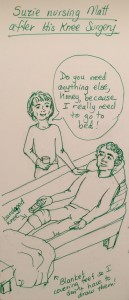
photoJust when I was feeling hopeless about Mom’s disease and my own ability and motivation to support her, Elizabeth came up with the perfect solution. Drawing a silly cartoon not only gave me a quicker, more efficient way to reach out to Mom, it also restored a maternal lineage, making me feel anchored and supported in a fun-loving tradition that spans generations. Instead of dreading the task of writing to Mom, I had fun drawing a scene of me “nursing” Matt after his recent knee surgery. My cards can’t ever recapture the humor, color, or charm of the inimitable “Mz. Gates,” but with the help of my sister, they can help me feel connected and make me smile, even in the face of loss.

Filed Under: Alzheimer's, Family

Break a Leg

May 10, 2014 by Suzanne Churchill 2 Comments

As I said on Facebook, my folks can’t seem to get a break—well, they got one, but not the kind we wanted. A couple of weeks ago, Mom fell and broke her femur, near the hip joint. She may have had a second fall, but we don’t know the details. A caregiver found her, and my Dad spent another day in ER, while they took x-rays and CT-scans, eventually coming to the conclusion that she would need surgery. After surgery, she would need physical therapy and an extended stay in the Masonic hospital rehab wing, before she could return to the Hearth.

The doctor’s reports were more optimistic than I felt. Sure, they could screw the bone back into place, but how would Mom be able to manage with physical therapy? Even before the fall, she could scarcely follow directions to stand or sit. Another disorienting hospital stay was likely to wreak more havoc on her dwindling cognitive functions. How could her plaque-ridden brain possibly learn to walk again?

Doubts like these breed terrible thoughts like: why bother repairing the body when the mind is so damaged? Wouldn’t it be better if she could catch pneumonia and go swiftly, saved from the discomfort and indignities of hospitalization? Wouldn’t it be better if (Write it!) if she could just die?

There, I’ve written the unthinkable. It can’t get any worse, can it? To understand hopelessness, to fully inhabit despair, there’s no better place to turn to than the “terrible sonnets” of Gerard Manley Hopkins. Take this excerpt from “No worst, there is none“:

No worst, there is none. Pitched past pitch of grief,
More pangs will, schooled at forepangs, wilder wring.
Comforter, where, where is your comforting?
Mary, mother of us, where is your relief?
My cries heave, herds-long; huddle in a main, a chief
Woe, wórld-sorrow; on an áge-old anvil wince and sing —
Then lull, then leave off. Fury had shrieked ‘No ling-
ering! Let me be fell: force I must be brief.”‘
Hopkins cries out for relief from the burden of his own life. The pain is different, however, when your mind is silently shrieking, “No lingering! Let her be fell,” about your own mother. It’s less wild and turbulent, more muted and weighty—a dull, intermittent ache, a deadly desire that seems at once utterly human and miserably inhumane.

I used to think T. S. Eliot’s “Portrait of a Lady” was a miserably inhumane poem. It enacts a series of one-sided conversations between the speaker and the eponymous lady. She’s needy and suffocating, and he’s desperate to elude her emotional demands. After several evasive maneuvers, the speaker imagines the ultimate escape:

Well! and what if she should die some afternoon,
Afternoon grey and smoky, evening yellow and rose;
Should die and leave me sitting pen in hand
With the smoke coming down above the housetops;
Doubtful, for quite a while
Not knowing what to feel or if I understand
Or whether wise or foolish, tardy or too soon …
Would she not have the advantage, after all?

…And should I have the right to smile?

The speaker’s lack of empathy—his calculated distance from his own emotions—always struck me as cruelly misogynist. But now his imagined relief at the prospect of the lady’s death seems more human and uncomfortably familiar. When intimacy cannot be reciprocated—whether because of a disease of the psyche (Eliot’s modern condition) or the brain (Mom’s Alzheimer’s)—the relationship can feel oppressive and burdensome. You just want to escape, and death beckons slyly, like a guilty pleasure.

Yet with Alzheimer’s, another apparition also beckons: the glimpse of the person as you once knew her. She appeared to my brother one day, when she was lying in the hospital bed, dozing off mid-sentence, unable to focus. Then, suddenly, she looked at him and said, “I just don’t want to disappoint you.” Voila, there she is, as anxious to please as ever. A few days ago, on the phone with me, she asked, “So have they made their decisions?” clearly referring to Thomas and Luke’s college plans. As I rambled on in enthusiastic detail, she seemed to disappear and go silent. “Mom, are you there?  Mom? Hello? Can you give the phone to Dad, Mom?” Silence. TV noise in the background. “Give the phone to Dad, Mom. I’ve got to go. I love you.” Silence. “Mom? I’ve got to go. I love you.” Then, suddenly, she replies, “I love YOU very much,” so ardently and intentionally that I feel cradled in a blanket of maternal love. I tell her I love her and say good bye again. Another pause, and then she scrapes the most wrenching, “Goodbyyeeee,” from her throat. It sounds like ripping apart industrial strength Velcro.

In those rare, unexpected moments of connection, I feel as if Mom is still there, intact, but able only on fleeting occasions to break through the thick fog and express herself. She’s moved past that horrifying stage of the disease when she couldn’t recognize her own husband. She knows, trusts, and loves us. And at those moments when she manages to reach us, I know that when she dies, it will be much worse than I have imagined. So I want her to live.

Filed Under: Alzheimer's, Family, Poetry, Uncategorized

Lay Back the Darkness

March 27, 2014 by Suzanne Churchill 2 Comments

If I’d read Edward Hirsch’s “Lay Back the Darkness” before writing my previous post, maybe I could have laid back some of my own darkness. Hirsch read the poem at Davidson a few years ago, but it didn’t speak to me then. That was well before Mom’s Alzheimer’s diagnosis. I’m a firm believer that poems open up to you when you need them, and shun you—sometimes quite rudely—when you don’t. Yesterday, watching the video of Hirsch’s talk at Davidson, I clearly needed this poem, because it not only opened up to me, but also extended its hands, saying, “Here’s another way, Suzanne, here’s another way to look at the situation.”

Lay Back the Darkness


My father in the night shuffling from room to room
on an obscure mission through the hallway.


Help me, spirits, to penetrate his dream
and ease his restless passage.


Lay back the darkness for a salesman
who could charm everything but the shadows,


an immigrant who stands on the threshold
of a vast night


without his walker or his cane
and cannot remember what he meant to say,


though his right arm is raised, as if in prophecy,
while his left shakes uselessly in warning.


My father in the night shuffling from room to room
is no longer a father or a husband or a son,


but a boy standing on the edge of a forest
listening to the distant cry of wolves,


to wild dogs,
to primitive wingbeats shuddering in the treetops.

Before he read this poem, Hirsch talked about poetry, saying, “I don’t know if you’ve ever had the experience—I hope you have—of sometimes reading a poem that is so… personal to you, so strong that it feels almost as if you’re writing the thing to which you’re actually only responding.” Hirsch then quoted the great Argentine writer, Jorge Louis Borges, who wrote in his own first book of poems:

Dear Reader,

Please forgive me for having written these poems first. It’s only something of an accident that I’m the unsure, ardent writer of these verses and you’re the reader.

It’s a strange plea, but what Borges alludes to, and what Hirsch underscores, is that uncanny feeling you get when you read a poem that speaks so exactly to your thoughts, feelings, and experiences that you could have written it yourself. When I listened to Hirsch read “Lay Back the Darkness” yesterday, I got that feeling.

If I did write that poem for Mom, it might go like this:

Play Back the Music


Dear Ed Hirsch,

Please forgive me for having rewritten your poem. It’s only something of an accident that I’ve become the unsure, ardent writer of your verse.


My mother in the Hearth shuffling from room to room
on an obscure mission through the hallway.


Help me, spirits, to penetrate her dream
and ease her uncertain passage.


Lay back the darkness for a lady
who could tidy everything but the shadows,


a musician who stands on the threshold
of a vast hall


without her walker or her heels
and cannot remember what she meant to say,


though her smile is bright, as if in greeting,
while her hands shake uselessly in worry.


My mother in the Hearth shuffling from room to room
is no longer a mother or a daughter or a wife,


but a girl standing on the edge of a dance
listening to the stirring thrum of song,


to young suitors,
to amorous heartbeats murmuring in the music.


800px-Olympic_Gardens_Dance_Hall,_Hunter_Street,_Halifax,_Nova_Scotia,_Canada,_ca-1._1948

Olympic Gardens Dance Hall, Hunter Street, Halifax, Nova Scotia, Canada, ca. 1948 [public domain].

Filed Under: Alzheimer's, Poetry

One Wild and Precious Life?

March 23, 2014 by Suzanne Churchill 6 Comments

IMG_1589Something there is that doesn’t love a post, that sends me off to Facebook, Buzzfeed, and email, even when I know I need to write. It’s been more than two weeks since I flew home to Connecticut to visit my folks, seeing them, for the first time, living in separate quarters: Dad in his new apartment; Mom in assisted living. There was so much to take in that I didn’t even miss the basement. Dad has turned the master bedroom into a workshop, and it’s so full of train paraphernalia, tools, boxes, and scrap materials that it feels a lot like the basement anyway. Outside the workshop, his apartment looked much better than I expected. He’s got it decorated with paintings, family photographs, and even a sconce holding a mint green candle. A woman in his bridge group told him, “You can tell this is a man’s apartment,” but I disagreed, saying the sconce alone was grounds for recalling his man card. The punctum (to borrow a term from Roland Barthes)—the detail that shot out like an arrow and pierced me—was not the sconce, however, but the corner cupboard. There was no room for it in the living room, so Dad put it in his bedroom, asking my sister to arrange Mom’s china collection just as she’d had it. There’s no language for love like that.

When we got to the Hearth, Mom recognized me from across the activity room, brightening when she saw me. I wonder what I looked like when I saw her there, sitting in a string of chairs lining the periphery of the room, supporting timeworn bodies of various  shapes, sizes, and degrees of motor control. My face, answering hers, must have mingled shock with recognition and relief as I compelled a smile. How many times in my childhood had I been among children’s choirs and Girl Scout troops paraded through nursing homes to cheer the elderly residents? Yet never once did I imagine my own parent sitting in one of those chairs.

I don’t think my Mom ever imagined playing Bingo either—or rather, trying to play Bingo, but having difficulty following the logic of the game and struggling with her shaky finger to slide the red plastic window across the number. Mom never liked Bingo, but now she joins whatever group activities are offered. She accepts a snack of three Lorna Doones, tasting one and saying, “Oh, that’s dry.” She eats them anyway, then swallows the juice from the Dixie cup delivered a few minutes later.

Stiff and unsteady, she walks slowly with a walker and needs help to stand and sit. When she’s moving by instinct, she can be quite agile: once she dropped a Kleenex, bent down, and retrieved it without a wobble. But if she has to think about what she’s doing or follow instructions, all systems overload, the mind freezes, and the body balks. I imagine moving through the world for her is like it would be for me if I lost my glasses: blurry, uncertain, and unnavigable.

Her cheeks are soft, smooth, and pink. She’s ready with a smile or laugh, and likes to give and receive compliments. She remains preoccupied with her own symptoms and ailments, giving unsolicited “organ recitals,” especially when Dad is around. She enjoys food without the fear of weight gain that haunted her all her life, and once, when Dad put his arm gently around her, she exclaimed, “That’s WONderful!”

There are jarring moments of clarity. When my sister and I were driving her to the nail spa for a manicure, she said, “I just hope I don’t give you both the disease I have.” Did she mean Alzheimer’s? Most of the time she no longer seems aware of her dementia, though she did qualify one remark, saying, “The thing that stands out most in my mind, and I don’t know if this is true…” The vision—of my sister as a toddler trying to run away—was probably true.

Most of what she says makes no sense. She mixes memory, imagination, and perception in an irrational blend. We try to find humor in the way she imagines suitors everywhere, wanting to marry her. Dad says, “Well, you can see why they would want to be with her. She’s a very attractive woman.” He says this without irony (another punctum). We no longer correct Mom or try to decipher her logic. Instead we just pick up a piece of something she says and thread it into something that makes sense to us, as if we were picking up a nightgown blown off the clothesline and pinning one corner back on, leaving the rest tossing in the wind.

Truth is, it’s not much fun spending time with her in the Hearth. You can’t have a real conversation, and there’s not much to do. Flip through photo albums, play a Broadway show CD, or take her down to the activity room to listen to a middle-aged guy play Irish songs on his keyboard. Pass a woman in the hall on the way who complains, “They say it was Irish music. That is NOT Irish music! It makes me sick to my stomach.” Sit next to another lady who seems much sharper than Mom. She looks right at you and says, “I am NOT happy.” You say, “I hope the music cheers you up,” and indeed it does, because during a jig, she’s singing along, tapping her feet, bobbing out of her seat; then a waltz makes her weep. You wish Mom would respond more to the music: she seems so vacant. When a male resident shuffles into the room, the lady next to you leaps up, exclaiming, “That’s my father!” She sits down, caught up in the next tune. You tell Mom you have to go and kiss her goodbye. She doesn’t seem sad.

Taking Mom out of the Hearth isn’t much fun, either. When you do, she’s so disoriented that she scarcely knows where she is or who you are. You steer her into the nail spa, and she stiffens in her seat. You have to stand behind her to keep her chair from rolling backward, and every so often, you prop her back up in her seat. You gently massage her arms and shoulders, trying to relax her muscles, but she doesn’t respond to your touch. When she gets back to the Hearth, she sleeps all afternoon.

You just want to avoid the situation. You’ve finally accepted that there’s nothing you can do, nothing you can fix. You can’t even soothe her. She will be happy to see you, but she won’t be unhappy when you leave. So leave. Get away. Put it out of your mind.

Because you’re thinking terrible thoughts: what is the point of such a life? Each day, a pattern of dull, meaningless activities, punctuated by snacks, meals, and bathroom breaks. Visits from family members, old friends, a doctor, nurse, an attendant blur together. Is she just filling space, killing time, waiting for the next small pleasure that’s offered to her—a sip of juice after a dry Lorna Doone?

And then you get really morbid: Is her life really so different from yours? Sure, you have more control, more agency, and decision-making power. You’re a productive citizen. But in her own way, she’s a productive citizen who also contributes to the economy: think how many jobs depend on her needs—cooks, caretakers, nurses, administrators. And aren’t you just living your own routine, waiting for the next pleasure that falls within your own, slightly larger orbit? What makes your life any more meaningful? What keeps you living, knowing that you’re on the same path of inevitable decline, leading inexorably to death?

See Robert Penn Warren, “American Portrait: Old Style“:

“But Jesus,” he cried, “What makes a man do what he does—

Him living until he dies!”

Suddenly, in these words, you see something not morbid but heroic in the human will to live. It’s a marvelous mystery, this impulse to go on, whether you’re confined to the Hearth or free to roam the earth. “Doesn’t everything die at last, and too soon?” Mary Oliver writes in “The Summer Day,” insisting that mortality renders life more piquant and precious, asking, “Tell me, what is it you plan to do / with your one wild and precious life?” Maybe, as Oliver suggests, our greatest task is to figure out “how to be idle and blessed,” as Mom surely is, secure in the Hearth.

IMG_1820I try to make peace with thoughts of heroic endurance and blessed idleness. Dad and I go to see Mom for the last time before he drives me to the airport to catch my flight home. Before I even get there, the wisdom of the poets is drowned out by the throbbing thought, “This may be the last time I see her that she recognizes me.” The visit isn’t any different from any other, except that I can’t stop thinking, “this may be the last time,” and I can’t stop weeping. The visit isn’t any different from the last; my sorrow stems from the sentimental frame I impose on the encounter. If only I could change the frame. Instead I kiss her goodbye and fly away.


Featured Image:  Steven Craven, “Christmas Day in a nursing home.” 24 December 2008. Geograph.org.uk. Creative Commons 2.0 licensed.

Filed Under: Alzheimer's, Family, Poetry, Uncategorized

Woman much missed

March 1, 2014 by Suzanne Churchill Leave a Comment

In Thomas Hardy’s poem, “The Voice,” repetition and rhyme create a haunting echo, sounding out a persistent tugging of desire that can neither be escaped nor fulfilled:

Woman much missed, how you call to me, call to me,
Saying that now you are not as you were
When you had changed from the one who was all to me,
But as at first, when our day was fair.

Read this stanza once, and the earworm will burrow into your mind. You can’t not feel the pain of longing in the repetition of the phrase, “call to me, call to me,” which is subsequently rhymed and ironically reduced to “all to me”—an echo of a former fullness that may never come again. You might not realize that you’re hearing a dactylic meter (“CALL to me, CALL to me”), but your body feels the strong beat that diminishes over time. Hardy’s sound patterns rehearse the inevitability of loss and the persistence of desire.

Today we received some good news about our sons Thomas and Luke on the college admissions front (nothing’s final until April, but they’re going to college!).  I’ve shared the news with my father and in-laws, because telling grandparents never feels like boasting. It feels more like giving them compliment—a way of saying, “Look who you helped bring into the world! Look who is carrying on your legacy!”

SCAN0001While I am bursting with joy and pride, I’m gutted by longing. I want to call my mother and tell her the news, too, because one else on earth would be more pleased than she.* My mom would remember holding those tiny babies in the hospital just after they were born, marveling at their big, bony heads and thin, fragile limbs, wondering how they ever came into being and how we would ever manage to keep them alive. My mom would feel the way I feel: a curious mixture of surprise and awe, combined with a sense of deja-vu, because we should have known and always have known how marvelous are these beings who have somehow, miraculously, become young men.

I don’t know if my longing is any different because my mom is still alive but prevented by Alzheimer’s from comprehending the news. I do know that, even though she’s alive, I’m already much missing her:

 Thus I; faltering forward,

      Leaves around me falling,
Wind oozing thin through the thorn from norward,
      And the woman calling.

In this case, though, I’m faltering forward, and I’m the woman calling. Thank goodness those boys are marching on.


*I say “on earth” in deference to my mother-in-law, Jane Churchill, who would be thrilled, too, though she probably would have been just as delighted by the “artistic” arrangements of laundry Luke and Thomas have left on the floor of their room.  Jane had a knack for finding beauty in things as they are, whereas my mom has always preferred things in their best form, especially when folded and neatly arranged.

Filed Under: Alzheimer's, Family, Poetry

Speak to me : Take my hand : What are you now?

January 19, 2014 by Suzanne Churchill 5 Comments

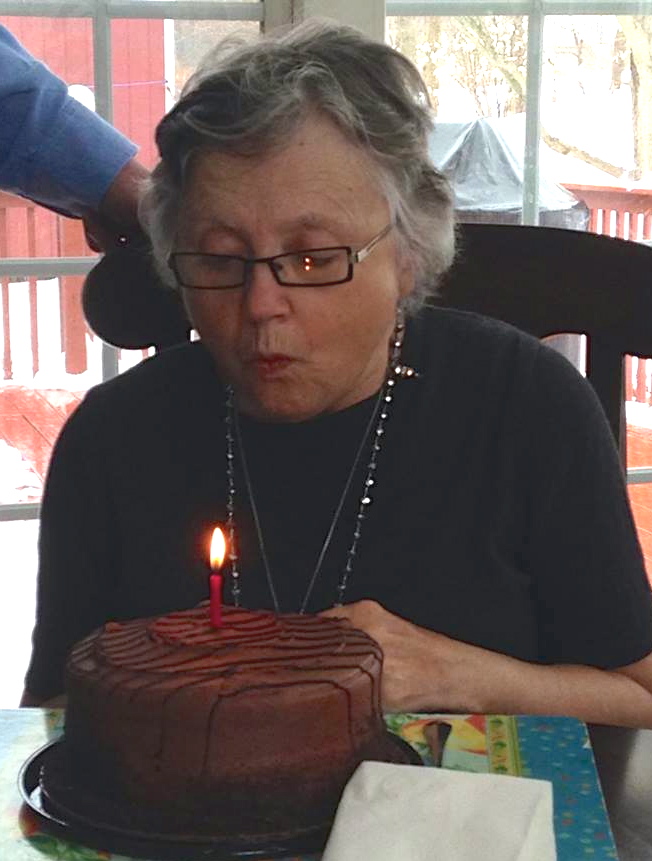
1532116_10202895045715800_602969367_nWhen I FaceTimed with my mom on January 5th—her 75th birthday—she was surprisingly “good.” I put that word in quotations marks because I’m uncomfortable with the moral judgment it seems to place on the natural course of her disease. Yet that’s the word that come to mind, and she was really, pretty good: she knew it was her birthday, she said she was 75, and she asked me (un-prompted), “What’s Matt doing?” The question meant that she not only knew who I was, but also remembered who I was married to. Conversation seemed pleasurable but tiring: by the time I summoned the kids to the screen to wish her a “Happy birthday,” she resorted to echolalia, wishing them “Happy Birthday” back, even though it wasn’t their birthday. She was cheerful and smiley. She seemed to be enjoying herself and the attention, not to mention the chocolate cake.

1557651_10202895045755801_1173266732_nIn our Face-Time encounter today, two weeks later, things weren’t so good. My sister reported last week that Mom had started exhibiting a strange symptom of straining to get words out, as if she had to wrench them out of her throat. I didn’t need to hear the guttural straining to know what my sister meant. I saw an early stage of the symptom in an expression that began appearing on Mom’s face last summer. A shadow would rise up on her face, lifting her eyebrows and wrinkling her forehead in a paralyzed anguish (you can see it happening in the photo on the left). “What does that expression on your face mean, Mom?” I asked, describing and mimicking it for her. She said she knew her face was doing that, but didn’t seem to know why. It was as her face was expressing things that her brain could no longer comprehend or control. Was it anxiety? Pain? Or just a neurological reflex?

Now the facial expression coordinates with speech, or rather, with the anguished effort to produce speech. She strains as if she has tear the words out of her body. Often words won’t come, or when they do, they stop mid-sentence. If you question her about the end of her sentence, or try to suggest a destination, she’s already forgotten it. In these moments, the effort to make conversation is futile, no matter how much we both want it to happen.

Our fragmented conversation reminds me of a fragmented scene in T. S. Eliot’s, The Waste Land, in which two lovers are bound in a fraught, intimate exchange. The first speaker desperately pleads for conversation, and the other lover refuses:

“Speak to me. Why do you never speak. Speak.
  “What are you thinking of? What thinking? What?
“I never know what you are thinking. Think.”
  I think we are in rats’ alley
Where the dead men lost their bones.

When I tried to talk to my Mom today, I felt as if I was silently urging her, “Speak to me. Speak. Speak.” It seemed as if her own mind was urging the same thing, pressing her to “Speak” and “Think.” And her own mind—or some other part of it—was as recalcitrant in refusing to cooperate as the lover in Eliot’s poem. Her mind had become a rat’s alley, and no matter how much she pressed it to speak, it would not give.

But maybe it’s not so bad for her. Psychologist Alan Dienstag, who conducts support groups for early Alzheimer’s patients, offers a reassuring perspective on the disease. Although Alzheimer’s is the disease Americans fear most, he says, it’s actually not the worst way to go, at least not for the patient. He tells this story about a workshop he ran:

There were about 20 people in the room and we were…going around the circle and people with early Alzheimer’s were talking about their lives and what they do to…give their lives meaning, find stimulating things to do, and so on. This man started talking about his experience as somebody with early Alzheimer’s, and he was painting a very…benign picture of it all. He said, “Well, you know, it’s difficult not to be able to remember, but I get up and I can do this and I can do that.” Basically he was just saying he’s fine, he’s OK. And over his shoulder, sitting behind him, was his wife. And she was crying…And I knew just how much he’d lost, how much she had lost.


…But there he was. He wasn’t uncomfortable. He really wasn’t. And so I think we project our feelings onto them, and we assume that they are suffering some terrible thing, but in fact that’s not necessarily the experience of it.

Listening to Dr. Dienstag’s interview helped me accept my Mom’s diagnosis: it was comforting to think that she wouldn’t suffer great pain—that for her, the worst was over. But now I’m not so sure. As I watch her on the screen, straining to extricate words, the effort appears agonizing. Maybe it isn’t physical pain. Maybe it’s emotional. Whatever it is, I can’t stand to see that look on her face and hear the words torn from her throat and shredded in the process. I feel like I’m not just witnessing pain, but actually inflicting it. By asking her questions and telling her about our lives, I’m putting her in a situation where she is compelled to speak, but cannot.

Our relationship has always been based on talking. Mom started reading aloud to my older sister and me well before I could understand the words. We spent the hot, humid summer days sitting in the living room in front of the fan as she read and read. When I was older, she would drive me places and tell stories about people’s lives and relationships—about marriage break ups, nervous breakdowns, jealousies and rivalries I was too young to understand but still fascinated by. I would ask questions, and she would always answer. Conversation became the fabric of our relationship.

So when she sees me, she knows, instinctively, that conversation should happen. And she can no longer make it happen. I can chatter on to fill the silence, but I’m not alleviating the pain that comes from the absence of reciprocation. Whose pain is it? Am I projecting my pain onto her, assuming she is “suffering some terrible thing,” as Dr. Dienstag says, when her experience is different? Her expression tells me I’m not projecting pain, though I’m probably mirroring it.

A few months ago, seeing her face on the screen gave me a sense of emotional connection, even when words faltered. But today, the effort of speech is too painful. I want to shut down the screen, to sit next to her and hold her hand, so that she won’t see me and feel like she has to speak.

Thinking about the effort of speech made me think of Muriel Rukeyser’s poem, “The Effort at Speech Between Two People.”  So I looked it up, and in one of those uncanny acts of grace, the poem handed me the very guidance I was looking for. Its recurrent refrain is:

:  Speak to me.          Take my hand.            What are you now?

In juxtaposing these phrases, the poem suggests that speaking to someone is analogous to taking that person’s hand. Both are reciprocal gestures of contact and communication. The poem also delivers a lesson I thought I’d already learned: we are always changing in relation to one another. So as my Mom and I continue to change (she on a more rapid course than I), I’m going to have to let go of speech and take her hand. That gesture may be my only answer to the question, “What are you now?” For now, anyway.

Filed Under: Alzheimer's, Family, Language, Poetry, Selfhood

  • « Go to Previous Page
  • Page 1
  • Page 2
  • Page 3
  • Go to Next Page »

Copyright © 2026 · Infinity Pro on Genesis Framework · WordPress · Log in